You Have 180 Days From the Grant — and the Clock Is Already Running
Your parent's will left you out. Or your partner's will gave everything to someone else. Or you're the executor, and a letter just arrived from a lawyer saying a claim is coming.
In British Columbia, a surviving spouse or child can ask the Supreme Court to vary a will that doesn't make adequate provision for them. But the window is strict: 180 days from the date the representation grant is issued — not from the death, not from when you found out, not from when you hired a lawyer. From the grant. And if you're the executor, you generally cannot distribute the estate for 210 days after that same grant, whether a claim has been filed or not.
The statutes are on BC Laws. The blank court forms are on the Supreme Court website. But neither one walks you through what happens between reading the will and the day the estate is finally settled. That's what the Dual-Clock Navigation System in this guide does — it maps the claimant's 180-day filing path and the executor's 210-day hold path side by side, so both sides of the process are visible in one place.
What's Inside
- Standing check — who can bring a wills variation claim under WESA section 60 (spouses and children only), who cannot, and what other options exist for extended family members
- Dual-Clock Timeline — the 180-day claimant filing window, the 30-day service window after that filing period expires, and the 210-day executor distribution hold, calculated from the grant date with every exception and early-distribution route explained
- Pre-grant vs. post-grant guide — how a Form P29 Notice of Dispute can delay the grant (and why it does not protect your s.60 deadline), plus the full post-grant sequence from Form 1 through to trial or settlement
- Executor duties during a claim — the distribution hold, the duty of neutrality, responding to a Notice of Civil Claim with Form 2, recordkeeping obligations, and CRA clearance certificate timing
- Court process walkthrough — filing a Notice of Civil Claim, document exchange, case planning conferences, mediation under the Notice to Mediate (General) Regulation, settlement negotiations, and what happens if the case goes to trial
- Cost reality — what estate litigation typically costs in British Columbia, retainer structures, contingency fees, and how to minimize billable hours by arriving prepared
- Free and low-cost help navigator — Access Pro Bono, its Legal Referral Service, Clicklaw, Courthouse Libraries BC, Mediate BC — with what each one actually offers and what it doesn't
- Deadline Tracking Log — a fillable worksheet for the grant date, the 180-day expiry, the 30-day service deadline after that filing period expires, the 210-day hold expiry, and CRA clearance milestones
- Record and Asset Inventory — a fillable list of wills, the grant, Form P1 notices, real property, accounts, joint tenancy, RRSP/TFSA designations, insurance, and written communications
- Form Purpose Index — a fillable log of Forms P1, P29, P30, 1, 2, 3, 11 and 22, and CRA Form TX19, with purpose, filing place, fee, and the date you used each
- Lawyer Interview Worksheet — structured questions to bring to your first consultation so you spend billable time on strategy, not on explaining the basics
- Procedural Route Map — a dual-path tick-and-date sheet for the claimant sequence and the executor sequence from Form P1 through distribution
Who This Is For
- A spouse or child who feels a will in British Columbia left them out or under-provided, and needs to understand the deadline and the process before the window closes
- An executor who has received a demand letter or been told a variation claim may be coming, and needs to know how long to hold the estate and what happens next
- A family member helping a parent or sibling navigate an unfamiliar court process and wants organized, clear information to bring to a first legal consultation
Why Not Just Use the Free Information Online?
The statutes, court rules and blank forms are all publicly available. Law firm blogs explain the basics. So what's missing?
No free resource puts the claimant path and executor path side by side with deadline calculations. Law firm blogs explain the law, but they're written to get you to call the firm, not to help you organize your documents before you do. Government sites publish Form P29 as a blank PDF without explaining that filing it does not protect your 180-day deadline. And no existing guide bundles a deadline log, a record inventory, a form-purpose index, a lawyer interview worksheet, and a procedural route map into one reference.
The guide takes what is scattered across dozens of government pages, court rules and law firm articles and puts it in the order you actually need it — with the worksheets that none of those sources provide.
The Free Checklist
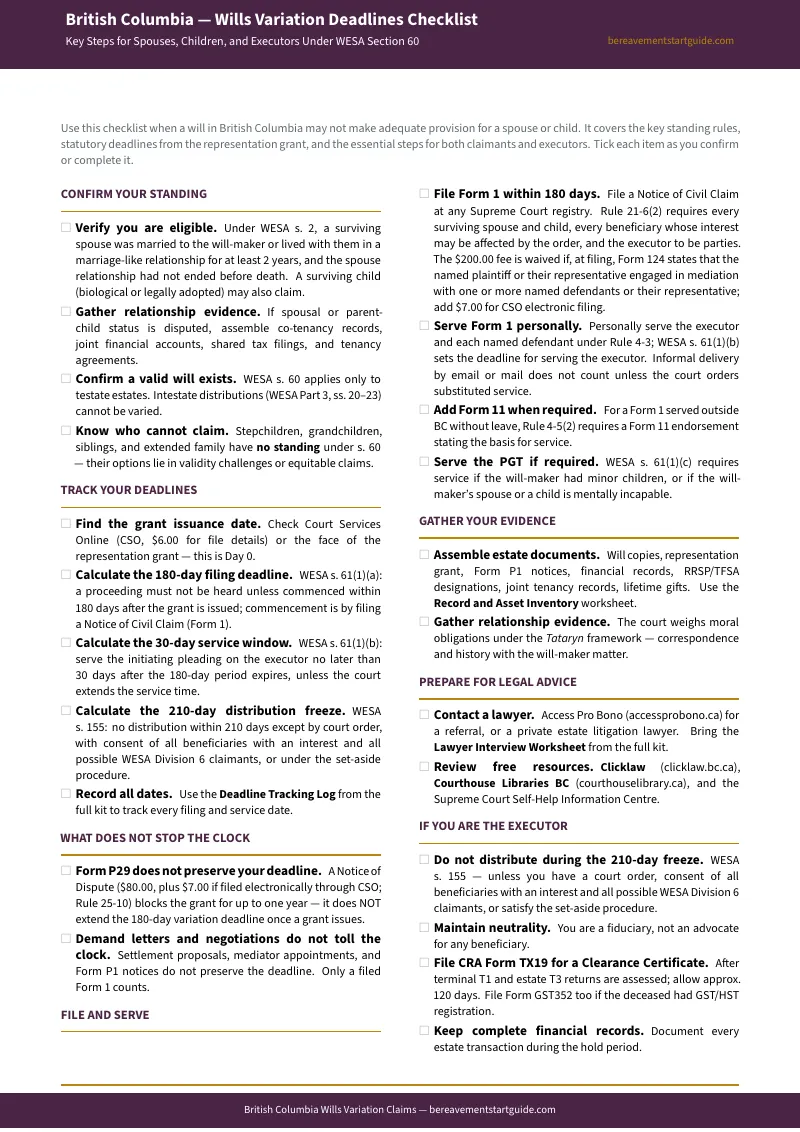
Not sure yet? The free BC Wills Variation Deadlines Checklist covers who can claim, the key deadlines, and where to find free legal help. It's a two-page starting point. The full guide goes deeper — with the complete court process, executor duties, worksheets and the dual-clock timeline.
Satisfaction Guarantee
Full refund, no time limit. If the guide isn't what you expected, email hello@bereavementstartguide.com and you'll get your money back.
Frequently Asked Questions
Is this legal advice?
No. This is an independent procedural navigation guide. It explains how the wills variation process works in British Columbia and helps you organize your documents, deadlines and questions — but it never assesses the merits of any individual claim. For advice on your specific situation, it directs you to qualified legal counsel, Access Pro Bono and its Legal Referral Service.
Is this published by the BC Government or the Supreme Court?
No. This is an independent commercial guide with no connection to the Supreme Court of British Columbia, the BC Government, the Public Guardian and Trustee, or the CRA. Official resources are signposted throughout.
I'm the executor, not the claimant. Is this still useful?
Yes. The guide covers executor duties in detail — the 210-day distribution hold, what to do when a claim is served, how to respond neutrally with Form 2, recordkeeping obligations, and CRA clearance timing. It's written for both sides of the process.
What if the estate is small?
The same statutory deadlines and procedures apply regardless of estate size. An executor who distributes prematurely — even from a small estate — may face personal liability if a valid claim is later served. The guide explains mediation costs and lists free and low-cost legal-help resources.
How is this different from the free checklist?
The free checklist is a two-page summary of who can claim and the key deadlines. The full guide covers the entire court process from pre-grant to distribution, includes five planning tools (Deadline Tracking Log, Record and Asset Inventory, Lawyer Interview Worksheet, Form Purpose Index, and Procedural Route Map), and walks through mediation, costs, executor duties, and the CRA clearance process.
Frequently Asked Questions
What if the rules change after I buy?
We update the guide when the rules change. Email us any time, even years later, and we'll send you the current edition free.