Your "Living Will" Has No Legal Standing in Newfoundland and Labrador. The Document That Protects You Has a Different Name — and Without a Green Sleeve on Your Refrigerator, Paramedics Are Legally Required to Ignore It.
You searched for "living will" or "healthcare proxy" because you want your medical wishes documented. Here is the first thing nobody tells you: those terms appear nowhere in Newfoundland and Labrador legislation. The province uses a system called the Advance Health Care Directive (AHCD), governed by the Advance Health Care Directives Act, 1995. Download an American template or an Ontario form tonight, and an NL hospital can disregard it tomorrow — because this province has no reciprocity legislation for out-of-province directives.
But getting the right document is only half the problem. Even a perfectly drafted AHCD can be overridden at the moment it matters most. In Newfoundland and Labrador, emergency clinicians do not rely on legal documents filed in a desk drawer. They rely on a Goals of Care Designation (GCD) — a medical order written by your physician that translates your values into one of three designations: Resuscitation, Medical, or Comfort. That order lives inside a bright green plastic pocket called the Green Sleeve, stored on your refrigerator door, where paramedics are trained to look for it. Without it, first responders arriving at your home are legally mandated to perform full CPR — regardless of what your signed directive says.
And Newfoundland and Labrador adds a complication that most other provinces do not. Your AHCD covers healthcare decisions only. Your finances — bank accounts, property, bills — require a completely separate instrument: the Enduring Power of Attorney (EPA). If you sign an AHCD but skip the EPA, your Substitute Decision Maker can refuse a ventilator on your behalf but cannot write a cheque to keep the lights on. If you sign an EPA but skip the AHCD, your family controls the money but has no legal authority over your medical care — and must apply to the Supreme Court for a Guardianship of the Person order to get it.
The Newfoundland and Labrador Advance Directive & Living Will Kit is a Green Sleeve Integration System — the only NL planning kit that connects what every other resource leaves scattered: your legal AHCD, your clinical Goals of Care Designation, and your financial EPA, assembled in the order you actually do the work, written in the language NL clinicians and courts actually use.
What's Inside the Green Sleeve Integration System
A 13-chapter guide, 3 appendices, 7 standalone printable worksheets, and a 20-item Quick-Start Checklist — covering the AHCD, the EPA, the Green Sleeve clinical protocol, and every NL-specific requirement that generic Canadian kits get wrong:
Chapter 1: The Dual-Track System Most Residents Get Backwards
Why Newfoundland and Labrador splits healthcare authority and financial authority into separate instruments — and what happens when you have one but not the other. The AHCD-vs-EPA decision matrix, who can create each document, the age thresholds (16 for an AHCD, 19 for an SDM), and the terminology trap that sends people searching for documents that do not exist in this province.
Chapter 2: Creating a Legally Valid AHCD
The four-step drafting process: values reflection with clinical-grade questions, SDM selection with the written acceptance requirement unique to NL, document drafting with model phrasing that clinicians can act on, and the execution rules that invalidate most self-drafted documents — two independent witnesses, the SDM-spouse exclusion, and the mark-in-lieu-of-signature protocol for physical impairment.
Chapter 3: The Green Sleeve — Where Legal Documents Meet Clinical Reality
The chapter that no free resource, government pamphlet, or online document builder covers. What the Green Sleeve is, how to request one from your community health clinic, how to coordinate it with your GCD order, and the refrigerator-door placement protocol that gives paramedics a legal basis to follow your wishes instead of defaulting to full resuscitation. This is how a piece of paper becomes a medical decision.
Chapter 4: When the Directive Activates
The incapacity trigger, how your SDM makes decisions under the "best interpretation of wishes" standard, the hard limits on SDM authority (your SDM cannot authorize research, cannot override specific treatment refusals you documented, cannot consent to non-therapeutic sterilization), and what happens when the SDM and the healthcare team disagree.
Chapter 5: Choosing Your SDM — The Selection Framework
Availability and emotional resilience matter more than seniority. The seven-question selection matrix, naming alternate SDMs, the divorce trigger that automatically revokes a former spouse's appointment, and the conversation guide — because the worst time for your SDM to learn your wishes is the day they need to enforce them.
Chapter 6: The Enduring Power of Attorney
The financial half of your plan. What the EPA covers (bills, accounts, property, investments), what it explicitly does not cover (medical decisions — not a single one), the execution requirements (witnesses, notarization options), and how to coordinate your AHCD and EPA so your SDM and your attorney are not working at cross-purposes.
Chapter 7: Storage, Distribution, and Emergency Access
The "do-not-lock" rule — a locked safe is useless at 2 a.m. The distribution protocol for physicians, hospitals, SDMs, and family members. The emergency wallet card. Digital considerations, including registering with the MyHealthNL portal for proxy access. Where your originals live, where copies go, and who gets notified.
Chapter 8: Updating, Amending, and Revoking
When to review (major life events, new diagnoses, every three to five years). The three legal methods of revocation, including a critical note on verbal revocation — which is valid under NL law but nearly impossible to prove without documentation. The notification obligations after any change.
Chapter 9: Moving To or From Newfoundland and Labrador
The reciprocity problem: NL does not have legislation recognizing out-of-province directives. What to do when moving to NL (execute a new AHCD), what to do when leaving (check the destination province's recognition rules), and what to do with the Green Sleeve when you relocate.
Chapter 10: Special Circumstances
Indigenous and remote communities in Labrador, including Nunatsiavut considerations. The mature minor provision for young people under 16 with serious health conditions. Common-law partners and the intestacy gap — NL's intestate succession rules do not recognize common-law relationships. Medical Assistance in Dying and what these documents can and cannot do. The Public Trustee — what it manages (financial estates) and what it does not manage (healthcare decisions).
Chapter 11: After Death — The Immediate Transition
The first 48 hours, step by step. Funeral cost management, including the SSWB Income Support funeral benefit (up to $5,000 for professional fees, up to $1,500 for extras) and the CPP Death Benefit clawback. Probate and estate administration overview for the Supreme Court of Newfoundland and Labrador, including Rule 56 Notice of Application requirements and the 0.6% probate fee. Tax filing deadlines.
Chapter 12: When to Stop Using This Guide and Call a Professional
An honest assessment: complex blended families, significant business assets, disputed capacity, Labrador indigenous land considerations. The specific triggers for a solicitor, an accountant, the Public Trustee, and a funeral director — plus how to arrive organized enough to minimize billable hours.
Chapter 13: Your Complete Advance Care Planning Checklist
All six planning phases in one sequential reference: preparation, drafting and execution, clinical integration, distribution, financial track (EPA), and ongoing maintenance. Every action item from the guide, mapped to the chapter that explains it.
Plus: Appendices
A side-by-side AHCD vs. EPA comparison table. A complete key contacts and resource directory — government departments, NL Health Services, the Supreme Court registry, the Public Trustee, PLIAN, funeral directors' associations, and palliative care coalitions. Everything you need without hunting through government websites.
Plus: 7 Standalone Printable Worksheets
- Signing-Day Checklist — Witness screening, execution steps, and post-signing distribution in one printable sheet. Bring it to the table on signing day.
- Green Sleeve Setup Protocol — The four-step process for booking your Goals of Care conversation, requesting the Green Sleeve, assembling it, and filling out your emergency wallet card.
- SDM Selection Worksheet — A seven-criteria evaluation matrix for comparing Substitute Decision Maker candidates, plus the five conversation questions to prepare them for the role.
- Distribution Tracker — A fill-in table for tracking every copy of your executed AHCD: who received it, when, and by what method.
- Emergency Wallet Card — A cut-out card for your wallet stating you have an AHCD, your Green Sleeve location, and your SDM's contact details.
- AHCD vs. EPA Comparison — A side-by-side reference card comparing the two instruments: governing law, scope, witnesses, activation triggers, and reciprocity.
- Key Contacts and Resources Directory — Every NL government department, court registry location, legal aid resource, and healthcare contact in one printable page.
Plus: The Quick-Start Checklist
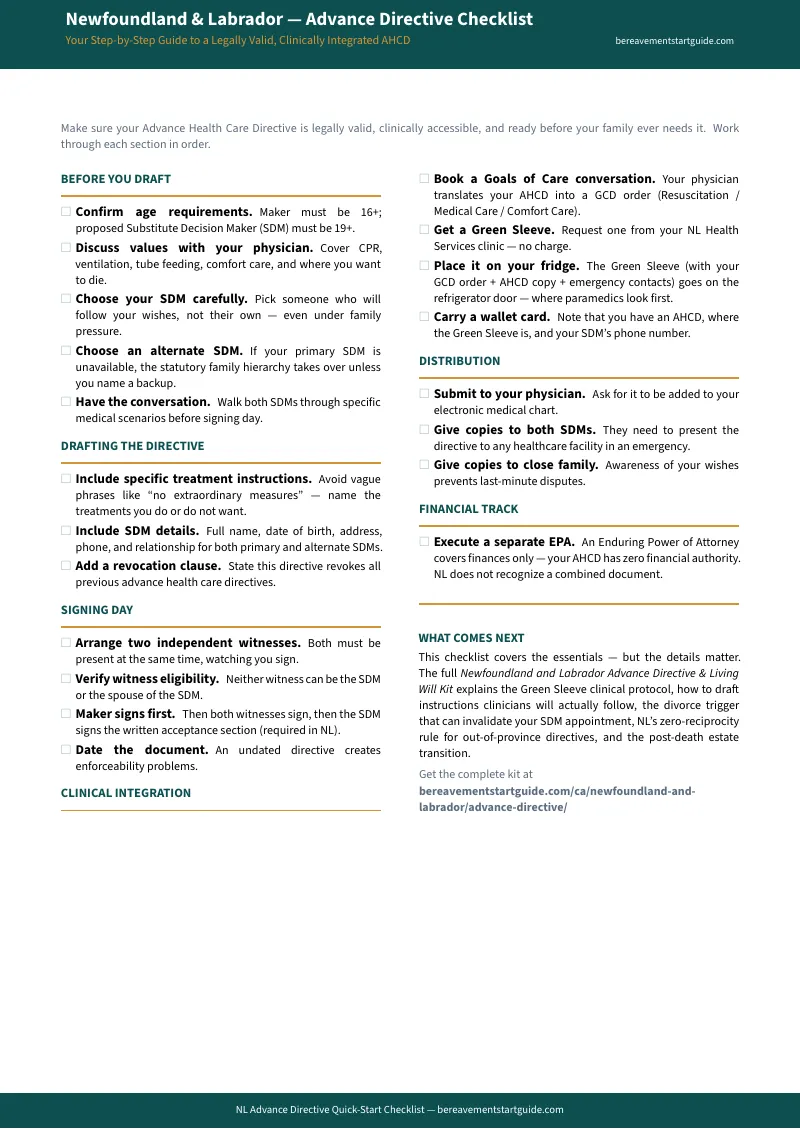
The standalone Newfoundland and Labrador — Advance Directive Quick-Start Checklist — 20 items across seven sections, from pre-drafting preparation through signing day, Green Sleeve setup, distribution, and annual maintenance. Every witness exclusion, SDM acceptance requirement, and clinical integration step at a glance. Print it and start tonight.
Who This Kit Is For
- The adult child managing care from a distance — a parent in Corner Brook or a remote outport, and you are in St. John's or Alberta. You need documents that local clinicians will follow, a Green Sleeve that paramedics can find, and an EPA that lets you handle the finances without a court application. The kit gives you the complete framework before the next health crisis forces a guardianship proceeding
- The proactive planner over 55 — retirement, a friend's health scare, or a routine review of your affairs. You want your medical wishes and your decision-maker documented properly, not left to a statutory hierarchy of relatives who may disagree with each other
- The couple doing this together — each of you needs your own AHCD and EPA. Neither of you — nor your children — can witness the document that names the other as SDM. The signing-day checklist prevents the execution error that invalidates both directives at once
- The common-law partner — NL's intestate succession rules do not recognize common-law relationships regardless of duration. Without a named SDM appointment, your partner has no guaranteed medical decision-making authority. The kit makes your partner's role immediate, documented, and unquestionable
- The caregiver of a parent with early-stage cognitive decline — capacity is a spectrum, and a parent who can no longer manage complex finances may still have the capacity to sign an AHCD. The kit explains the capacity standards and when a formal assessment is needed — information that may save you from a Guardianship of the Person application
- The newcomer to Newfoundland and Labrador — your out-of-province directive does not carry automatic legal force here. The kit explains what NL recognizes, what it does not, and how to execute new documents under provincial law
Why Free Resources Will Not Build This Plan
The forms are free. Knowing which ones you need, drafting them so clinicians can act on them, executing them so they hold up legally, and integrating them with the clinical system that actually controls what happens in an emergency — is not.
- The government's "It's Your Decision" booklet — authoritative and free, but written from the department's perspective. It gives you blank spaces to fill in your medical wishes with no guidance on clinical phrasing. No Green Sleeve instructions, no EPA coordination, no storage or distribution protocol
- PLIAN (Public Legal Information Association of NL) — excellent plain-language legal definitions, but explicitly states it is not a template and recommends hiring a lawyer. No DIY forms, no clinical integration guidance
- Dying With Dignity Canada's NL kit — compassionate, well-designed, and updated regularly. But it does not integrate with the NL Green Sleeve or Goals of Care Designation system, does not address outport logistics, and does not cover the SSWB funeral benefit or probate requirements
- NL Health Services clinical materials — excellent on Goals of Care Designations and MyHealthNL proxy access. But the clinical system explicitly does not provide legal documents and does not explain AHCDs, EPAs, or estate administration
- Online document builders (Willful, Epilogue) — polished document generation starting at $99 to $150, using terms like "Living Will" that have no legal meaning in NL. No clinical integration, no Green Sleeve, no estate transition guidance
- NL solicitors and estate lawyers — thorough and customized at $400 to $1,000 or more. The right call for complex estates and disputed capacity. And unavailable at 10 p.m. on a Sunday when a parent is admitted to hospital
Free resources hand you a blank form and a statute. The Green Sleeve Integration System gives you the complete NL plan — the AHCD, the EPA, the clinical bridge, the signing protocol, the distribution framework — assembled in the order you do the work, written for the person doing it.
— Less Than One Hour of a Solicitor's Time
An NL solicitor charges $400 to $1,000 or more for an advance planning package; online builders start at $99 and stop at the document itself. A Guardianship of the Person application for a parent who never signed anything costs thousands in legal fees, takes months to process, and puts your family's private medical details before a judge. This kit costs less than a single hour of professional time and gives you the complete system: thirteen chapters covering the dual-track AHCD/EPA framework, clinical-grade drafting guidance, the Green Sleeve integration protocol, SDM selection and conversation tools, signing and witnessing rules, storage and distribution, cross-border planning, special circumstances for outport communities, and the first-48-hours estate transition. Plus seven standalone printable worksheets and the Quick-Start Checklist you can print and start tonight. And a money-back guarantee, no time limit — if the kit does not give you clarity and a completed plan, email us for a full refund.
Not ready for the full kit? Download the free Newfoundland and Labrador — Advance Directive Quick-Start checklist — 20 steps covering the drafting essentials, the witnessing rules that invalidate most DIY documents, and the Green Sleeve setup that makes your directive clinically actionable. It is enough to get the critical moves right. The full kit is there when you want the complete roadmap.
A medical crisis does not wait for you to finish researching. This kit turns an afternoon into a legally binding, clinically followed plan — the documents your family needs, drafted the way NL doctors can actually act on.