The bank says you need probate. Do you?
Someone in your family has died and you have been told — by a bank teller, a government clerk, or a well-meaning relative — that you need a Grant of Probate before you can touch anything. That might be true for some assets. For others, it is not, and probate fees on a modest Nova Scotia estate can run into the hundreds or thousands of dollars you do not need to spend.
The problem is that nobody tells you which assets are which. The court's own forms assume you are applying for probate. The bank's front-line staff default to the safest answer. Free government websites explain legal rules one at a time, but none of them walk you through the question that matters: which accounts, titles and designations in this specific estate can be collected without a court grant?
The Estate Triage System
The Nova Scotia — Settling an Estate Without Probate guide gives you a structured, asset-by-asset triage system designed for the way real Nova Scotia estates work. Instead of reading legal theory and hoping you are applying it correctly, you work through every account and title with a framework that sorts each one into three clear groups:
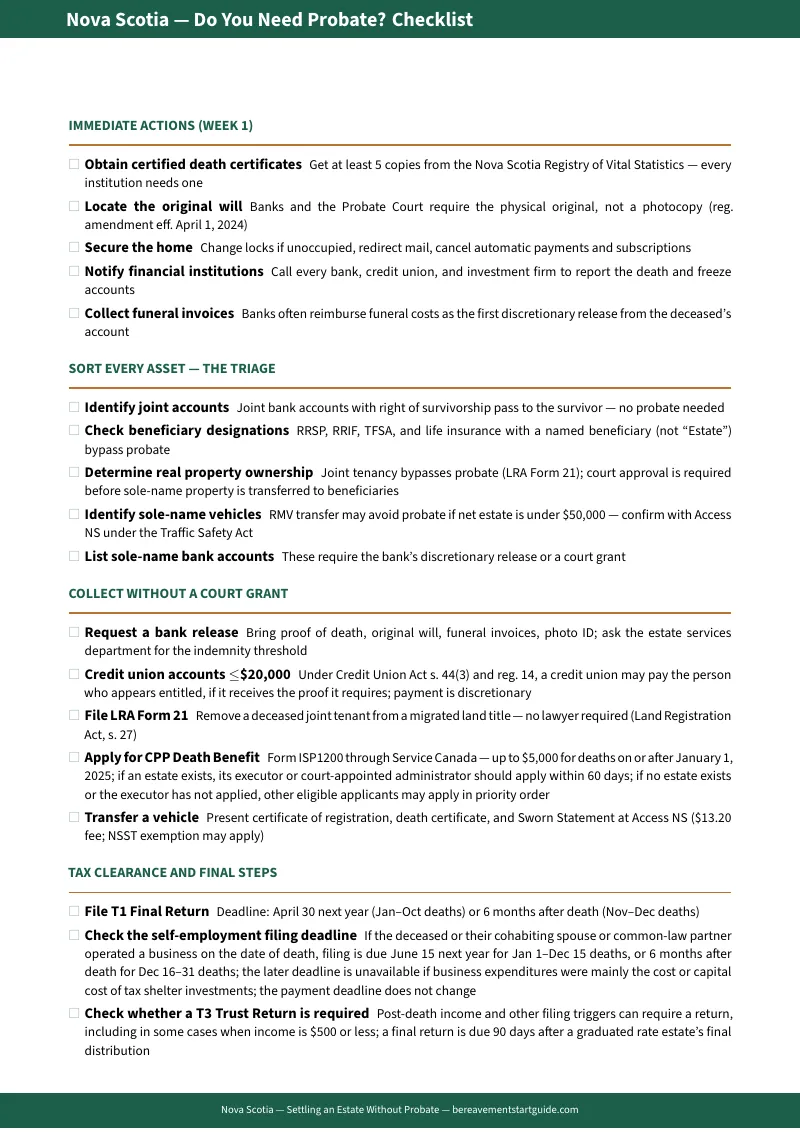
- Passes outside the estate — joint tenancy, named beneficiaries on TFSAs, RRSPs, RRIFs, life insurance and segregated funds. These never enter probate.
- Eligible for a discretionary release — solely held bank and credit union accounts below the institution's internal waiver threshold, collectible with the right documentation and the right conversation with a senior estate officer.
- Requires a court grant — solely owned real property under the Land Registration Act or account balances above the bank's limit. A dispute concerning the will may also require a court grant. The guide tells you exactly when to stop and where to go next.
What you get
- Asset Triage Worksheet — a separate printable form that tracks every account, parcel of land, vehicle and insurance policy from first call to final release, so nothing slips through
- Bank Release Scripts — a separate printable sheet with the exact phrasing for requesting a discretionary release under a Letter of Indemnity, escalating past front-line staff, and documenting the institution's written decision
- Bank Release Letter Template — a formal written request letter to submit to any financial institution's estate services department
- LRA Form 21 Walkthrough — step-by-step instructions for removing a deceased joint tenant from a registered title through Property Online, with the supporting documents you need
- Vehicle Transfer Checklist — a separate printable checklist covering every document and fee for transferring a deceased person's vehicle at Access Nova Scotia
- CPP Death Benefit Claim — file Service Canada Form ISP1200 correctly and avoid the most common rejection reasons
- CRA Tax Clearance Tracker — a separate printable tracker for every filing from T1 Final Return to TX19 Clearance Certificate, with deadline calculation and an asset schedule worksheet
- Probate Fee Calculator — the full Nova Scotia probate tax schedule with a fillable worksheet to calculate exactly how much you save by keeping assets out of probate
- Financial Institution Contact Log — record every phone call and meeting with banks, credit unions and transfer agents as your evidence trail
- Escalation Checklist — a clear set of triggers that tell you when self-directed settlement must stop and a formal court grant or lawyer is required
Who this guide is for
- A surviving spouse or adult child who wants to collect bank funds, transfer a vehicle or clear a joint land title without paying probate fees
- A named executor who has been told by a bank that probate is required for a modest account and wants to know what the bank's internal waiver process actually looks like
- An out-of-province helper managing a Nova Scotia estate from Ontario, Alberta or BC who needs the main settlement steps, forms and deadlines in one document
- A family member settling a small estate — no real property, no disputes, accounts under the bank's release threshold — who wants to confirm that probate can be skipped entirely
Why not use free resources?
Free government resources are valuable, and the guide points you to every one of them. But those resources are built around the court process — they help you apply for probate, not determine whether you can avoid it. The Nova Scotia Probate Court website lists Forms 8, 9 and 10 for opening a formal court file. It does not explain how to negotiate a discretionary release from a bank, how to file LRA Form 21 through Property Online, or how to assemble a CRA clearance application for an estate that never went through court.
Online will platforms like Willful and Epilogue help people before a death — creating wills and powers of attorney. After the death, when you are standing at a bank counter with a death certificate and no idea what to ask for, they offer nothing. Generic DIY executor kits from Amazon reference "small estate affidavits" as a general probate shortcut that Nova Scotia does not provide. A limited credit-union route does exist: under section 44(3) of the Credit Union Act and regulation 14 of the Credit Union Regulations, if a member dies without an executor or administrator, a credit union may pay up to $20,000 from the deposit to the person who appears entitled, on an affidavit or other proof it requires.
The guide fills the gap between free court forms and a legal retainer. It organises what the government publishes in scattered locations into one workflow, adds the institutional scripts and tracking tools that no official source provides, and tells you honestly when the self-directed route ends.
Satisfaction guarantee
If the guide does not help you, email hello@bereavementstartguide.com for a full refund, no time limit. We read every message.
Start settling the estate
Download the free checklist to find out whether this estate needs probate at all. If you already know it does not — or you want the full asset-by-asset system right now — get the complete guide for and start working through the first asset tonight.
Frequently Asked Questions
What if the rules change after I buy?
We update the guide when the rules change. Email us any time, even years later, and we'll send you the current edition free.