
The Medical Examiner Has Your Child. The Police Are in Your House. And You Cannot Remember How to Unlock Your Own Phone.
A detective is photographing your living room. A child protective services investigator wants to interview your surviving children — today. The daycare where the accident happened has gone silent, and you have a sinking feeling that every hour of delay is an hour of surveillance footage being overwritten. An insurance adjuster left a voicemail about your policy. A journalist is parked outside. The funeral home is waiting for a release that the medical examiner cannot give yet because the toxicology results take months.
Meanwhile your hands are shaking and you cannot stop them. You read a sentence and the words disappear before you reach the end. You walked into the kitchen for a reason that has evaporated. Your chest feels like someone is sitting on it.
That is not weakness. That is a documented neurological response to sudden traumatic loss — your prefrontal cortex has gone offline at the precise moment when evidence preservation deadlines are running, insurance claim windows are open, and a six-month government tort notice period may have already started its countdown.
The Accidental Child Death Triage System — an External Brain for the Worst Weeks of Your Life
After an Accidental Child Death is the practical crisis triage toolkit built for the specific institutional collision that no other child loss triggers: mandatory forensic autopsy, multi-agency death scene investigation, potential criminal and civil proceedings running in parallel, evidence that can vanish in hours, insurance carriers looking for exclusions, and a family in cognitive freefall expected to make irreversible decisions on every front simultaneously.
Not a grief memoir. Not a law-firm intake page. Not a government handout written in bureaucratic language your brain cannot process right now. A sequenced operating system that tells you exactly what to do, in what order, with fill-in-the-blank templates and copy-paste scripts — designed to be read in five-minute intervals by a brain in shock.
The toolkit covers what no single free resource does: the pediatric autopsy process explained with clinical accuracy and complete gentleness, the "Pending" death certificate bottleneck with three strategies to keep your finances moving, a ready-to-send Spoliation of Evidence letter to stop daycare footage from disappearing, AD&D insurance appeal strategies with a worked example, government tort claim deadlines that can permanently forfeit your rights if missed, bereavement leave scripts, financial assistance directories, age-specific sibling communication scripts, media and social media privacy lockdown protocols, and crisis recognition thresholds — in one printable document that works at 2 a.m. when you are googling in the dark.
What's Inside the Toolkit
- The Medicolegal Process Decoded — because no parent expects to learn that the medical examiner has supreme legal authority over their child's body, that a forensic autopsy is mandatory and does not require consent, and that a death scene investigation will treat their home as an evidence site. The guide explains what happens, why it happens, and reassures you that all surgical incisions are strategically hidden by burial clothing — an open casket viewing is fully compatible with a completed autopsy.
- The "Pending" Death Certificate Navigator — because your bank, your insurance carrier, and the probate court all require a finalized death certificate to release funds, and the toxicology lab that holds your certificate hostage works on a two-to-six-month timeline. Three concrete strategies to keep your family's financial recovery moving while you wait: interim Letters of Administration, alternative proof-of-death letters from the medical examiner, and parallel amendments for errors on the preliminary certificate.
- Evidence Preservation Templates — Ready to Send — because when a child dies at a daycare, in a vehicle, or on a defective product, the facility's first instinct is to protect itself, and digital surveillance footage can be overwritten within days. A copy-paste Spoliation of Evidence letter demanding preservation of all video, logs, staff qualifications, and incident reports — sent via certified mail before the evidence trail goes cold.
- The Insurance Minefield Map — because AD&D insurers exploit every ambiguity to deny claims. The intoxication trap (denying coverage for therapeutic medication levels detected in postmortem toxicology), the sickness exclusion (reclassifying an accident as "illness" when a medical event contributed), the minor beneficiary blockade (freezing payouts when children are named as beneficiaries). A worked example walking you through a full ERISA administrative appeal.
- Government Tort Claim Deadlines — because if your child's accident involved a public entity — a school district bus, a municipal pool, a state-run facility — the standard two-year statute of limitations is superseded by a strict notice period, often six months. Miss that notice and your right to seek civil remedy is permanently forfeited, regardless of how strong your case is.
- Bereavement Leave Decoder — because your employer's HR department needs documentation this week, and the statutory leave entitlements vary wildly by jurisdiction. Fill-in-the-blank employer notification templates and the specific statutes to cite so you do not have to compose that conversation from scratch.
- Financial Assistance Directory — because funeral costs are devastating when your family's accounts are frozen behind a pending death certificate. The TEARS Foundation (The Charlie and Braden Project covers children aged 1–12 who died from accidental causes), state Crime Victim Compensation Funds, employer death benefits and child riders you may not know exist — with eligibility criteria and filing deadlines.
- 72-Hour Family Triage Protocol — because when everyone in the household is incapacitated by shock, essential daily operations collapse. The three-role delegation model: Administrative Gatekeeper (handles calls, organizes bills, coordinates with the attorney), Domestic Coordinator (manages pets, locks the house, collects mail), and Sibling Advocate (maintains surviving children's routines and shields them from raw emotional states).
- Age-Specific Sibling Communication Scripts — because "went to sleep" teaches a child to fear bedtime, and "went to a better place" teaches them that the people they love will leave without warning. Word-for-word scripts using developmentally honest language for children ages 3–8, warning signs of pathological grief in children, and guidance on safely involving siblings in funeral rituals without forcing participation.
- Media and Social Media Privacy Lockdown — because journalists mine social media profiles to harvest family photos, and a "No Trespassing" sign legally revokes their implied license to approach your front door. The lockdown protocol, designated spokesperson templates, and the legal tools to stop reporters who bypass your sign — because they are committing civil trespass from the second of entry.
- Worksheets and Planning Tools — Incident Information Log, Benefits/Leave/Claims Tracker, Pathology and Investigation Query Bank, Chore Coordination Message Bank, Social Media Lockdown Checklist. Every administrative form you would otherwise have to invent while cognitively impaired — each one a separate printable page.
Who This Guide Is For
- Parents in acute shock, facing mandatory autopsy, police investigation, and insurance deadlines while unable to read a full paragraph
- Partners expected to manage logistics, field calls from institutions, and hold the family together while processing their own grief in silence
- Grandparents mourning the grandchild and watching their adult child suffer — needing clear boundaries on how to help without overstepping
- The family advocate — the sibling, parent, or friend who stepped up to handle everything and needs a structured operating manual
- Anyone searching at 2 a.m. for answers about pending death certificates, daycare surveillance footage, AD&D claim denials, government tort deadlines, or how to explain the accident to a surviving sibling
Why Free Checklists and Google Searches Fall Short
Law-firm blogs are technically accurate on evidence preservation and wrongful death timelines — but they are written as client intake funnels, and they alienate parents who feel repulsed by immediate legal solicitation when they have not even buried their child. Government victim-service pages give you accurate information in sterile, bureaucratic language your brain cannot process under cognitive shock. Hospital handouts stop at discharge and address none of the legal, financial, or administrative crisis that follows. Nonprofit portals have compassionate content buried six pages deep behind navigation that assumes executive function you do not have. Grief memoirs are essential — later, when your nervous system has settled enough to process narrative.
No free resource consolidates the medicolegal process, the evidence preservation templates, the insurance appeal strategies, the bereavement leave decoder, the financial assistance directory, the privacy lockdown protocols, the sibling communication scripts, and the crisis recognition thresholds into one sequenced document. That consolidation is the product. It exists so you do not have to search eight different websites while your hands are shaking and your mind cannot hold more than one step at a time.
Guarantee
Full refund, no time limit. If the toolkit does not help your family, email hello@bereavementstartguide.com and we will refund you — no forms, no justification required. The guide is completely independent and does not accept affiliate fees or referral commissions from law firms, funeral homes, or insurance companies.
Get the Toolkit
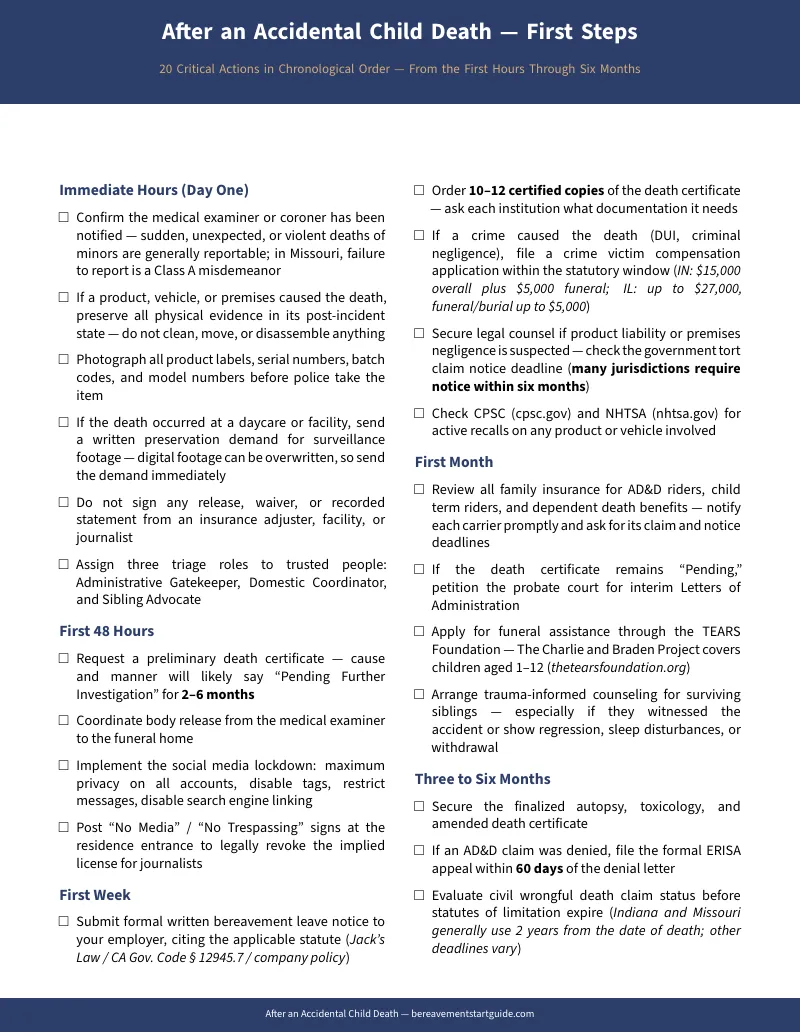
You can download the free emergency checklist right now — it covers the critical first steps for the first hours, first week, and first month. When you are ready for the complete system — all thirteen chapters, every template, every script, every worksheet — the full toolkit is available for as an instant download.