The department has a protocol. Your family needs one too.
Within hours of a line-of-duty death, your loved one's agency activates an entire command structure — funeral liaisons, benefits coordinators, media officers, honor guard. That machinery is built to serve the department's mission, not your family's survival. And while the department's protocol runs on a predetermined script, the decisions that determine your financial future, your legal standing, and your right to grieve privately are happening on a parallel timeline that no one is managing for you.
Surveillance footage overwrites on automatic cycles. COBRA election windows start ticking. Outdated beneficiary designations on pension accounts can legally divert six figures to an ex-spouse — regardless of what the will says. And the federal PSOB benefit, worth over $460,000, requires documentation that agencies sometimes fail to compile unless a family member knows to ask for it.
Generic grief guides do not cover any of this. Nonprofit peer-support networks like C.O.P.S. and the NFFF are invaluable for long-term healing, but their resource libraries are scattered across dozens of PDFs, organized by topic, not by urgency. And wrongful death attorneys cover the legal theories clearly enough to convince you to call — but they are not going to hand you the self-help checklists, letter templates, and filing procedures you need in the hours before you decide whether to retain anyone.
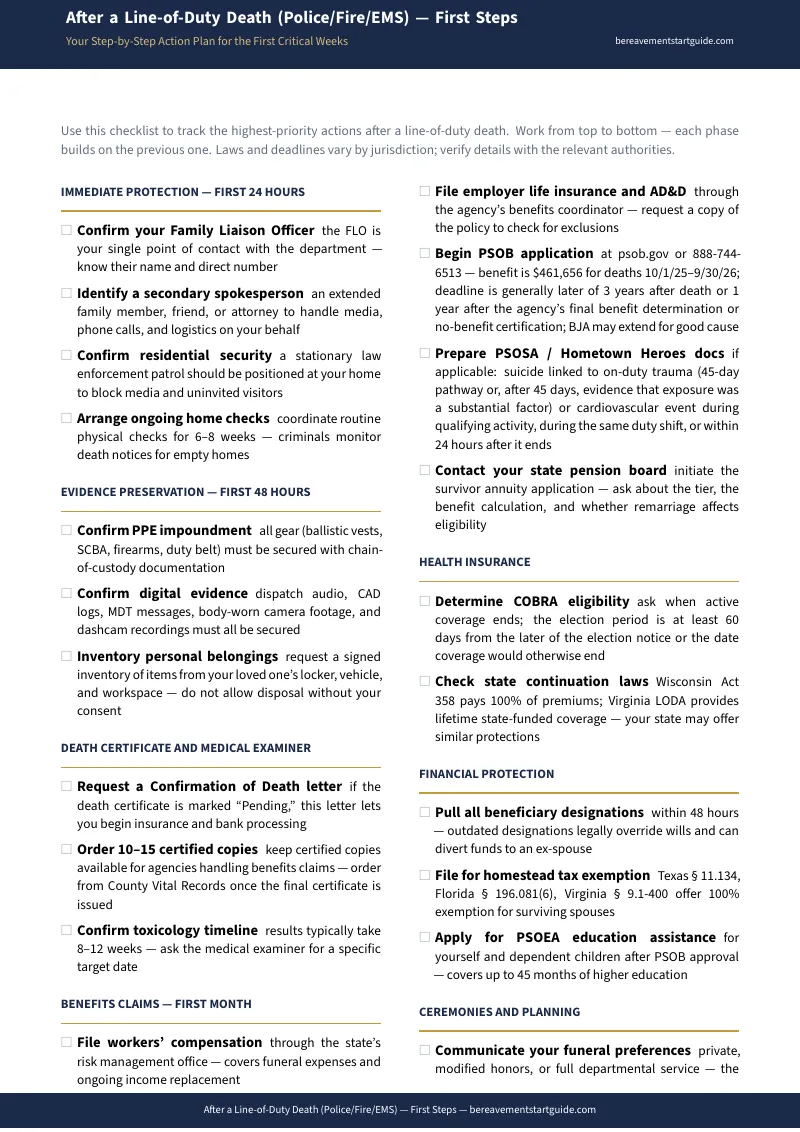
The Line-of-Duty Death Triage System is different. It is not a grief book or a memorial resource. It is a step-by-step administrative and legal triage toolkit — a 51-page guide, a 22-item First Steps checklist, six boundary-setting scripts, three customizable letter templates, and five fillable tracking worksheets — built specifically for the emergency of losing a police officer, firefighter, or EMS provider in the line of duty. It consolidates the benefits filing procedures, evidence preservation steps, health insurance continuation rules, and family boundary scripts into one sequenced system that you can work through from the moment you receive the notification.
What's inside the toolkit
- First 24-Hour Triage Protocol — exactly what to secure, who to contact, and how to protect your home during the highest-risk window. Includes Family Liaison Officer expectations and boundary-setting scripts for when the department's ceremonial plans conflict with your family's wishes.
- Evidence Preservation Framework — a systematic procedure for confirming that dispatch audio, body-worn camera footage, CAD logs, and personal protective equipment are all secured with chain-of-custody documentation. This baseline is essential whether your family later pursues a benefits claim, a wrongful death action, or both.
- Death Certificate Wording Guide — how proximate cause versus immediate cause entries affect your eligibility, what to do when the certificate is filed as "Pending" for months during forensic toxicology, and how to request a Confirmation of Death letter to unfreeze insurance and bank processing in the interim.
- Complete Federal Benefits Walkthrough — PSOB Part A (over $460,000), PSOEA educational assistance (up to 45 months of higher education), the Hometown Heroes Act for cardiovascular events, and the PSOSA pathway for trauma-related suicides. Filing timelines, required documentation, and what to do if a claim is denied.
- State Pension and Workers' Compensation Navigation — how to initiate survivor annuity applications, understand tier calculations, and determine whether remarriage affects your eligibility under your specific state's pension rules.
- Health Insurance Continuation Map — COBRA mechanics and election periods, plus state-specific fully-funded continuation laws (Wisconsin Act 358, Virginia LODA, and others) that can eliminate your out-of-pocket premium entirely.
- Beneficiary Designation Audit — why outdated designations on employer life insurance and pension accounts legally override a current will, and the 48-hour pull procedure that prevents an ex-spouse or former beneficiary from receiving funds intended for your family.
- Blended Family and Domestic Complications — QILDRO versus QDRO requirements for pension division, cohabiting partner eligibility gaps, and how to prevent estate disputes from escalating during peak bereavement.
- International Benefits Coverage — Canada's Memorial Grant Program for First Responders (up to $300,000 tax-free), UK Police Pension death grants and survivor pensions across the 1987/2006/2015 schemes, and Australia's Enhanced Police Support Scheme.
- Children's Grief and Family Support — age-specific communication strategies, behavioral warning signs, and how to help children navigate the collision between their private grief and the public "hero" narrative that surrounds a line-of-duty death.
Who this is for
You are here because a police officer, firefighter, or EMS provider you love died in the line of duty — and you need to know what to do next. You may be a surviving spouse, a parent, an adult child, a sibling, or a designated beneficiary. The death may have been a tactical incident, a cardiovascular event, a training accident, a vehicle collision, an occupational cancer diagnosis, or a suicide linked to the cumulative trauma of the job.
This toolkit was built for families in the first hours and first months after a line-of-duty death. It covers every service branch — law enforcement, fire, EMS — and every cause-of-death scenario that triggers the federal and state benefit systems. It works whether your loved one served a municipal department, a county sheriff's office, a state agency, a federal bureau, or a volunteer fire company.
Why free information is not enough
Department liaison officers are designated as facilitators, but they are sworn members of the agency. They face institutional pressure to secure your consent for public ceremonies and to manage the department's narrative. They are not your independent advocate — they cannot advise you on pension disputes, beneficiary conflicts, or whether the agency's investigation was adequate.
Nonprofit resource libraries are fragmented by design. C.O.P.S. provides peer support, the NFFF covers fire-service-specific protocols, the IAFF publishes benefit summaries, and the BJA hosts the PSOB application portal. Each one covers a slice. None of them consolidates the full administrative picture — from notification to estate settlement — into a single, sequenced system organized by urgency.
Government benefit portals explain the system's requirements in the system's language. They tell you what documentation to submit. They do not tell you how to get that documentation when the medical examiner is backlogged, the agency's records division is slow to respond, or your loved one's death certificate has been filed as "Pending" for months.
This toolkit replaces the search with a system. You work through it in order, from the first 24 hours through benefits filing, estate settlement, and long-term recovery — without needing to figure out which organization covers which step.
Your purchase is protected
Full refund, no time limit. If the toolkit does not help you, email hello@bereavementstartguide.com and you will receive a complete refund. No forms, no questions, no expiry date.
The toolkit costs less than a single hour of the professional guidance it replaces — and it is yours to keep and refer back to for as long as you need it.
Get the full toolkit and start protecting your family's rights today.