The Military Took Over the Moment Your Person Died. Now You Have 72 Hours to Make Decisions Nobody Prepared You For.
A Casualty Notification Officer and a chaplain appeared at your door. They said words designed to be clear and respectful, but your brain could not hold onto them because trauma does not work the way official procedures assume. Within 24 hours, a Casualty Assistance Calls Officer will arrive with forms and acronyms — PADD, SGLI, LOD, DD-93 — and questions about burial, remains, and whether you want the media present when the flag-draped transfer case arrives at Dover.
You are not expected to know any of this. You are expected to decide anyway.
Government portals have the information, scattered across hundreds of dense PDF pages written by the same bureaucracy that created the system. Grief memoirs tell you it gets better. Law firms tell you to call them. TAPS and Military OneSource provide exceptional long-term support. But right now — tonight, this week — you need someone to tell you what to do next, in what order, in language your brain can actually process.
The Military Casualty Triage System — A Sequenced Operating Manual for Families in Crisis
The After a Military Service Death toolkit is a 13-chapter triage system built for families navigating the most administratively complex form of bereavement that exists. Not a grief memoir. Not a government survivor's guide written in bureaucratic shorthand. Not a single-branch pamphlet. This is a sequenced operating manual covering all U.S. service branches plus UK, Canadian, and Australian frameworks — with fill-in templates, worked dollar examples, communication scripts, and a role-assignment system — designed to be used in five-minute intervals at 2 a.m. by a brain running on adrenaline and no sleep.
The toolkit covers what no single free resource does: how to verify that the uniformed person at your door is genuine (not a scammer), how SGLI pays out when private insurance would deny the claim, what a line-of-duty investigation means for your housing and benefits, how to navigate the PADD dispute when your in-laws want a different burial than you do, and what happens to your healthcare and pension if you remarry — all in one printable system that works when every phone call ends with "we'll get back to you" and the CACO has gone home for the night.
What's Inside the Toolkit
- First 48-Hour Triage Protocol with Family Role Assignment — because when one person is fielding the CACO's paperwork, coordinating with the funeral home, fielding calls from both sets of grandparents, and trying to explain things to a seven-year-old, critical benefit deadlines get missed and that person collapses. The role assignment system distributes responsibilities across defined positions — Administrative Coordinator, Logistics Coordinator, Communications Coordinator, Family Caretaker — so the Death Gratuity gets filed, the funeral home gets chosen, and somebody is managing the children, all without destroying any single person in the process.
- CACO Navigation and Scam Protection — because your Casualty Assistance Calls Officer is an active-duty service member completing an assignment that may be their first. Some CACOs are extraordinary. Others are overwhelmed themselves. This chapter explains what the CACO is required to do for you, what falls outside their scope, how to request a replacement if the relationship breaks down, and — critically — how to verify that the uniformed person at your door is genuine, because scammers in authentic-looking uniforms have been documented appearing at survivors' homes demanding upfront "processing fees" to release remains.
- Death Gratuity and SGLI Claims with Worked Examples — because the $100,000 tax-free Death Gratuity can arrive within 72 hours but only if the DD Form 397 is filed immediately, and the $500,000 Servicemembers' Group Life Insurance payout has no suicide exclusion, no contestability period, and no misconduct restriction — unlike private life insurance policies, which routinely deny claims within two years of issuance. This chapter walks you through completing SGLV Form 8283, choosing between the lump-sum and 36-month installment options, and understanding exactly what your private insurer can and cannot deny.
- Line-of-Duty Investigation — What It Means for Your Benefits — because the command's LOD determination, initiated within five days of the death, decides whether the death occurred in the line of duty or was due to willful misconduct. A "not in the line of duty" ruling disqualifies your family from the 365-day BAH continuation, Dependency and Indemnity Compensation, and other transitional benefits. This chapter explains what the investigation covers, what "willful misconduct" means legally, and how to appeal through the Board for Correction of Military Records if you disagree with the finding.
- Funeral Honors and Burial Coordination — because active-duty deaths and veteran deaths receive different levels of government support, and the gap between what people assume the military covers and what it actually covers can mean thousands of dollars in unexpected funeral costs. This chapter covers national cemetery vs. private burial, full military honors vs. standard honors, the PADD designation and what happens when family members disagree about burial location, and specific branch requirements — including the seven-day advance notice for Marine Corps honors.
- Housing, TRICARE, and the Remarriage Penalty — because the 365-day BAH continuation keeps your rent paid only if the LOD determination is favorable, TRICARE eligibility follows a three-year transition timeline, and remarrying before age 55 strips your SBP annuities, DIC compensation, and healthcare coverage entirely. This chapter maps the complete financial transition — what stays, what goes, and the deadlines that determine which category each benefit falls into.
- Death Certificate Delays and the Cash-Flow Crisis — because when the Armed Forces Medical Examiner System retains jurisdiction over a non-natural death, the cause of death is classified as "pending investigation" for months while toxicology and forensic reports are finalized. Without a certified death certificate, you cannot file for SGLI, update DEERS, settle private bank accounts, or close the estate. This chapter explains what you can do while waiting and how to manage the financial gap when your primary income has disappeared and the insurance payout is frozen.
- SBP, DIC, and Long-Term Survivor Benefits — because the Survivor Benefit Plan annuity, Dependency and Indemnity Compensation, educational benefits under DEA Chapter 35, and the tax relief provisions of IRC Section 692 form a layered system that nobody explains in one place. This chapter provides a complete financial map with worked monthly income examples, explains the SBP-DIC offset elimination, and walks you through submitting claims to the VA.
- Personal Effects Tracking — because your person's belongings are shipped from theater or base to the Joint Personal Effects Depot at Dover Air Force Base, where they are inventoried by a Summary Court Officer before being delivered to the primary next of kin. Families routinely wait months for this process and have no clear way to track their items. This chapter explains the timeline, your rights regarding the inventory, and what to do when items are delayed, damaged, or missing.
- International Comparison — UK, Canada, and Australia — because allied nations operate entirely different casualty systems. The UK assigns a Visiting Officer through the JCCC. Canada deploys a Designated Assistant through the CAF Transition Group. Australia provides a Bereavement Support Team through DMFS. This chapter covers country-specific forms, deadlines, and support organizations so families in allied nations can use the same toolkit.
- Media, Privacy, and Social Media Scams — because the 24-hour notification embargo is routinely broken online, social media scammers steal deceased service members' photos to create fake profiles, and anything your family says publicly can affect future benefits claims or legal proceedings. This chapter provides template media statements, a protocol for coordinating with the military Public Affairs Officer, and a social media lockdown checklist.
- Supporting Children Through Military Loss — because children process military death differently depending on age, and the surviving parent is often too cognitively and emotionally overwhelmed to provide age-appropriate support while managing their own crisis. This chapter provides scripts for explaining different causes of death, behavioral indicators that distinguish normal grief from childhood traumatic stress, and resources like TAPS Good Grief Camps designed specifically for military children.
- Communication Scripts for Every Institutional Encounter — read-aloud scripts for notifying extended family (including when parents are divorced), coordinating with your CACO, speaking with insurance adjusters, requesting investigation updates, and asking the hard questions about cause of death. Each script is designed to get clear answers and establish a paper trail without triggering institutional defensiveness.
Who This Guide Is For
- Surviving spouses carrying the CACO meetings, the PADD decisions, the insurance claims, the housing transition, and the weight of explaining what happened to your children — all before you have slept a full night
- Parents who have been assigned a separate casualty officer because their child was married — navigating a system that legally prioritizes the spouse while your grief has no administrative standing and your instinct to control the funeral arrangements has no legal authority
- Siblings excluded from official briefings, government-funded travel to the dignified transfer, and funeral decision-making — doing the coordination work and the emotional labor while the support network focuses on the parents or the partner
- Battle buddies and unit members carrying survivor guilt and moral injury with no structured bereavement support beyond an immediate unit briefing — looking for a way to help the family that goes beyond "let me know if you need anything"
- Anyone managing the aftermath — a family readiness leader, a chaplain's spouse, or the person the family has silently designated as the one who can still hold a phone conversation and read a form
Why Free Resources Leave You Exposed
Government survivor's guides are authoritative and legally accurate, but they are written in dense, legalistic language scattered across hundreds of PDF pages on separate DoD, VA, and branch-specific websites. Each one assumes you already understand the system. A traumatized brain cannot synthesize the Navy's CACO handbook, the VA's DIC application instructions, and the IRS's Section 692 guidance into a coherent action plan while running on three hours of sleep.
TAPS and Military OneSource provide exceptional emotional support, peer matching, and casework assistance — and this toolkit explicitly recommends both. But their educational materials are dispersed across webinars, pamphlets, and articles, not sequenced into a single step-by-step administrative workbook you can print, divide among family members, and use at 2 a.m. when the helpline is on hold.
Grief memoirs are powerful for long-term healing, but they do not tell you how to file SGLV Form 8283, how to challenge a "not in the line of duty" determination, or how to track personal effects stuck at the Joint Personal Effects Depot. They speak to the person you will be in six months. You need the person you are tonight to survive this week.
The After a Military Service Death toolkit exists in the space none of these resources occupy: high operational utility combined with genuine empathy, covering all U.S. branches plus allied nations in a single sequenced system. It translates the military's own requirements into clear, human, step-by-step instructions — without trying to recruit you, protect an agency, or pretend that filling out forms is the same as healing.
Satisfaction Guarantee
If the toolkit does not help — for any reason — email hello@bereavementstartguide.com and we will refund you in full, no time limit. You are dealing with enough right now. The last thing you need is purchase anxiety on top of everything else.
You Don't Have to Navigate This Alone
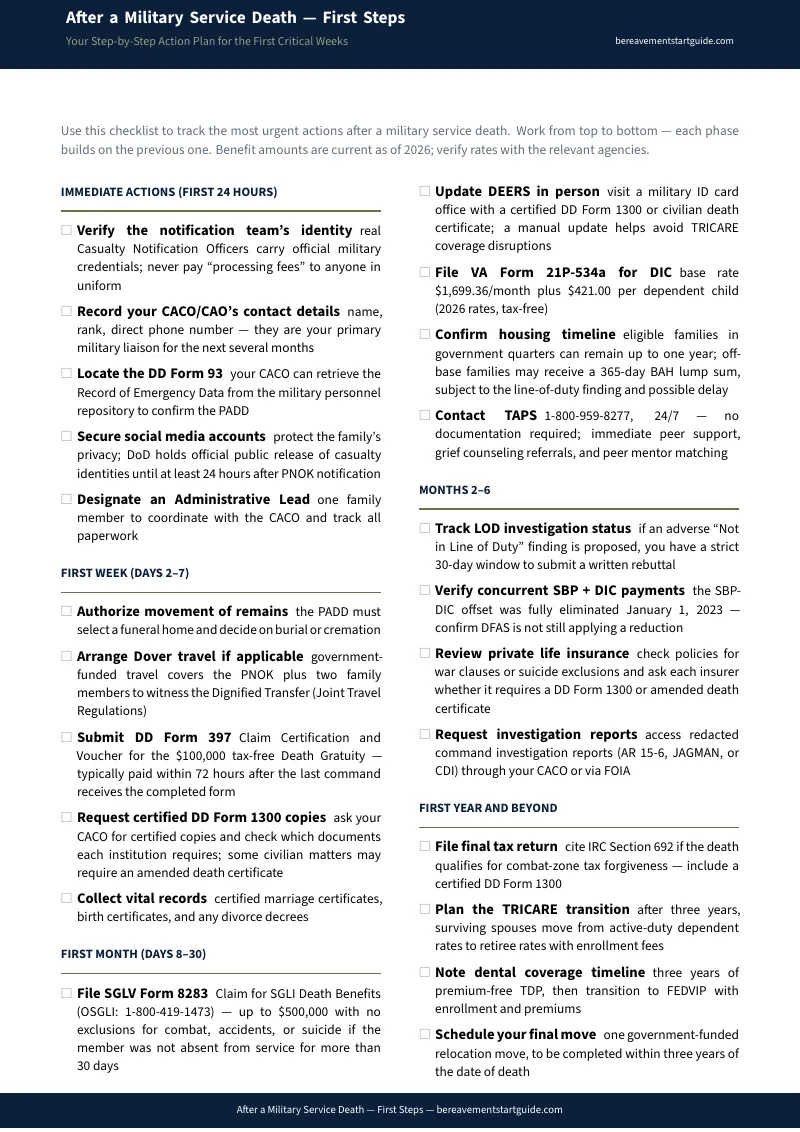
The free checklist gives you the sequence — what to do and when. If that is all you need right now, take it. But if you need the fill-in claim forms, the worked dollar examples, the communication scripts, the international framework comparison, and the chapter-by-chapter system that walks you through every institutional encounter from the CACO's first visit to the VA's final benefits determination — get the full After a Military Service Death toolkit and give your family a structured operating manual that works when your brain cannot.
You are away from having an external brain for the most administratively complex bereavement of your life.