The Storm Took Your Person. Now Every Government Agency, Insurance Company, and Newsroom Wants a Decision from You by Friday.
A hurricane tore through the coast. A tornado dropped without warning. A flood rose overnight and swallowed everything. A wildfire moved faster than anyone predicted. And now someone you love is dead — and you are standing in a disaster zone, displaced from your home, your documents destroyed, your phone battery dying, trying to figure out whether the medical examiner or the coroner has jurisdiction over the remains, whether FEMA will pay for the funeral, whether the insurance company can deny your claim by calling it an "Act of God," and whether the reporters camped outside the shelter have the legal right to photograph your family.
Meanwhile, the part of your brain that handles planning, sequencing, and decision-making has shut down. Cortisol and adrenaline have hijacked your prefrontal cortex. You are reading the same FEMA webpage three times and retaining nothing. You cannot remember whether you already called the funeral home or only thought about calling. You are making decisions that carry financial and legal consequences for years — with a brain that cannot hold a grocery list.
That is not weakness. It is a documented neurological response to sudden traumatic loss compounded by environmental displacement. And no free resource on the internet is built for a brain in that condition.
The Disaster Death Triage System — an Administrative Operating System Built for a Brain in Crisis
After a Natural Disaster Death is the step-by-step administrative triage toolkit built specifically for the aftermath of a disaster-related death. Not a grief memoir. Not a government pamphlet. A sequenced operating system that tells you exactly what to do, in what order, with copy-paste scripts for every phone call — designed to be read in five-minute bursts by a brain in shock, on a phone with one bar of signal, from a shelter or a relative's couch.
The toolkit covers what no single free resource does: the mass fatality identification process, presumptive death declarations when there is no body, the death certificate wording that determines whether FEMA and insurance approve or deny your claim, the duplication-of-benefits rule that disqualifies families who accept the wrong help first, the evidence preservation steps that vanish when cleanup crews clear the site, the media trespass laws nobody tells you about — in one printable document that works at 2 a.m. when you are searching from a dark room because you cannot sleep.
What's Inside the Toolkit
- The First 72 Hours — Safety, Search, and the Family Assistance Center — because the immediate hours after a disaster death are not like the immediate hours after any other death. You may be evacuated, displaced, separated from other family members, and unable to reach the location where your person died. This chapter sequences the critical first actions: registering with the National Emergency Family Registry and Locator System, understanding Search and Rescue protocols, accessing the Family Assistance Center, and coordinating with mass fatality management teams — all in numbered steps designed for a brain that can barely follow a single instruction.
- How Mass Fatality Identification Works — because when multiple people die in the same event, your loved one enters a formal forensic identification protocol that is nothing like a standard hospital death. The medical examiner or coroner may hold remains for days or weeks while DNA matching, dental records, and fingerprint analysis are completed. This chapter explains the NAME mass fatality management standards, what the family's role is during the identification process, why you may not be able to view the remains immediately, and how to designate a single family liaison to the ME/C office to prevent conflicting information.
- Presumptive Death When There Is No Body — because floods, tsunamis, and structural collapses sometimes leave no remains to recover. This chapter covers the legal standard for presumption of death, the accelerated declarations available under disaster-specific statutes, the court petition process, the typical waiting periods (and when federal disaster declarations shorten them), and how to proceed with insurance claims and estate administration while the petition is pending.
- Death Certificate Wording — The Language That Determines Your Benefits — because a death certificate that lists "cardiac arrest" without connecting it to the hurricane that knocked out the oxygen equipment will trigger immediate claim denials from FEMA and insurance. This chapter explains the CDC's distinction between direct and indirect disaster deaths, what the certifying language must include, how to review the certificate before accepting it, and how to request an amendment from the certifying physician or coroner when the wording fails to establish the disaster connection.
- Insurance Claims — Force Majeure, AD&D Exclusions, and How to Fight Denials — because insurance companies routinely invoke "Act of God" clauses, accidental death and dismemberment exclusions, and pre-existing condition riders to deny claims following natural disasters. This chapter covers the specific policy language to look for, the difference between standard life insurance (which generally pays) and AD&D policies (which may not if the death involved a medical event during evacuation), the insurer's documentation deadlines that tighten after a disaster, and the appeals process when a claim is denied.
- FEMA Funeral Assistance — Application, Exclusions, and the Duplication Trap — because FEMA can provide up to $9,000 for disaster-related funeral expenses under Other Needs Assistance, but it is legally prohibited from reimbursing costs already covered by burial insurance, prepaid funeral plans, or GoFundMe donations — while life insurance payouts are exempt from this duplication rule. This chapter walks through the application field by field, flags the expenses FEMA excludes (obituaries, flowers, printed programs, catering, guest transportation), and explains how to sequence your funding sources so you do not accidentally disqualify yourself.
- Document Replacement After a Disaster — because when a flood or fire destroys original wills, life insurance policies, birth certificates, marriage certificates, and property deeds, you need to know how to file an Affidavit of Lost Will, access state expedited vital records replacement portals, contact the drafting attorney's office for copies, and reconstruct the paper trail that every institution will demand before releasing funds or transferring assets.
- Protecting Your Privacy from Media Intrusion — because high-profile disasters attract aggressive journalists who may pursue your family for interviews, photograph damaged property, or handle scattered personal effects without authorization. This chapter covers your right to revoke implied license by posting "No Media" signage, the legal basis for trespass-to-goods claims, why grief-shock compromises your capacity to consent to interviews, and pre-written scripts for refusing media contact and appointing a family spokesperson.
- Understanding Traumatic Grief and Survivor's Guilt — because the grief that follows a disaster death is compounded by environmental trauma, displacement, and often direct witnessing of the death. This chapter explains the neuroscience of "grief brain," the specific manifestations of survivor's guilt, how trauma reminders (rain, wind, sirens, specific smells) can trigger panic in children, and the difference between normal acute grief and Prolonged Grief Disorder. It provides grounding techniques and a curated directory of disaster-specific resources including SAMHSA, the Red Cross Disaster Mental Health program, and the MISS Foundation.
- The Recovery Timeline — Month by Month — because after the acute crisis passes, you face an 18-month administrative backlog of probate delays, insurance investigations, property claims, and courthouse backlogs that pile up after every major disaster. This chapter maps the realistic timeline so you know what to expect at each stage and can pace yourself without assuming something has gone wrong.
- Nine Printable Worksheets and Trackers — incident information log, benefits and claims tracker, evidence and scene documentation log, recovery timeline tracker, official communication call log, FEMA application tracker, death certificate audit sheet, document replacement tracker, and family role assignment chart. Every administrative artifact you would otherwise have to invent while cognitively impaired — each one a separate printable tool you can hand to a family member and say "you handle this one."
Who This Guide Is For
- Surviving spouses and partners who lost their person in a hurricane, flood, tornado, wildfire, or earthquake — and are managing a displaced family, a destroyed home, and a cascade of institutional demands at the same time
- Parents who lost a child to the disaster and are navigating mass fatality protocols while processing unbearable loss
- Adult children whose parent died during the event — who are coordinating from another state or country while trying to reach the disaster zone
- The family member who witnessed the death and is carrying intrusive sensory memories alongside the administrative burden
- Anyone managing the aftermath — executor, next of kin, or the person everyone assumes "has it handled" — while personally displaced, traumatized, and running on no sleep
Why Free Checklists and Government Pages Fall Short
FEMA's disaster assistance pages are accurate, but they are dense, bureaucratic, and scattered across dozens of uncoordinated subdomains — impossible to navigate when your executive function is offline. Hospital and coroner handouts are a single double-sided sheet that gets lost in the next evacuation. Law-firm disaster death pages are written to convert you into a litigation client. Nonprofit support pages are empathetic but generic — focused on standard loss, not the specific administrative chaos that follows a disaster death.
No free resource consolidates the mass fatality identification process, the presumptive death petition, the death certificate wording audit, the FEMA duplication-of-benefits rule, the insurance force majeure defense, the document replacement portals, and the media trespass boundaries into one sequenced document built for a cognitively impaired brain operating from a disaster zone. That consolidation is the product. It exists so you do not have to search six agency websites, three legal forums, and a FEMA hotline at 2 a.m. from a shelter while your hands are shaking.
Guarantee
Full refund, no time limit. If the toolkit does not help your family, email hello@bereavementstartguide.com and we will refund you — no forms, no justification required. The guide is completely independent and does not accept affiliate fees or referral commissions from funeral homes, estate attorneys, or insurance companies.
Get the Toolkit
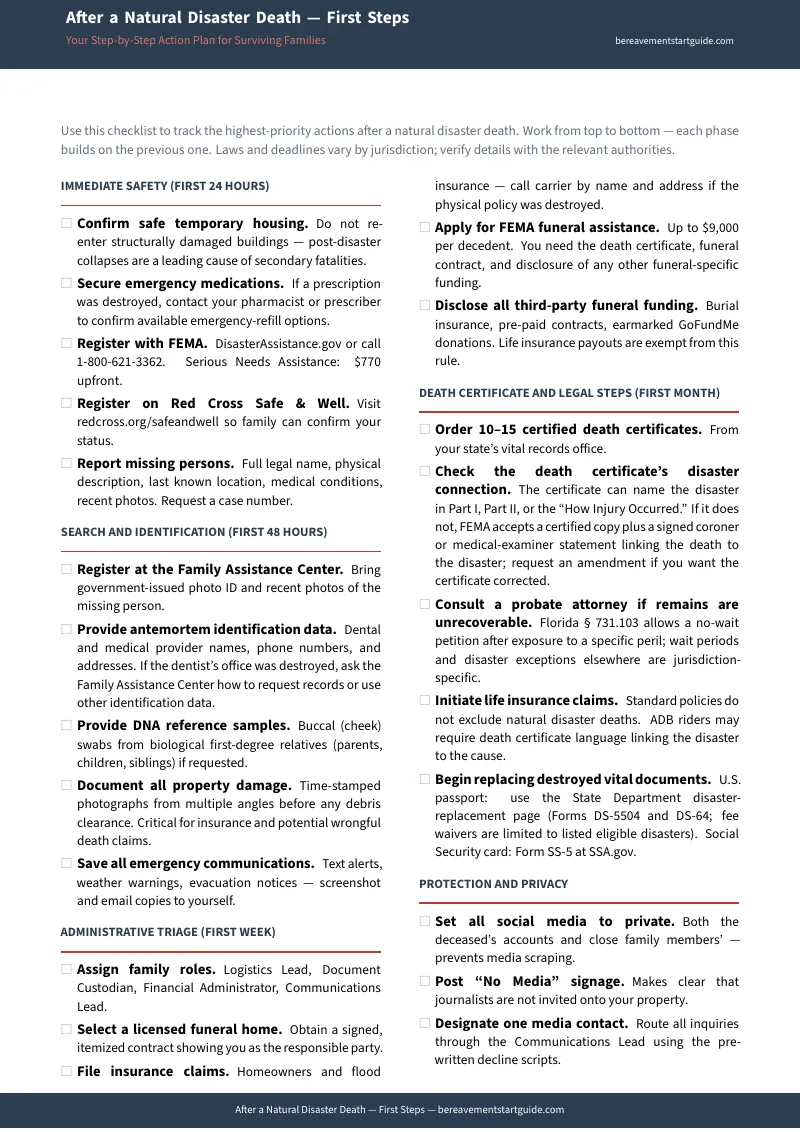
You can download the free one-page emergency checklist right now — it covers the 24 most critical actions for the first week after a disaster death. When you are ready for the complete system — all thirteen chapters, every worksheet, every script — the full toolkit is available for as an instant download.