Your Baby Was Alive. You Held Them. And Now Every System Around You Needs a Decision Before You Can Breathe.
A hospital social worker is explaining autopsy options while you are still trying to understand what happened. Someone is handing you forms about birth registration — and death registration — because a neonatal death requires both. Your breasts are filling with milk. The insurance company's thirty-day enrollment clock started the moment your baby was born, and if you miss it, they can retroactively deny every NICU charge from the moment of birth. Your employer needs documentation. A funeral home is asking questions about an infant.
You are reading the same sentence three times. You walked into the hallway and forgot why. Your hands are shaking and you cannot stop them. You are managing logistics while everyone around you falls apart, and you do not know whether that makes you strong or broken.
Neither. That is a documented neurological response to acute traumatic loss — your prefrontal cortex has gone offline at the precise moment when evidence preservation windows are closing, insurance enrollment deadlines are running, and employment leave eligibility depends on paperwork you submit this week.
The Neonatal Loss Triage System — an External Brain for the Worst Week of Your Life
After a Neonatal Death is the operational triage toolkit built for the crisis that a neonatal death uniquely creates: a baby who was legally born alive triggers a dual-track administrative cascade — birth certificate and death certificate, newborn insurance enrollment and medical billing, paternity affidavits and death registration — compressed into days while you are in postpartum physical recovery and acute traumatic grief. Not a grief memoir. Not a hospital discharge packet. Not a law-firm blog pushing litigation. A sequenced operating system that tells you exactly what to do, in what order, with fill-in-the-blank templates and copy-paste scripts — designed to be used in five-minute intervals by a brain in shock.
The toolkit covers what no single free resource does: the clinical distinction between stillbirth and neonatal death that changes every document you file, autopsy tiers including the SUIDI protocol for home deaths, evidence preservation before hospitals overwrite records on routine schedules, multi-country dual registration, the insurance enrollment deadline that can financially devastate a grieving family, funeral funding programs, lactation suppression protocols, communication scripts for every audience from toddlers to HR, and the grief dynamics unique to a loss society measures by duration rather than depth — in one printable document that works at 2 a.m.
What's Inside the Toolkit
- The Stillbirth–Neonatal Death Distinction and Why It Changes Everything — because the clinical definition of a live birth (any sign of life after complete expulsion — breathing, heartbeat, cord pulsation, voluntary movement — regardless of gestational age or survival duration) determines which certificates you file, which benefits you qualify for, which government agencies are involved, and whether you need a paternity affidavit. The jurisdiction comparison table covers the US, UK, Canada, and Australia. The Role Delegation Model for appointing a family proxy before any other decision.
- Autopsy Decision Framework and the SUIDI Protocol — the three consent tiers (full, limited, external-only), what each reveals about cause of death and recurrence risk, and the questions to ask your care team. Placental pathology as a separate, less invasive investigation most families overlook. Genetic testing and recurrence-risk counselling. When a coroner or medical examiner takes jurisdiction and overrides parental consent. If your baby died at home: the SUIDI (Sudden Unexplained Infant Death Investigation) protocol — what investigators will ask, what they will examine, and what your rights are during the process.
- Dual Birth-and-Death Registration — Filing Two Certificates, Not One — because a neonatal death requires both a Certificate of Live Birth and a Certificate of Death, where a stillbirth requires only one. Why the cause-of-death wording on Line A matters for insurance claims and potential legal action. The SSN trap: how to avoid requesting a Social Security number for a deceased newborn on the hospital birth worksheet. Commemorative certificates for losses below the legal reporting threshold.
- Evidence Preservation Before the Window Closes — if you suspect something went wrong during delivery or NICU care, electronic fetal monitoring strips, EMR audit trails, placental tissue blocks, and cord blood gases are routinely overwritten or discarded on hospital schedules. The evidence preservation letter — what it must say, who receives it, and the legal consequences for the hospital if they destroy records after receiving it. Statute of limitations by jurisdiction.
- Employment Leave Decoder — US, UK, Canada, Australia — because your leave entitlements after a neonatal death depend on jurisdiction and documentation you submit this week. FMLA transition from parental to medical or bereavement leave, state-level paid family leave, Jack's Law parental bereavement leave, EI maternity and sickness benefits, Paid Parental Leave eligibility — with fill-in-the-blank HR notification templates.
- The Insurance Enrollment Deadline That Can Destroy Your Family Financially — your baby's NICU stay, resuscitation, and specialty care are covered under the mother's plan for thirty days, but only if you formally enroll the newborn within the special enrollment window (thirty days for employer plans, sixty days for ACA marketplace plans). If you miss it because you were grieving, the insurer can retroactively deny every claim from the moment of birth. How to audit separate mother/baby billing, unbundled charges, denial codes, and ERISA appeal deadlines.
- Funeral Funding Comparison Table — infant funeral costs on top of medical bills. The Children's Funeral Fund for England, The TEARS Foundation, state burial assistance registries, and charitable grants — with eligibility criteria and coverage amounts side by side. Reduced infant rates that many funeral homes offer but do not advertise. Burial, cremation, aquamation, and memorial service options. FTC Funeral Rule rights.
- Lactation Suppression Protocol — your body completed a birth and is producing milk regardless of the outcome. Non-pharmacological protocols (expressing to comfort, supportive undergarments, cold compresses, cabbage leaf technique, reverse pressure softening for severe engorgement), pharmaceutical options (pseudoephedrine, estrogen-containing contraceptives), clinical red flags for plugged ducts and mastitis, and legacy options — milk donation through accredited banks and breastmilk keepsake jewellery.
- Communication Script Library — copy-paste family announcement templates, the two-day staggered social media protocol, workplace notification templates, and age-specific sibling communication scripts using the concrete words "died" and "dead" instead of euphemisms that cause lasting harm. Boundary scripts for intrusive questions and minimizing platitudes. Delegation scripts for the family advocate.
- Sibling Support — the Forgotten Mourners — children grieve the baby and the sudden emotional unavailability of their parents simultaneously. Why "the baby went to sleep" causes children to develop debilitating fears of falling asleep. Age-specific language scripts. Behavioral regression, separation anxiety, and somatic complaints as normal grief responses. Activities that help children integrate loss.
- Grandparents, Witnesses, and Secondary Trauma — grandparents mourn the baby and the helplessness of watching their own child suffer. Clinical staff who witnessed the death or resuscitation attempt. Family members present during traumatic deliveries. How secondary trauma and moral injury manifest, and where each group can find support.
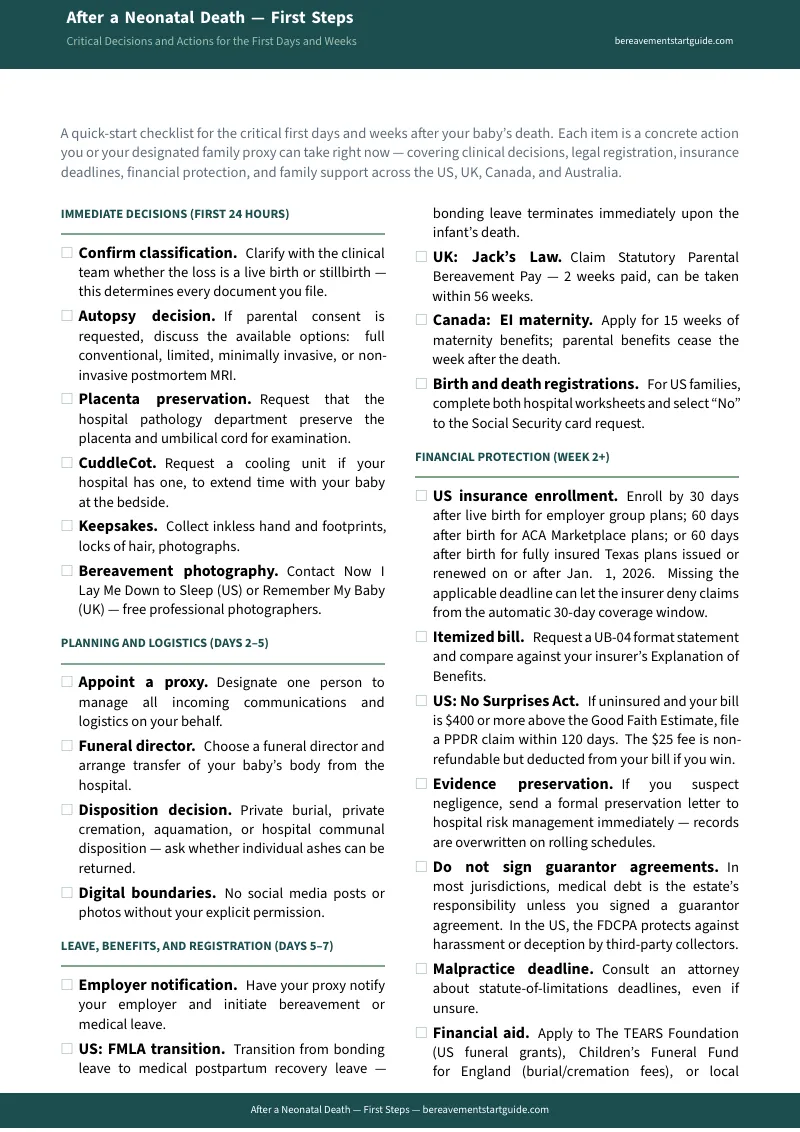
- Worksheets and Planning Tools — First-Week Triage Checklist, Family Role Assignment Worksheet, Clinician Interview Guide, Investigation Tracker, Evidence Preservation Letter Template, Benefits and Claims Tracker, Financial Aid Tracker, School Notification Letter, Billing Dispute Log, and Incident Information Log — each a separate printable PDF.
Who This Guide Is For
- Parents whose baby lived — for minutes, hours, or days — and who now face a dual administrative track that no hospital handout fully explains
- Mothers recovering from delivery while managing lactation, insurance deadlines, and a body that completed a birth and does not know the outcome
- Partners holding everything together — making calls, signing forms, coordinating with funeral homes — while processing their own grief in silence
- Grandparents navigating a double grief and needing clear boundaries on how to help without overstepping
- The family advocate — the sibling, parent, or friend who stepped up and needs a sequenced operating manual
- Anyone searching at 2 a.m. for answers about birth certificates for babies who died, insurance enrollment deadlines, lactation suppression, evidence preservation, or how to explain death to a three-year-old
Why Free Checklists and Google Searches Fall Short
Hospital discharge packets are clinical and drastically incomplete — most cover the mother's physical recovery and stop there, leaving insurance enrollment, evidence preservation, partner grief, and lactation suppression entirely unaddressed. Government vital records pages give you accurate legal information in bureaucratic language your brain cannot process right now. Nonprofit portals have excellent content buried behind navigation that assumes executive function. Grief memoirs are important — later. Law-firm blogs reduce your baby's life to a malpractice case evaluation and ignore the administrative and physical realities. Reddit threads mix practical advice with emotional support in ways that make both harder to use at 2 a.m.
No free resource consolidates the stillbirth-versus-neonatal-death distinction, the dual registration track, the autopsy decision framework, the SUIDI protocol, the evidence preservation letter, the employment leave decoder, the insurance enrollment deadline, the funeral funding comparison, the lactation suppression protocol, the communication scripts, sibling support, and the grief dynamics into one sequenced document. That consolidation is the product. It exists so you do not have to search ten different websites while your body is recovering from birth and your mind cannot hold more than one step at a time.
Guarantee
Full refund, no time limit. If the toolkit does not help your family, email hello@bereavementstartguide.com and we will refund you — no forms, no justification required. The guide is completely independent and does not accept affiliate fees or referral commissions from funeral homes, hospitals, or insurance companies.
Get the Toolkit
You can download the free emergency checklist right now — it covers the immediate first steps for the hospital stay and first two weeks. When you are ready for the complete system — all fourteen chapters, every template, every script, every worksheet — the full toolkit is available for as an instant download.