The employer has a legal team. The insurer has a denial playbook. You have 48 hours before critical evidence disappears.
Fifteen workers die on the job every day in the United States alone. Each of those deaths triggers a collision of forces that no family is prepared for — an OSHA investigation locked behind legal privilege, a workers' compensation insurer scanning for denial grounds, an employer whose corporate counsel is already managing liability, and a medical examiner whose "Pending" death certificate can freeze your insurance claims for months.
Free resources exist in fragments: OSHA brochures written in regulatory language, wrongful death law firm blogs designed to funnel you into a retainer, union websites that cover only their own members, and grief books that treat a preventable industrial fatality the same as a natural death. None of them give you the complete operational sequence — from evidence preservation in the first 48 hours through workers' compensation appeals, third-party civil lawsuit options, and the traumatic grief that follows a sudden, violent, preventable loss.
The Workplace Fatality Crisis System
After a Workplace Accident Death is a crisis management toolkit purpose-built for the specific regulatory, legal, financial, and emotional aftermath of a fatal workplace incident. Not a grief memoir. Not a law firm intake form. A modular, chronological operating system with checkboxes, scripts, templates, and worksheets — structured for a brain in shock that cannot hold a multi-step plan in working memory.
Every section solves a specific, urgent problem: evidence that the employer is about to overwrite. Workers' compensation formulas that vary wildly by state. Insurance contestability traps that exploit your disorientation. Posthumous payroll rules that can lock your family out of the deceased's bank account. OSHA investigation procedures that leave you in the dark for six months. Communication scripts for conversations you cannot bear to have. And the traumatic grief chapter explains what is actually happening to your nervous system — because understanding the biological mechanism behind intrusive images, rage, and cognitive fog is the first step toward regaining functional capacity.
What makes this different from free resources
Law firm websites focus on litigation and ignore the immediate survival crisis. Government pages provide sterile regulatory timelines with zero emotional guidance. Grief books address feelings but leave you completely unprepared for an active industrial investigation. Union resources cover only their own members. This toolkit occupies the middle ground that none of them touch — practical, compassionate, and comprehensive enough to function as your external brain from the first 48 hours through the first year.
The six structural gaps in existing resources:
- Too legalistic — law firm portals rush you into litigation before you have secured evidence, notified OSHA, or understood your workers' compensation rights
- Too clinical — government documents provide cold regulatory breakdowns with no recognition that you are in acute trauma
- Too spiritual — grief literature focuses on acceptance while your family's financial future depends on filing deadlines
- Too sales-driven — wrongful death attorney pages use your tragedy as a lead-generation funnel
- Too jurisdiction-specific — most resources assume a single country's legal framework, leaving families in the UK, Canada, or Australia completely stranded
- Too generic — standard bereavement guides treat a workplace accident the same as a death from old age, ignoring the investigation, the employer's liability management, and the specific trauma of preventable loss
What's inside — chapter by chapter
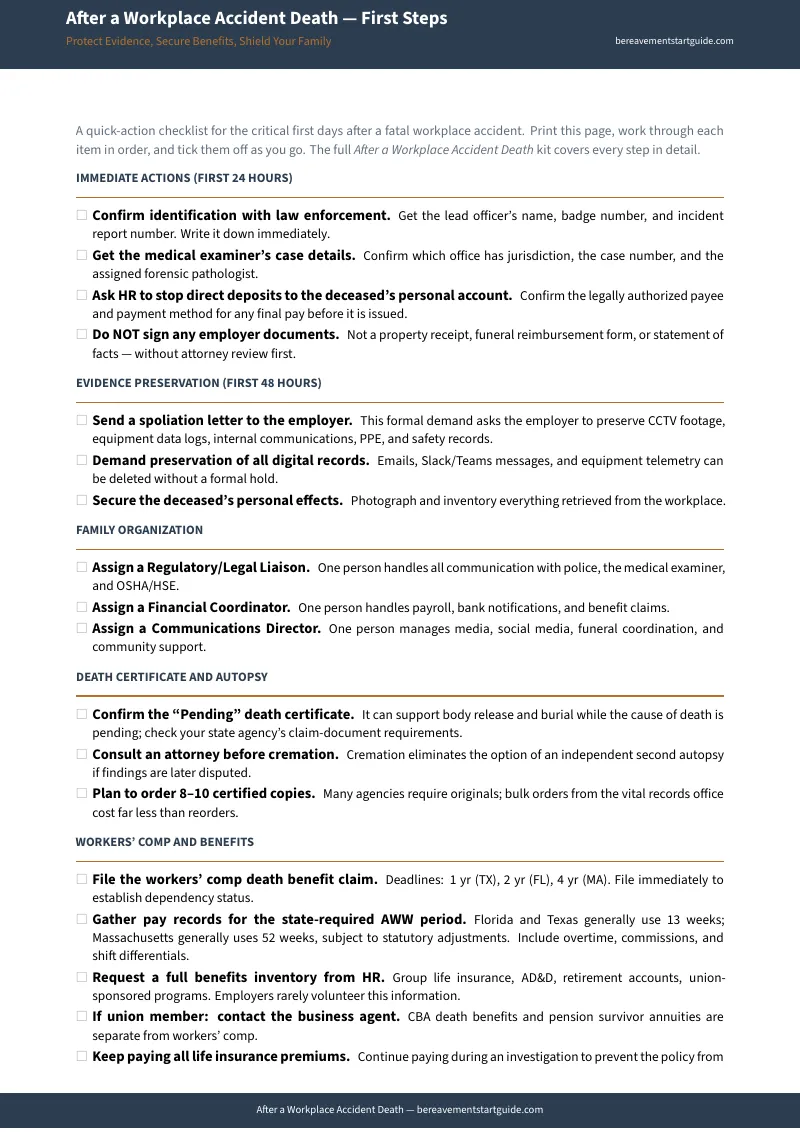
- First 48 Hours Triage Protocol — confirm facts with law enforcement, send the spoliation letter to freeze evidence, stop payroll deposits before they trap funds in probate, assign family roles, and learn what not to sign
- Medical Examiner and Death Certificate — why the "Pending" certificate freezes insurance claims, when cremation becomes a legal tripwire, and how to challenge misleading post-mortem toxicology results
- OSHA Investigation Navigation — the 8-hour reporting rule, your family's right to participate, the OSHA National Family Liaison, FOIA procedures, plus UK HSE/RIDDOR, Canadian, and Australian frameworks
- Posthumous Payroll — IRS Publication 15 obligations, the W-9 trap, and how to ensure final pay reaches the estate instead of a frozen account
- Workers' Compensation Death Benefits — Average Weekly Wage calculations, dependency tiers, burial allowances, benefit duration, and appeal strategies when the insurer denies on intoxication or misconduct grounds
- Beyond Workers' Comp — Civil Lawsuits — the Exclusive Remedy doctrine and four exceptions that let you pursue full damages: third-party liability, employer willful misconduct, uninsured employers, and the dual-capacity doctrine
- Insurance Claims — life insurance, AD&D, contestability traps, premium continuation during investigations, and bad-faith delay countermeasures
- Media and Privacy Protection — digital profile lockdowns, social media preservation, copy-paste media statements, and scripts for online commentators
- Traumatic Grief — the clinical distinction between normal grief, PTSD, and Prolonged Grief Disorder, with somatic grounding techniques built for the intrusive imagery that follows a violent, preventable death
- Union Protections and Industry Relief — CBA death benefits, pension survivor annuities, Construction Angels, the Fallen Lineman Organization, Kids' Chance scholarships, and industry-specific charitable funds
- Communication Scripts — fill-in-the-blank templates for family notification, employer communication, OSHA interaction, insurance calls, media inquiries, and age-appropriate language for children
- Worksheets and Planning Tools — eight standalone printable PDFs: incident information log, benefits and claims tracker, evidence preservation checklist, FOIA request checklist, communication log, questions for investigators, monthly recovery timeline, and a complete set of communication scripts — built for five-minute working sessions when sustained concentration is impossible
- Resource Directory — OSHA Family Liaison, USMWF, Threads of Life, Kids' Chance, NACG, and industry-specific survivor organizations with direct contact information
Who this is for
- Surviving spouses and partners who lost someone at work without warning and are managing shock, an estate, a workers' comp claim, and a federal investigation simultaneously
- Adult children whose parent died on a construction site, in a factory, inside a confined space, or on a rig
- Parents who lost an adult child to a workplace fatality and are confronting an employer that was the last entity responsible for their child's safety
- Siblings whose grief is being overlooked because the support network is focused on the spouse or children
- Coworker witnesses carrying intrusive sensory memories, survivor guilt, and fear about their own safety
- Anyone managing the aftermath — executor, union representative, or the person everyone assumes "has it handled" because they are not visibly falling apart
Satisfaction guarantee
Full refund, no time limit. If this toolkit does not help you, email hello@bereavementstartguide.com and we will refund you — no forms, no justification required.
Start with the free checklist or get the full toolkit
The free checklist gives you the immediate triage sequence — the first actions that cannot wait. The full After a Workplace Accident Death toolkit covers every regulatory, legal, financial, and emotional dimension of the weeks and months ahead, with the complete template library, communication scripts, and resource directory. Download either one instantly — no account required.