There Is No Body. There Is No Death Certificate. And Every Institution You Call Says They Cannot Help You.
The bank froze the joint account three weeks ago because the other signatory is "absent — status unknown." The mortgage payment is due in nine days. The life insurance company says they need a death certificate before they can process anything — but the coroner says there is nothing to certify because there is no body. Law enforcement classified the case as medium risk on day four and you have not heard from the detective in eleven days. A volunteer search group is asking you to coordinate logistics for Saturday. A journalist wants a comment for the evening news. Your mother-in-law asked whether you have tried calling their phone again.
Meanwhile your brain will not stop scanning. Every crowd, every car that resembles theirs, every notification sound — your nervous system spikes and crashes, spikes and crashes, because without physical remains, the mind never receives the neurological signal that allows grief's learning process to begin. Psychologists call this ambiguous loss. It feels like being trapped in a permanent emergency that no one around you can see.
And while your nervous system is stuck in that loop, the administrative machinery of modern life is demanding decisions: bank access, mortgage payments, insurance premiums, pension claims, tax filings, school enrollment, utility accounts — every institution requiring documentation you cannot produce because your loved one is neither confirmed dead nor confirmed alive.
The Ambiguous Loss Administrative System — a Structured Companion for the Cruelest Form of Grief
When Someone Goes Missing — Presumed Dead is the practical toolkit built for the specific legal, financial, and emotional paralysis that no other form of bereavement triggers: a loved one who has vanished without a body, without a death certificate, and without a timeline for resolution — while every financial obligation they carried keeps running on autopilot.
Not a grief memoir about ambiguous loss. Not a law-firm intake page designed to sell a retainer. Not a government handout written in bureaucratic language your traumatized brain cannot parse. A sequenced administrative companion that tells you exactly what to do, in what order, with fill-in-the-blank templates, copy-paste scripts, and jurisdiction-specific legal guidance — designed to be read in five-minute intervals by a brain that cannot hold more than one step at a time.
The toolkit covers what no single free resource does: first-72-hour emergency stabilization, forensic evidence preservation protocols for DNA reference samples and digital devices, interim estate management through conservatorship or guardianship filings, the legal declaration of presumed death with jurisdiction-specific timelines and the Specific Peril Doctrine, life insurance claim strategies including the indemnity bond, banking and mortgage protection, pension and benefits access workarounds, ambiguous loss psychology with somatic stabilization techniques, children's support scripts, communication templates for family and media, and symbolic memorialization planning — in one printable document that works at 2 a.m. when you are searching for answers in the dark.
What's Inside the Toolkit
- 72-Hour Emergency Stabilization Protocol — because the first three days are four crises arriving simultaneously, and most families learn the hard way that a well-meaning relative who logs into the missing person's phone can trigger a security lockout that corrupts cellular ping evidence investigators need. The digital lockdown procedure, the automated payments audit that stops liquid assets from draining, the missing-person report filing checklist with the three things to demand before leaving the station, and the four-role family delegation system that prevents paralysis by consensus.
- Law Enforcement Escalation Toolkit — because over 75% of adult missing-person cases are classified as medium risk, and medium-risk cases receive wildly inconsistent investigative intensity depending on the department's active caseload. The specific documented evidence that triggers a reclassification to high priority, NamUs registration guidance, the communication log template that creates a paper trail when nobody is returning your calls, and escalation scripts for when the investigation has stalled.
- Forensic Preservation Protocol — because hairbrushes, toothbrushes, used bandages, and dental floss contain irreplaceable reference DNA that is destroyed the first time someone cleans the house. The reference DNA collection guide, the digital evidence freeze procedure that prevents security lockouts from corrupting location metadata, and the forensic odontology and medical imaging records to collect now — before you need them for identification.
- Interim Estate Management Navigator — because without a death certificate, banks are legally prohibited from sharing information about or allowing withdrawals from accounts held solely in the missing person's name. How conservatorship works in the US state by state (including what happens if the person returns), how the UK Guardianship (Missing Persons) Act 2017 works and why its high financial barriers have left thousands of families in administrative limbo despite the law's existence, the Power of Attorney "springing clause" trap, and concrete steps to prevent foreclosure, vehicle repossession, and utility shutoffs while every institution tells you they need documentation you cannot produce.
- Legal Declaration of Presumed Death — Step by Step — because the statutory waiting periods range from five years in California and Florida to seven years in New York, Texas, and England — but the Specific Peril Doctrine lets courts waive the period entirely when the person was exposed to a verified catastrophe. The jurisdiction-specific timeline table, the court petition process, the evidence checklist courts actually require, and the difference between a Coroner's Inquest and a civil presumption-of-death petition.
- Life Insurance Claim Strategy — because the most catastrophic error families make is stopping premium payments once someone goes missing, assuming a claim is active. If the policy lapses before a formal court declaration of death, the insurer is legally entitled to deny the claim entirely. How to file a claim without a standard death certificate, what an indemnity bond is and why insurers require one, and the difference between "Pending" and "Undetermined" manner-of-death wording and how each affects processing.
- Banking, Mortgage, and Tax Filing Guide — because Married Filing Jointly remains available when a spouse is missing, mortgage forbearance programs exist but banks do not volunteer them, and the credit damage from unpaid joint obligations can follow you for years. Joint account access rules, hardship program eligibility, and the tax filing strategies that protect your finances during the limbo period.
- Pension and Benefits Access Workarounds — because Social Security survivor benefits require a court declaration of presumed death, the spousal consent requirement blocks pension withdrawals, and most caseworkers have never processed a "missing presumed dead" claim and do not know the correct procedure. State-specific victim compensation funds, federal and state benefits directories, and the documentation packages that expedite claims when the standard forms do not have a checkbox for your situation.
- Ambiguous Loss Psychology — Stabilization, Not Platitudes — because "at least you still have hope" is the cruelest thing anyone says, and your nervous system's permanent threat loop is a documented neurological response, not a character flaw. Dr. Pauline Boss's framework for the grief that defies closure, the difference between ambiguous loss and Prolonged Grief Disorder, somatic grounding techniques for intrusive images and hypervigilant scanning, and why managing the estate is not "giving up" — it is protecting the person you love.
- Children's Support Scripts and Activities — because explaining "missing" to a five-year-old is fundamentally different from explaining it to a fifteen-year-old, and both need an honest framework that does not promise resolution it cannot deliver. Age-appropriate communication scripts, developmental grief responses, non-verbal therapeutic activities, and the warning signs that mean a child needs professional intervention.
- Communication Templates and Media Boundary Protocols — because journalists and online sleuths can harvest social media photos within hours, and extended family, employers, and schools all need notification in language you do not have the cognitive capacity to compose. Ready-to-send templates for every audience, "No Comment" scripts, the social media lockdown procedure, and designated spokesperson templates so you never have to field another intrusive question yourself.
- Worksheets and Planning Tools — Disappearance Timeline Log, Evidence Inventory Tracker, Financial Accounts and Obligations Register, Law Enforcement Communication Log, Benefits and Claims Status Tracker, Media Boundary Template, Family Role Assignment Worksheet, and Questions for Investigators and Legal Counsel. Eight separate printable worksheets — every administrative form you would otherwise have to invent while your brain is cycling between hope and grief.
Who This Guide Is For
- Spouses and partners whose joint finances are frozen, whose mortgage is coming due, and who cannot get a single institution to acknowledge a status that does not appear on any dropdown menu
- Parents coordinating with law enforcement, managing volunteer search efforts, and trying to keep the investigation active while their own cognitive capacity deteriorates with every passing week
- The family advocate — the sibling, adult child, or close friend who stepped forward to manage the legal and financial chaos and needs a structured operating manual, not scattered advice
- Anyone searching at 2 a.m. for answers about frozen bank accounts, missing-person insurance claims, presumption of death petitions, conservatorship filings, or how to hold a memorial without a body — and finding only law-firm intake pages, sterile government portals, or grief literature that validates the pain without telling you what to do on Monday morning
Why Free Checklists and Google Searches Fall Short
Law-firm blogs are technically accurate on presumption-of-death statutes and conservatorship filings — but they are written as client intake funnels designed to sell retainers, and they ignore the psychological trauma that makes it impossible to act on legal information when your nervous system is in permanent threat mode. Government victim-service pages give you accurate definitions in sterile, bureaucratic language that assumes a cognitive capacity you do not have. Nonprofit portals like Missing People UK and NamUs have compassionate, excellent content — buried behind navigation that requires executive function your brain has taken offline. Grief literature validates the ambiguous loss experience but offers no administrative roadmaps. Hospital and coroner handouts stop at their institutional boundary and address nothing beyond it.
No free resource consolidates the forensic preservation protocols, the interim estate management filing guidance, the legal declaration procedures, the insurance claim strategies, the pension access workarounds, the communication scripts, the media boundary templates, the children's support activities, and the ambiguous loss stabilization techniques into one sequenced document designed for five-minute intervals. That consolidation is the product. It exists so you do not have to search nine different websites while your hands are shaking and your mind cannot hold more than one step at a time.
Guarantee
Full refund, no time limit. If the toolkit does not help your family, email hello@bereavementstartguide.com and we will refund you — no forms, no justification required. The guide is completely independent and does not accept affiliate fees or referral commissions from law firms, private investigators, or insurance companies.
Get the Toolkit
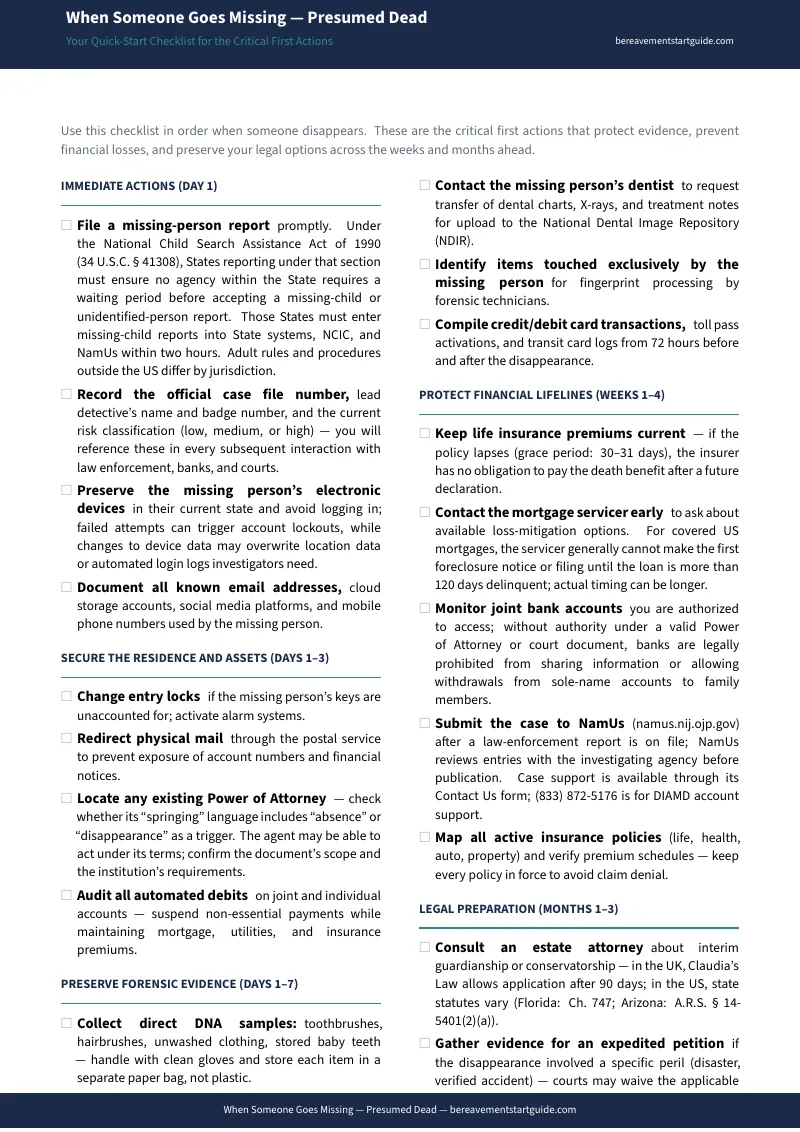
You can download the free emergency checklist right now — it covers the critical first steps for the first hours, first week, and first month after someone vanishes. When you are ready for the complete system — all fourteen chapters, every template, every script, every worksheet — the full toolkit is available for as an instant download.