You just got the worst phone call of your life. Now a foreign government wants paperwork.
An Australian family member has died in the Philippines. You're grieving, you're exhausted, and within hours you're being asked to make decisions about embalming deadlines, hospital bills you can't verify, and a funeral home you've never heard of — from the other side of the world.
The Australian Embassy will give you a list of contacts and a pamphlet. Your travel insurer wants forms you haven't obtained yet. Google returns advice written for Americans. The Philippine civil registry operates on paper, requires physical presence, and follows a legal hierarchy that doesn't recognise your de facto partner.
You need the Corridor Action System — a step-by-step framework that maps every decision, document, and deadline in the Australia-Philippines death corridor, in the exact order you'll face them.
What makes this different from Googling it
Free resources cover fragments. The embassy handles consular limits. Repatriation firms quote you PHP 350,000+ and manage only the transport. Estate lawyers address only the Australian side. No single source connects all three jurisdictions — Philippine municipal bureaucracy, international transport logistics, and Australian estate law — into one sequence that a sleep-deprived family member can follow from day one.
The Corridor Action System does. It tells you what to do at 2 AM when the hospital calls, what to do at 9 AM when the civil registry opens, and what to do six weeks later when the bank freezes the accounts.
What's inside the full guide
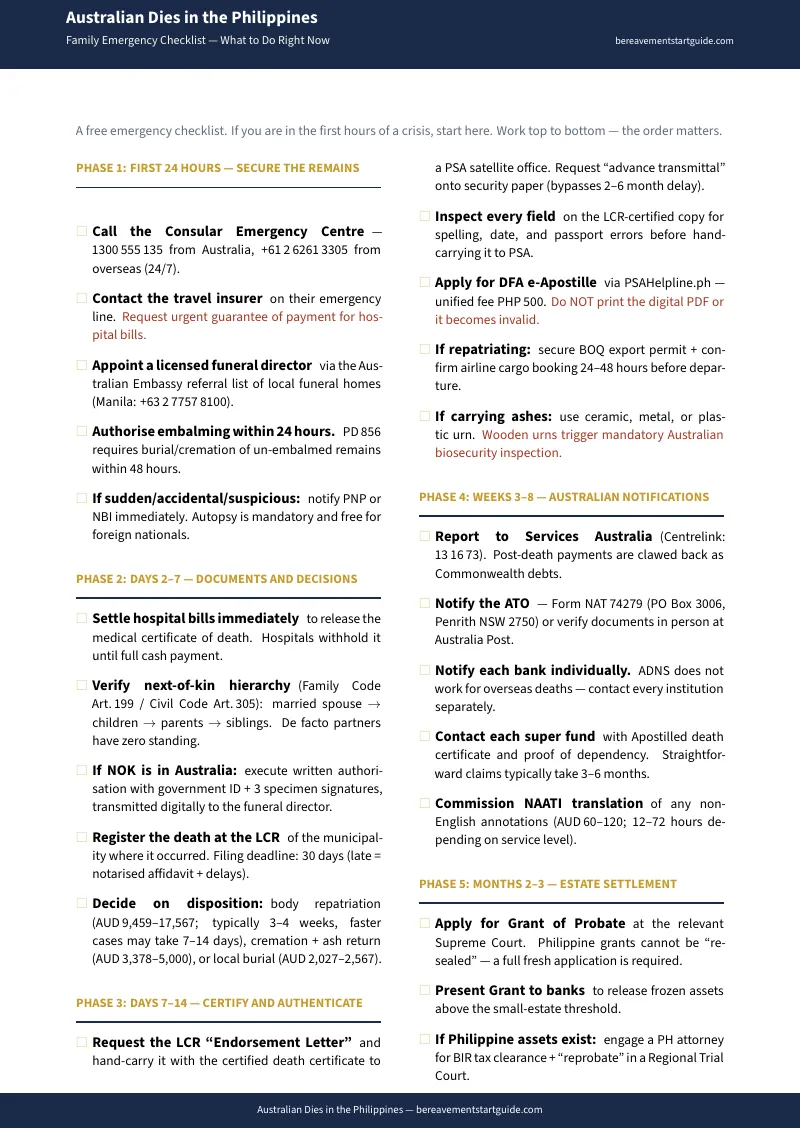
- First 72 hours — triage protocol — the exact notification sequence (embassy → insurer → funeral director → police), the 48-hour embalming deadline under PD 856, and the hospital billing strategy that prevents the single most common cause of week-long delays in this corridor
- De facto partner barrier — legal workaround — Philippine law gives unmarried partners zero signing authority over remains; the guide explains the Valino v. Adriano precedent and the Article 307 funeral-directive mechanism that overrides the default hierarchy
- Three-tier death certificate chain — LCR registration, PSA fast-track endorsement (compresses 6 months to ~2 weeks), and the fully digital DFA e-Apostille system, with portal URLs and fee breakdowns
- Repatriation cost calculator — worked examples for four disposition paths (local cremation, ash transfer, local burial, full body repatriation) with airline cargo packaging rules, X-rayable urn requirements, and DAFF biosecurity clearance procedures
- Australian estate playbook — the non-Commonwealth probate barrier (Philippine court orders cannot be resealed), state BDM registration rules (Victoria's strict evidence requirements), bank account freeze protocols, and superannuation death benefit claim timelines
- Special Power of Attorney template — ready for notarisation, covering both DFA Apostille submission and local funeral home authorisation
- Government notification checklist — every Australian agency that needs to be contacted, with required documents and processing windows
- 9 standalone printable tools — document tracking matrix, cost and payment log, agency communication log, insurance claim checklist, 90-day timeline planner, disposition decision worksheet, key contacts card, and more — each designed to print and fill in by hand at the kitchen table or the consular office
Who this is built for
- Surviving spouse or de facto partner — especially if you need to understand your legal standing before flying to the Philippines
- Adult children coordinating remotely — managing the process from Sydney, Melbourne, or Brisbane while juggling work and grief
- Executors and administrators — handling cross-border estate settlement where Philippine probate grants can't be resealed in Australian courts
- Travel companions or first responders — on the ground and unsure what to do when police and hospital staff ask for next-of-kin authorisation
Why not free tools?
The Smartraveller page tells you consular services exist. It doesn't tell you that the local civil registrar takes six months to transmit records to the PSA unless you hand-carry an endorsement letter. It doesn't mention that hospitals routinely withhold death certificates until all bills are paid in cash. It doesn't warn de facto partners that Philippine law gives them zero authority over their partner's remains.
Reddit threads contain real experience — from Americans dealing with different embassy procedures, or from Filipinos navigating domestic deaths. Neither applies to the specific regulatory combination an Australian family faces in this corridor.
Repatriation firms charge AUD 4,400 to AUD 17,000+ for the transport alone. They don't handle your Australian estate administration, superannuation claims, or bank notifications. The guide covers what they cover and everything they don't — for a fraction of a single consultation fee.
Satisfaction guarantee
Full refund, no time limit. Email hello@bereavementstartguide.com and we'll process it — no forms, no questions.
Start with the free checklist or get the complete guide
The free checklist gives you the critical first-72-hours sequence — enough to stabilise the situation and avoid the most expensive mistakes. The full guide () covers the entire corridor from the first phone call through the final probate filing, with worked cost examples, document templates, and agency contact details.
Immediate digital delivery. You'll have the guide open on your screen within minutes — which matters when the preservation clock is already running.