You're Managing a Crisis Across Two Countries — and Neither Government Will Coordinate It for You
An Australian family member has died in the United Kingdom. You're sitting in Australia, 16,000 kilometres away, trying to figure out who has custody of the body, whether you need to fly over, and which of the dozens of urgent tasks should happen first.
The UK has three separate death registration systems. The Australian consulate can offer sympathy but not much else. Your bank just froze every account. And every piece of advice you find online covers only one side of the corridor — UK procedures or Australian estate rules — never both.
The Cross-Border Emergency System — One Workflow That Covers Both Countries
The Australian Dies in the UK Family Emergency Guide maps the entire corridor in a single, sequenced workflow. It starts with the phone calls you should make in the first 72 hours and ends with closing the last Australian bank account — covering every jurisdiction-specific registration rule, document legalisation step, and financial threshold along the way.
This is not a collection of general tips. It is an operational manual built specifically for Australian families navigating a death in England, Wales, Scotland, or Northern Ireland.
What's Inside
- The First 72 Hours Notification Sequence — who to call and in what order, starting with the travel insurer (because a valid policy puts the insurer in charge of logistics, not you). Contact the wrong entity first and you can lock into an expensive repatriation path before understanding your options.
- UK Death Registration Across Three Jurisdictions — England and Wales require in-person registration within 5 days. Scotland allows remote registration by phone within 8 days. Northern Ireland allows remote registration within 5 days. The guide covers each system, including the "qualified informant" rule that stalls most families managing from Australia.
- Coronial and Procurator Fiscal Procedures — if the death was sudden, unexpected, or occurred within 24 hours of hospital admission, the coroner takes legal custody of the remains and the standard registration process halts. The guide explains how to track the investigation, obtain interim certificates, and avoid the single most expensive mistake families make: booking a repatriation flight before the coroner's Out of England Certificate (Form 103) is physically in hand.
- The Hague Apostille Document Path — Australian banks, super funds, and courts will reject photocopies, scans, solicitor-certified copies, and e-Apostilles of UK death certificates. The guide details the exact certification path through the FCDO Legalisation Office so your documents are accepted the first time.
- Repatriation vs Cremation vs Local Burial — a transparent cost and timeline comparison so the family can make this decision with facts. Full-body repatriation typically costs £4,000–£10,000 and takes 10–14 business days. UK cremation with ashes transport costs £1,595–£3,000 and the ashes can travel immediately. The guide also covers DAFF biosecurity rules — which urn materials clear Australian customs without delay and which trigger mandatory inspection.
- Australian Bank-by-Bank Thresholds — when an Australian bank learns a customer has died, it freezes all accounts. The Australian Death Notification Service does not support overseas deaths, so you must contact each bank individually. The guide details the specific dollar thresholds at NAB ($100,000), CBA (case-by-case), and Bank Australia ($50,000) that determine whether you can release funds with certified documents alone or need a formal Grant of Probate.
- Superannuation Death Benefits and Tax Optimisation — whether the payout is tax-free or taxed at up to 32% depends entirely on the relationship between the beneficiary and the deceased under ITAA 1997. The guide explains the tax-dependant vs non-tax-dependant rules and what happens when an expat dies intestate without a clear beneficiary nomination.
- The Probate Resealing Blueprint — under the Colonial Probates Act 1892, a UK Grant of Probate can be "resealed" by an Australian state Supreme Court, giving it the same legal authority as a locally issued grant. The guide covers the application process, court fee schedules, and document requirements so you can sell Australian real estate and transfer shares without starting separate probate proceedings.
Who It's For
- Australian families who have just lost someone in England, Scotland, Wales, or Northern Ireland
- Named executors managing a cross-border estate remotely from Australia
- Travel insurance case managers coordinating UK-to-Australia repatriation claims
- Funeral directors handling international cases between the UK and Australia
- Employers or institutions supporting the family of a deceased Australian worker or student
Why Not Just Google It?
The information exists — scattered across Smartraveller, GOV.UK, National Records of Scotland, GRONI, individual bank bereavement pages, ATO rulings, and state Supreme Court websites. The problem is not access to information. The problem is that none of these sources reference each other, none of them tell you what order to do things in, and getting the sequence wrong costs real money and real time.
Booking a repatriation flight before the coroner signs Form 103 means the airline charges a rebooking fee and the coroner's office accepts no liability. Sending a photocopied death certificate to NAB instead of a GRO-issued certified copy with a paper Apostille means a rejection letter and a six-week delay. Paying a cross-border attorney to explain the probate resealing process costs hundreds of dollars per hour for information this guide delivers in a single chapter.
The guide puts the entire corridor in one document, in sequence, with the cross-references already done — so you are not piecing together a process from twenty different websites while operating under grief and time pressure.
Your Purchase Is Protected
Full refund, no time limit. If the guide is not what you expected, email hello@bereavementstartguide.com and we will process your refund — no forms, no questions.
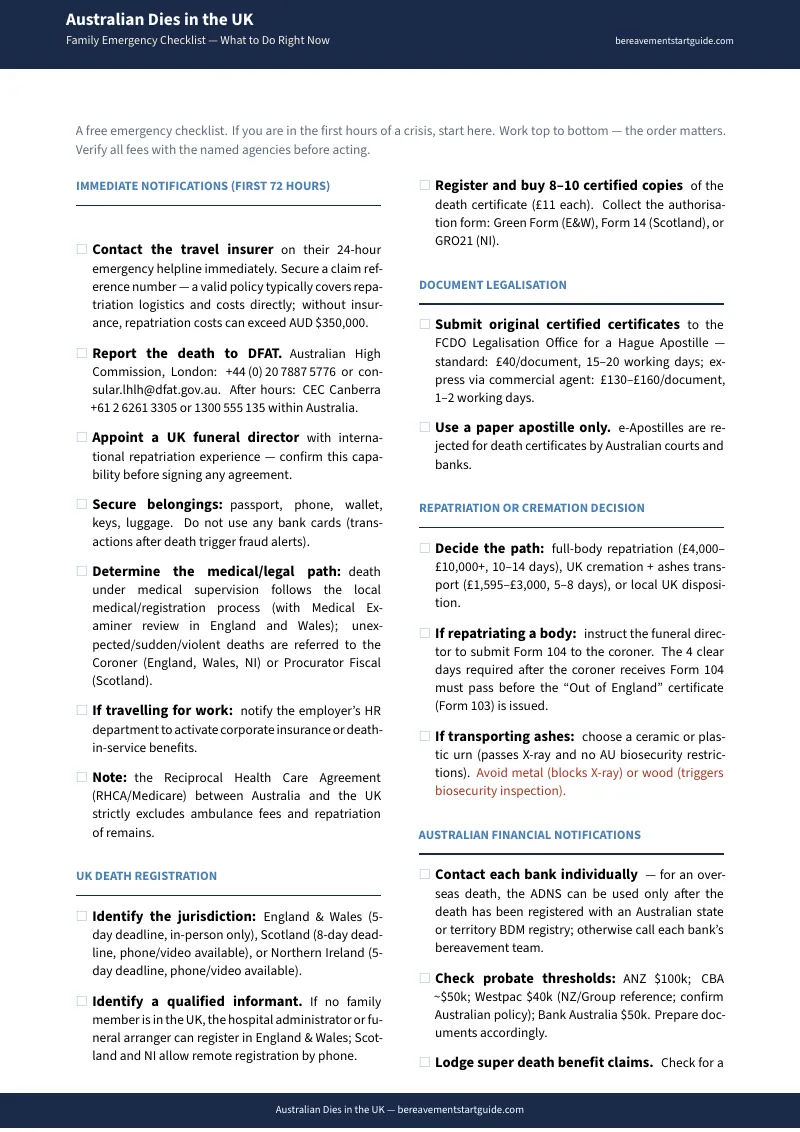
You also get the free emergency checklist — a printable two-page summary of every action item, deadline, and phone number — whether or not you purchase the full guide.
Download the free checklist now, or get the complete guide to handle the entire UK-to-Australia corridor with confidence.