You just got the worst phone call of your life — and now two countries' bureaucracies want paperwork.
A Canadian citizen has died in the United States. Someone in your family — maybe you — needs to figure out how to bring them home, access frozen bank accounts, file for benefits across two countries, and navigate a legal process that involves county coroners, state vital records offices, airline cargo departments, the Canada Border Services Agency, and the IRS.
There is no single government office that handles this. Global Affairs Canada will give you a list of funeral homes. Your travel insurer will give you a claims checklist. The US funeral director will give you a price sheet. None of them will give you the full picture — the chronological sequence of decisions that determines whether this process takes five days or five weeks, whether insurance pays or denies, and whether the estate settles cleanly or locks up for two years.
The Cross-Border Repatriation System
This guide is built around a single principle: the order of your first six phone calls determines everything that follows. Call the funeral home before the insurer, and you risk voiding your coverage. Sign a contract before the coroner releases the body, and you are committed to arrangements you may not be able to afford. Order one death certificate instead of ten, and you will spend months waiting for documents that every Canadian institution needs simultaneously.
The Cross-Border Repatriation System maps the entire process from the initial notification through Canadian estate settlement — in chronological order, with the dependencies made explicit, so you never make an expensive decision without understanding what it commits you to downstream.
What's Inside
- The 6-Call Sequence — the exact order of notifications that protects your insurance claim and prevents the most common $5,000–$10,000 CAD mistakes families make in the first 48 hours
- US Death Certificate Playbook — how the state-level vital records system works, why you need 8–10 certified copies, and how to order them remotely from Canada (including state-specific access restrictions in California, Florida, Arizona, and others)
- Apostille Fast-Track Guide — the simplified Hague Convention process that replaced the old multi-step legalization system in January 2024, with processing times and fees for every state where Canadian deaths commonly occur
- Repatriation vs. Local Cremation Decision Framework — a side-by-side comparison with real cost ranges, so you can make the repatriation-or-cremation decision with numbers instead of pressure from a funeral home with a financial interest in the answer
- Airline Cargo and CBSA Requirements — everything the sending funeral home should know but might not tell you, including container specifications, Known Shipper registration, and the reason metal or stone urns will be rejected at airport security
- Insurance Claims Roadmap — travel insurance, credit card coverage, and employer group policies explained in plain language, including the notification deadlines and documentation requirements that protect your claim
- Canadian Estate Settlement Sequence — notifying banks, accessing frozen accounts for funeral expenses, provincial probate filing, and the CPP death benefit (including the 2025 top-up rules)
- US Estate Tax Obligations — IRS Form 706-NA requirements for Canadian estates with US-situated assets above $60,000 USD, and the 12–24 month processing timeline that freezes those assets
- Two Worked Cost Examples — a full-body air repatriation from Florida and a local direct cremation in Arizona, with itemized breakdowns you can use to verify quotes from funeral homes and cargo brokers
- Coroner and Medical Examiner Holds — what triggers an investigation, how to obtain a "pending cause" certificate to proceed with arrangements while waiting for toxicology, and how to communicate with the coroner's office from Canada
- 7 Printable Planning Tools — emergency contact log, document tracker, repatriation decision worksheet, insurance claim tracker, Canadian estate notification tracker, US estate tax threshold calculator, and a key contacts reference card — all designed to print and fill in as you work through the process
Who This Is For
You are the spouse, adult child, sibling, or executor. A Canadian citizen has died — or is dying — in the United States. You need to make decisions this week that will affect the next six to eighteen months of paperwork, costs, and legal proceedings. You do not have time to read 14 government websites, call six agencies to ask the same question, and piece together a process that no single source explains end to end.
This guide also serves as a standard reference for travel insurance case managers, corporate HR teams, and university administrators who need a structured handoff document when a Canadian employee, student, or client dies in the US.
Why Not Free Resources?
The information exists — scattered across Global Affairs Canada bulletins, state vital records websites, IRS publications, CBSA memoranda, and airline cargo policy pages. None of these sources talk to each other. The government portal tells you to "contact a funeral home" but does not explain that contacting a funeral home before your travel insurer can void your coverage. The funeral home tells you to authorize embalming but does not explain that cremation in the US costs a fraction of repatriation and that you can carry the ashes home yourself.
Free resources give you fragments. This guide gives you the sequence — and the sequence is what prevents the $5,000 to $15,000 CAD mistakes that families make when they follow the fragments in the wrong order.
The Free Checklist vs. The Full Guide
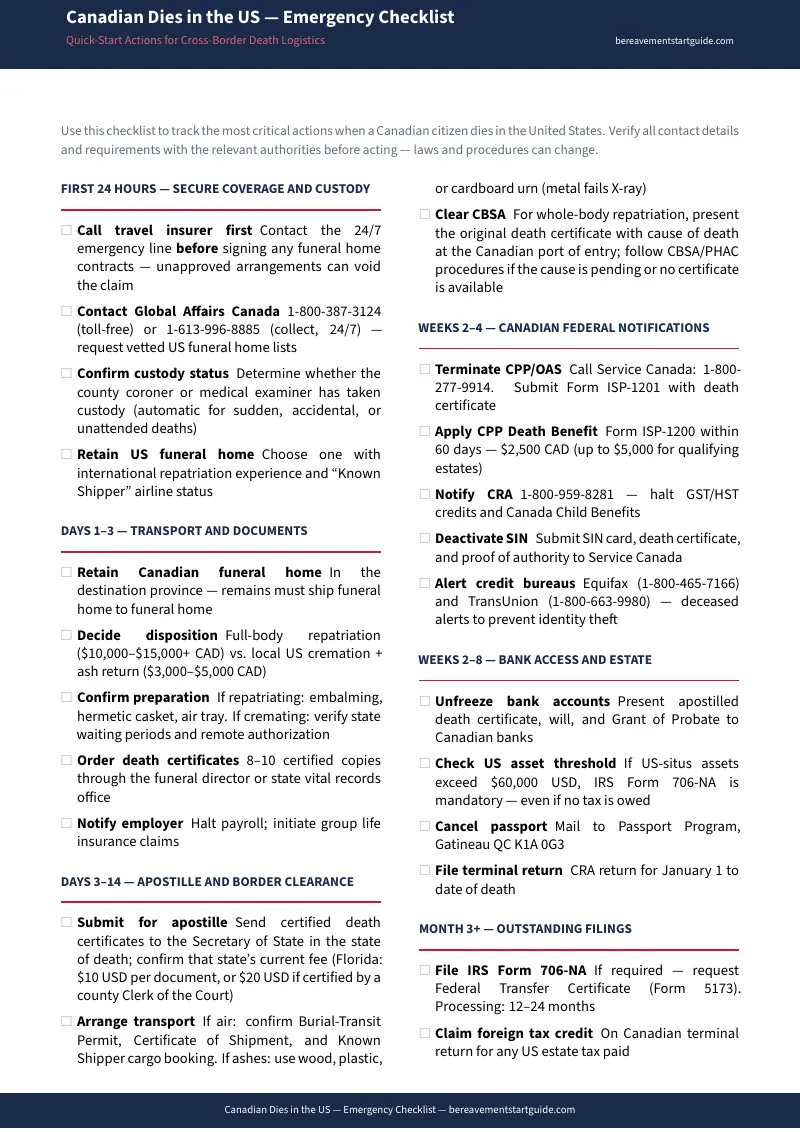
The free emergency checklist gives you the task list — every action item, in order, that needs to happen from the day of death through Canadian estate settlement. It is a one-page reference designed to keep you on track during the most overwhelming week of your life.
The full guide explains how to execute each step — the phone scripts, the cost comparisons, the state-specific requirements, the insurance claim strategies, and the financial planning tools that turn a checklist item into a completed task. If the checklist tells you "order certified death certificates," the guide tells you how many, from which office, what access restrictions apply in that state, how to request them from Canada, and why ordering too few will delay everything downstream by weeks.
Satisfaction Guarantee
If the guide does not give you a clear, actionable path through the cross-border process — or if your circumstances change and you no longer need it — email hello@bereavementstartguide.com for a full refund, no time limit. We read every message and respond within one business day.
Your family is dealing with enough uncertainty right now. The logistics should not be one of them.
The free checklist is yours immediately — download it, start checking off the first three items tonight, and see whether the structure helps. When you are ready for the full system — the scripts, the cost frameworks, the state-by-state details, and the estate settlement roadmap — the complete guide is waiting at .