When Someone You Love Dies 14,000 Kilometres Away
You're in China. A phone call arrives from Australia — a hospital, a police officer, a university administrator — and everything changes. Your family member is gone, and you're staring at a foreign legal system that expects you to act immediately across a two-to-three-hour time-zone difference.
Australian state coroners hold bodies indefinitely during investigations. Bank accounts freeze the moment a death is reported. Every document you need must be authenticated through a process most families have never heard of. And back in China, you have 30 days to cancel the Hukou at the local police station before domestic estate distributions lock up too.
One wrong step — apostilling a translation before the original, ordering too few death certificates, missing a travel insurance pre-approval call — and you lose weeks you cannot get back.
The Cross-Border Bereavement Navigator
This is not a pamphlet of general advice. The Cross-Border Bereavement Navigator is a sequenced, step-by-step system built for the specific Australia-to-China corridor — covering Australian state-level procedures, the Hague Apostille pipeline, Chinese civil requirements, and the financial processes that connect them.
Where government portals give you static legal language and funeral homes give you a quote, this guide gives you the order — what to do first, what depends on what, and exactly which documents each institution requires before they will release a body, unlock an account, or accept a death registration.
What's Inside the Guide
- The first 72 hours protocol — who to notify (insurer, employer, consulate, tour operator), how to appoint a funeral director remotely, and what the Chinese consular mission can actually do for you versus what it cannot
- State-by-state death registration — BDM timelines, costs, and restrictions for NSW, Victoria, Queensland, and Western Australia, so you know exactly how long your jurisdiction takes
- The Hague Apostille workflow — the post-November 2023 process that eliminated consular legalization, including how to bypass DFAT's six-week appointment backlog through registered mail or express agencies that complete it in 2–4 business days
- Translation sequencing that Chinese authorities actually accept — the exact order for NAATI-certified translations, because getting the sequence wrong means Chinese PSBs and banks reject your entire document package
- Full-body repatriation logistics — embalming certificates, zinc-lined export caskets, Public Health Unit transit certificates, airline cargo booking requirements, and a cost breakdown ($12,000–$22,000 USD) so nothing surprises you
- The ashes carriage alternative — X-ray-compatible urn requirements, the consular Certificate of Carriage of Ashes (骨灰携带证明), Chinese customs declaration procedures, and a cost comparison ($5,000–$9,500 AUD) that helps you make the right choice for your family
- Frozen bank account release letters — how to access up to $15,000 AUD in funeral-expense releases from the deceased's accounts before probate, and when you need a Grant of Probate or Letters of Administration for amounts above $100,000 AUD
- Superannuation, workplace insurance, and WorkSafe claims — including the $15,230 AUD repatriation reimbursement cap for accepted workplace deaths in Victoria
- Hukou cancellation within the 30-day deadline — which documents the PSB requires, how to present apostilled Australian death certificates to Chinese authorities, and how to settle bank accounts and property transfers in China
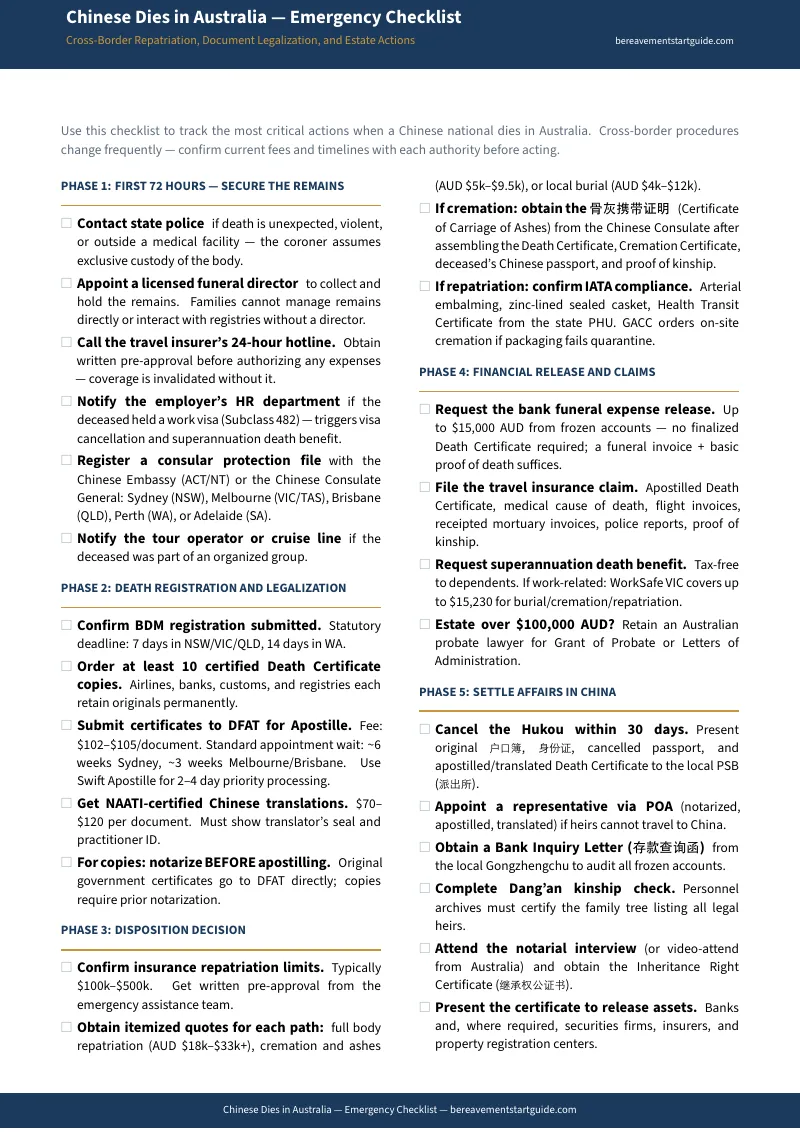
Plus the Emergency Checklist and 7 Printable Planning Tools
A printable, phase-by-phase action list covering every deadline and document requirement across both countries — from the first phone call through final estate settlement in China. Check items off as you complete them so nothing falls through the cracks during the most difficult weeks of your life.
You also receive seven standalone worksheets and trackers designed to be printed and filled in as you work through the process: a 72-hour emergency action checklist, a disposition decision worksheet for comparing repatriation, cremation, and local burial costs side by side, a document legalization tracker for the Apostille pipeline, an ashes carry-on flight checklist, a bank release request log, a Chinese estate administration timeline covering Hukou cancellation through asset release, and an agency communication log for recording every call and submission.
Who This Guide Is For
- Family in China — adult children, spouses, or siblings coordinating an Australian death remotely, often across language barriers and time zones
- A relative on the ground in Australia — a spouse on a dependent visa or a family member who flew in and is navigating unfamiliar institutions alone
- Executors managing cross-border estates — frozen Australian bank accounts, superannuation, dual-jurisdiction wills, and probate thresholds
- Travel insurance case managers and university international offices — professionals who need a structured, verified workflow to coordinate repatriation and family support efficiently
Why Not Just Search Online?
You could spend weeks piecing together information from Australian government portals, Chinese embassy notices, WeChat posts, and Reddit threads. Some of that information is accurate. Much of it is outdated — especially anything referencing the pre-November 2023 consular legalization process that no longer exists.
The real problem is not finding information. It is finding the sequence. Government portals tell you what documents they need but not which agency you must visit first, or that a translation done after the Apostille will be rejected, or that ordering fewer than ten death certificates will leave you unable to submit to multiple agencies simultaneously.
This guide was built for the specific Australia-to-China corridor. Every cost, timeline, and procedural step reflects the current Hague Convention framework and 2026 state registry rules. It connects the dots between Australian and Chinese systems so you do not have to figure out the dependencies yourself during the worst week of your life.
Full Refund, No Time Limit
If any template, checklist, or procedural sequence in this guide is rejected by an Australian bank, court, registry, or Chinese PSB, email us at hello@bereavementstartguide.com for an immediate, full refund. No time limit, no questions.
You also receive the free emergency checklist when you enter your email — a one-page printable covering the essential first steps, so you can begin immediately while deciding whether the full guide is right for your situation.
Get the full guide and start working through the process today. The checklist tells you what to do. The guide shows you how — with every document, cost, timeline, and institutional requirement in the correct sequence for the Australia-to-China corridor.
Price: