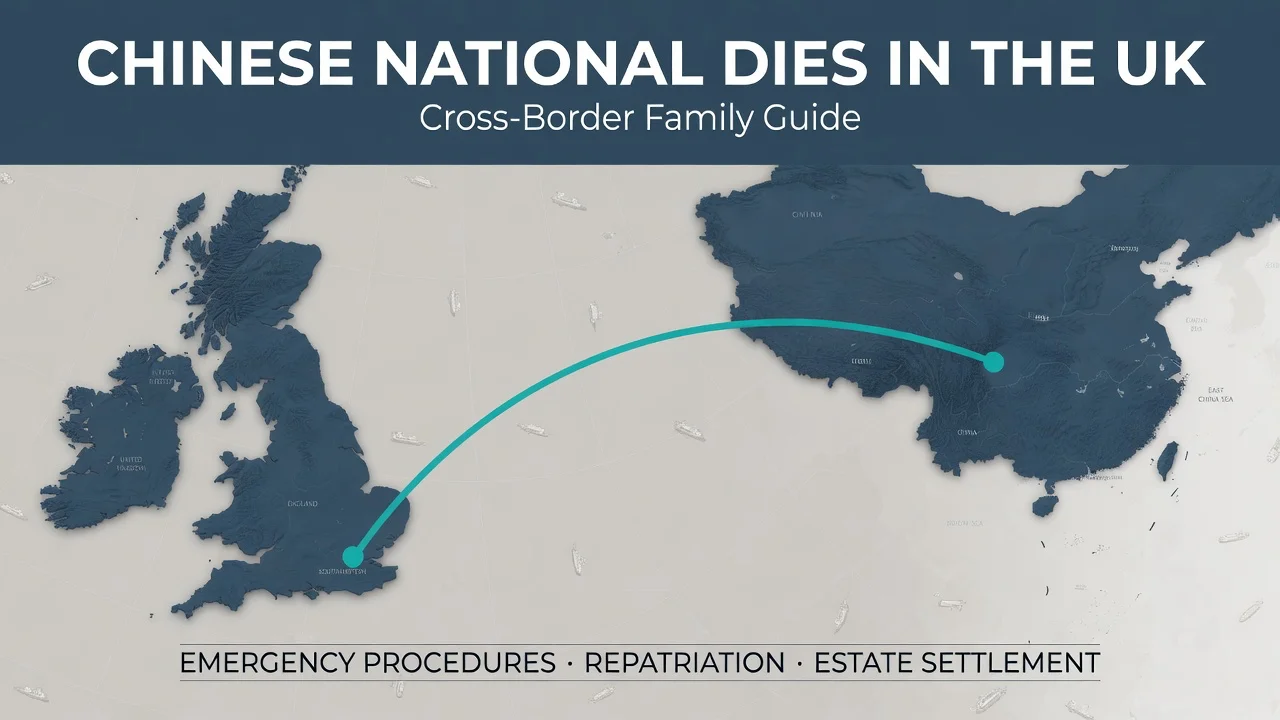
Two Countries. Two Legal Systems. One Family Trying to Bring Someone Home.
When a Chinese national dies in the United Kingdom, the family doesn't just face grief — they face a bureaucratic maze that stretches across two countries with completely different legal traditions, different languages, and a seven-hour time difference separating them from the people who need to make decisions.
The coroner has the body. The bank has frozen the accounts. The clock is running on Hukou cancellation back in China. And every Google search returns a different answer — some of it outdated by years, some of it from funeral directors selling £5,000 repatriation packages, and none of it in a sequence that tells you what to do first.
The Cross-Border Bereavement Navigator
This is the resource that doesn't exist anywhere else: a single, chronological guide that covers both the UK administrative process and the Chinese civil procedures, in the order you'll actually face them. Not a collection of government pamphlets stitched together. Not a funeral director's FAQ designed to funnel you toward their most expensive service. A neutral, step-by-step system built for families who need to coordinate across borders under impossible time pressure.
What Makes This Different from Free Resources
Government portals (GOV.UK, the Chinese Embassy) give you accurate fragments — but they're written for institutions, not for a family member in Guangzhou who just received the worst phone call of their life at 3 a.m. Repatriation companies give you a quote, not a decision framework. WeChat groups and Xiaohongshu posts share real experiences, but they're disorganised, often contradictory, and frequently repeat pre-November 2023 consular legalisation rules that no longer apply.
The Cross-Border Bereavement Navigator closes these gaps:
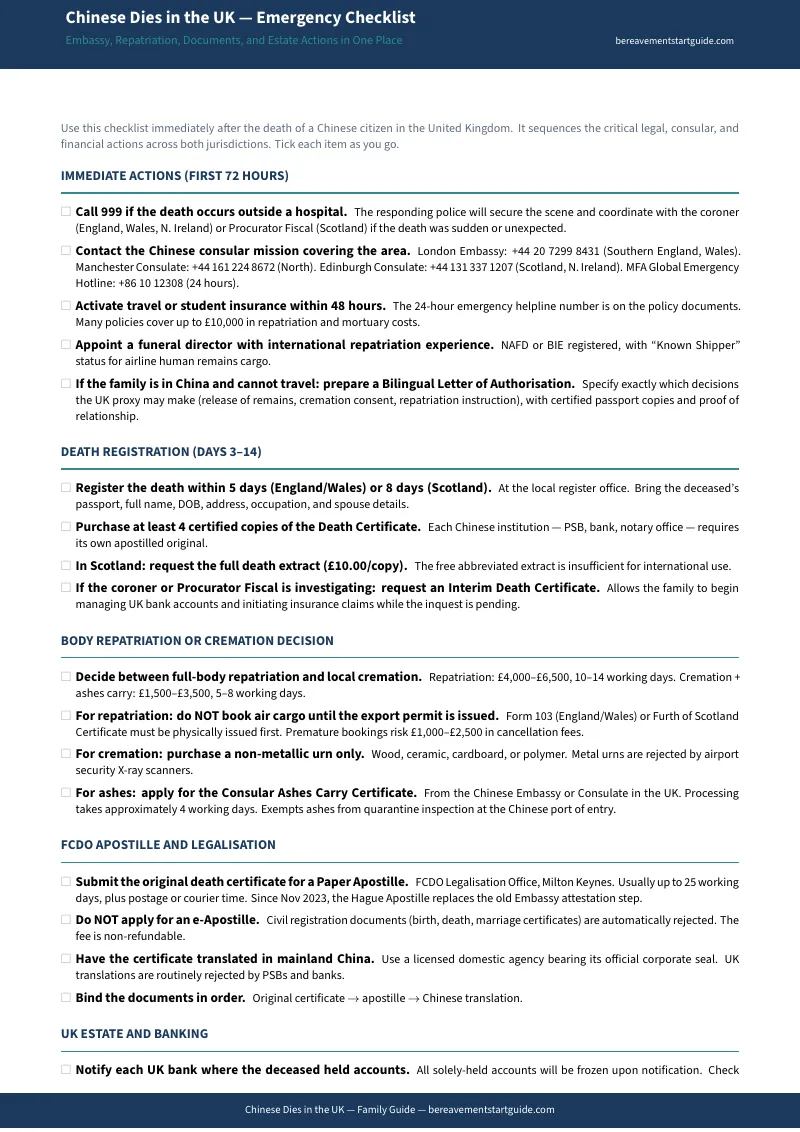
- Jurisdiction-specific procedures — the guide separates England/Wales (Coroner → Form 103) from Scotland (Procurator Fiscal → Furth of Scotland letter), because filing the wrong form wastes days you don't have
- The repatriation decision engine — a side-by-side comparison of full body repatriation (£4,000–£6,500) versus direct cremation and ashes carry (£1,500–£3,500), including airline-specific urn requirements so you don't arrive at Heathrow with a metal urn that security will refuse to clear
- Post-2023 Hague Apostille workflow — the exact FCDO submission process, plus why local Chinese PSBs still reject e-Apostilles and how to avoid the double-translation trap that costs families hundreds of pounds in wasted fees
- Bank-by-bank Small Estates thresholds — Barclays (£50,000), Lloyds (£25,000/£50,000), NatWest (£50,000), HSBC (case-by-case) — with the specific remote closure procedures each bank accepts from overseas executors
- China-side estate settlement — the 30-day Hukou cancellation deadline, the Inheritance Notarisation Certificate process for frozen bank accounts, and what happens to WeChat Pay and Alipay balances tied to the deceased's identity
- Remote coordination protocol — bilingual Letter of Authorisation templates for delegating decision-making power to a UK-based proxy, so family members in China can manage the process without an emergency visa application
Who This Is For
- Family members in mainland China who need to coordinate the UK process remotely — you're managing this from thousands of miles away, possibly without a UK visa, and you need every step in sequence
- Spouses or companions already in the UK who are dealing with hospitals, mortuaries, and registrars while managing their own immigration status and grief
- University student support teams and corporate HR departments who need a neutral, step-by-step handoff guide when a Chinese student or employee's family is in crisis
- Travel insurance case managers who need to understand the document chain before authorising repatriation or cremation claims
Why Free Tools Fall Short
Free online advice for this corridor has three consistent problems:
It's fragmented. GOV.UK tells you how to register a death. The Chinese Embassy website tells you about consular assistance. Repatriation companies explain their cargo process. No single source connects these into the sequence a family actually needs to follow — and getting the sequence wrong (booking air cargo before the coroner issues Form 103, for example) doesn't just delay things. It can void your insurance claim.
It's outdated. China's accession to the Hague Apostille Convention in November 2023 fundamentally changed how UK death certificates are legalised for Chinese use. Forum posts and WeChat guides still describe the old multi-step embassy legalisation process. Following those instructions wastes weeks and money on a procedure that no longer exists.
It's biased. Most detailed repatriation information comes from companies selling £4,000+ transport packages. They rarely mention that direct cremation plus personally carrying ashes home costs a fraction of that price and avoids the GACC quarantine pre-declaration entirely. This guide is independent — no funeral home affiliation, no service referrals, no hidden upsells.
Satisfaction Guarantee
If the guide doesn't deliver what you need, contact us for a full refund — no time limit, no questions, no forms. Email hello@bereavementstartguide.com and we'll process it promptly.
This guide is an independent resource. It is not affiliated with any government agency, funeral home, or repatriation company. All procedures and thresholds are current as of 2026.
Get Started Now
Download the free emergency checklist to get the critical first-72-hours action items immediately. When you're ready for the complete cross-border process — from hospital release through China-side estate settlement — the full guide is waiting at .