Your family just got a phone call from Saudi Arabia. Now what?
Someone you love — a brother, a daughter, a parent — has died while working in the Kingdom. The embassy will confirm the death and stamp a certificate. But between that phone call and the moment the casket arrives home, there are 25 sequenced administrative actions across two countries, three government ministries, and a sponsor who controls the entire Saudi side of the process.
Miss one step — or execute them out of order — and you lose weeks. The Saudi government mortuary charges daily cold-storage fees. The sponsor quietly arranges a local burial without your consent. The GOSI survivor pension claim window ticks down. And the Arabic death certificate that took a month to obtain gets rejected by Ethiopian or Eritrean banks because one stage of the four-stage consular legalisation chain was skipped.
Free resources exist. The embassy website lists requirements. Diaspora Facebook groups share fragments of advice. But none of them sequence the full corridor — from the Saudi police report to the final estate filing in Addis Ababa or Asmara — in the order you actually need to execute it, with the exact documents, offices, and phone numbers for each step.
The Corridor Crisis Navigator — built for this exact emergency
The Ethiopian/Eritrean Dies in Saudi Arabia — Family Guide is a complete crisis management manual for the Horn of Africa–Saudi Arabia death corridor. It covers what happens at the Saudi hospital, the police station, the sponsor's office, the Ethiopian or Eritrean embassy, the Ministry of Foreign Affairs in Riyadh, GOSI headquarters, Saudia Cargo, and the civil registries in Addis Ababa and Asmara — in chronological order, with decision trees for every fork in the path.
This is not a generic "death abroad" pamphlet. It is built specifically for the Ethiopian and Eritrean corridor — the Kafala system dynamics, the non-Apostille legalisation chain that only affects countries outside the Hague Convention, the GOSI occupational hazards branch that covers registered migrant workers, and the blood money (diyya) claims process in Saudi Sharia courts.
What the guide covers
- 72-hour crisis stabilisation protocol — exactly who to call, in what order, and what to say to the sponsor, the hospital, the police, and the embassy in the first three days
- Kafala system navigation — the sponsor holds the administrative keys to the death certificate, final exit visa, and body release. The guide maps the clearance sequence the sponsor must run — hospital or police report, Civil Affairs death certificate, police export letter, Jawazat exit visa, embalming, consular export permit, cargo booking — and what to do when the sponsor stalls, refuses, or pressures you for local burial
- Sponsor dispute resolution — the escalation ladder from embassy intervention to labour office complaint to formal legal action, with the statutory citations that obligate the employer to fund repatriation
- The four-stage consular legalisation chain — neither Ethiopia nor Eritrea is party to the Hague Apostille Convention, so every document must pass through a Ministry of Justice–licensed Arabic translation → Saudi MOFA attestation → embassy consular legalisation → domestic MOFA authentication in Addis Ababa or Asmara, in that exact order, before your home country's institutions will accept it
- Repatriation logistics — embalming at government-approved mortuaries (King Saud Medical Complex, King Fahd Hospital), zinc-lined casket specifications, the embalming certificate (Shahadathul Thahneeth), and air waybill booking with Saudia Cargo and Ethiopian Airlines
- Repatriation vs. local burial decision framework — the religious, cultural, financial, and administrative dimensions of each option, structured so you make this decision with full information rather than under employer pressure
- GOSI survivor benefits — eligibility criteria, the pension pool calculation, the one-time death grant (up to SAR 10,000), the online portal navigation with its Arabic-language and SMS verification barriers, and the occupational hazards branch for workplace accident deaths
- Blood money (diyya) claims — when a third party is liable for the death, the embassy files a lawsuit in Saudi Sharia courts on your behalf using a legalised Power of Attorney. The guide covers the claims process, documentation requirements, and realistic timelines
- End-of-Service Benefit recovery — the employer's legal obligation to pay outstanding wages, accrued leave, and the ESB. When the employer withholds these during repatriation, the guide shows the enforcement mechanisms
- Unnatural and investigatory deaths — what happens when the CID opens a forensic investigation, how long mortuary holds typically last, and the separate administrative track for deaths involving state execution, border-crossing casualties, or custodial neglect
- Post-repatriation estate settlement — the domestic legalisation process in Ethiopia or Eritrea, from Ministry of Foreign Affairs authentication to filing with local courts, banks, and land registries
- Corridor cost breakdown — standard repatriation runs $2,130–$6,000 (SR 8,000–22,500), itemised by component (embalming and zinc-lined casket, translation, air freight, ground transport), so you know what each service should cost before anyone quotes you
- Six fillable worksheets — Emergency Contact Sheet, Document Tracking Checklist, Sponsor Communication Log, EOSB Calculation Worksheet, Repatriation vs. Local Burial Decision Guide, and Cost Estimation Worksheet, each a printable form you write on
Who this guide is for
- Immediate next-of-kin in Addis Ababa, Asmara, or the rural provinces — coordinating the crisis remotely while the body is held in a Saudi government mortuary
- Diaspora relatives in Washington D.C., Columbus, Toronto, London, or Jeddah acting as the financial and logistical coordinator through church networks, community associations, or crowdfunding
- Fellow workers in Saudi Arabia who need to stabilise the situation on the ground before the legal next-of-kin can act from home
- Families facing sponsor pressure for local burial, who need documented statutory citations to enforce the employer's repatriation obligation
- Families of workers in huroob status navigating the additional immigration-penalty clearances when the standard employer-funded pathway is unavailable
- Churches, mosques, and diaspora associations organising community fundraisers and needing a definitive operational checklist
- Foreign employment agencies in Addis Ababa and Asmara managing client obligations under bilateral labour agreements
Why free resources aren't enough for this corridor
Government websites list requirements. They do not sequence them. The Ethiopian Embassy in Riyadh publishes general consular guidance, but it does not map the Kafala clearance chain, explain the non-Apostille legalisation sequence, or walk you through the GOSI online portal's Arabic-language interface. Diaspora Facebook groups share fragments of experience, but advice that worked for a natural death in a hospital does not apply to a workplace accident that triggered a CID investigation.
Commercial repatriation firms handle the logistics — casket, embalming, air freight — for $2,000 to $4,000 in professional fees on top of direct costs. They do not help you recover the GOSI survivor pension, the outstanding End-of-Service Benefit, or the blood money claim that could be worth more than the repatriation itself.
This guide covers the entire corridor end-to-end: the crisis stabilisation, the administrative sequence, the financial recovery, and the estate settlement — in one document, in chronological order, with the exact offices, phone numbers, and document requirements for each step.
Satisfaction guarantee
Full refund, no time limit. If the guide does not help you navigate this crisis, email hello@bereavementstartguide.com and we will refund your purchase in full.
Get the guide now
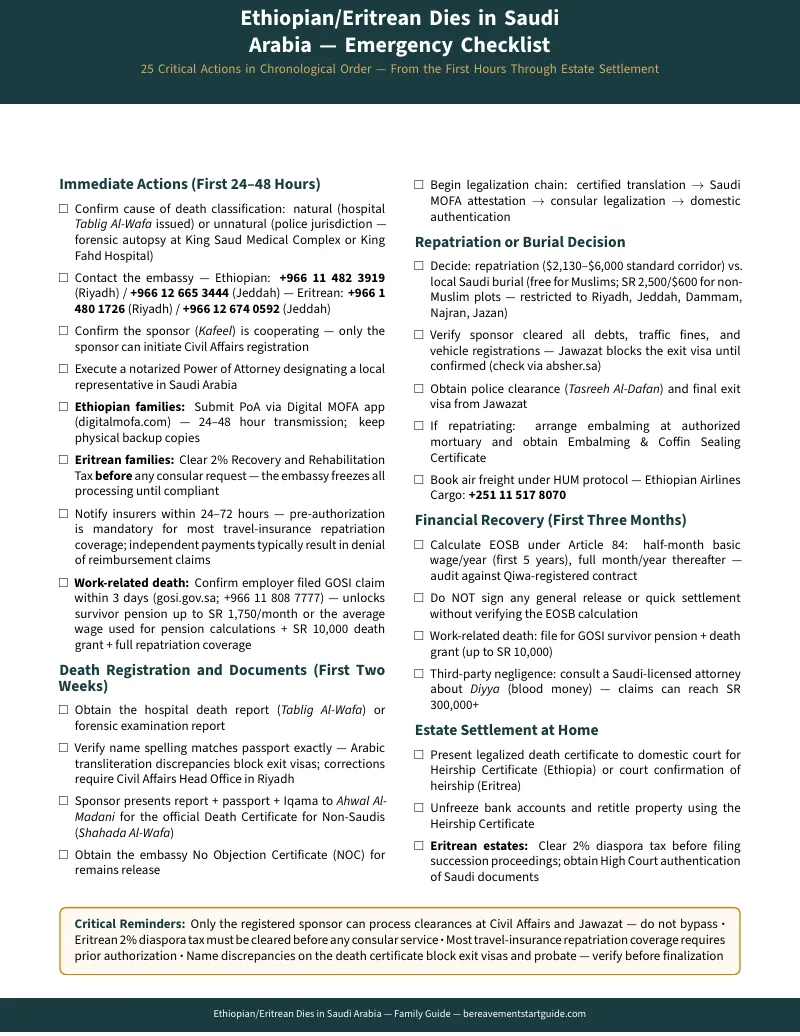
The free emergency checklist covers the critical first steps. The full guide covers the entire corridor — Kafala navigation, legalisation chain, GOSI claims, blood money, employer liability, and estate settlement.
Full Guide: — instant download, printable PDF, 43 pages.
Free Checklist: 25-item emergency checklist covering the first 72 hours — yours free, no payment required.