Your Family Member Died in the UAE. The Clock Is Running in Two Countries — and Neither One Pauses for Grief.
Right now, the remains are in a government mortuary. The UAE health authority needs a death certificate application through the correct emirate portal — Abu Dhabi's TAMM, Dubai Health, or Emirates Health Services — and each one has different fees, different digital requirements, and different physical offices. The employer has already begun the visa cancellation that will freeze every bank account tied to the deceased. And the Indian Embassy won't issue the No Objection Certificate that unlocks repatriation until they receive the original passport, an attested death certificate, and a sponsor letter with the exact dues-and-drawn statement.
If you're coordinating this from India, you're navigating Arabic-language portals, unfamiliar government offices, and a document sequence where one missing stamp halts everything downstream. If you're in the UAE, you're managing mortuary visits, police clearances, and consular appointments while dealing with immediate financial pressures — frozen accounts, employer gratuity disputes, and dependent visa deadlines that started counting the moment the sponsor died.
The Cross-Border Document Sequencer
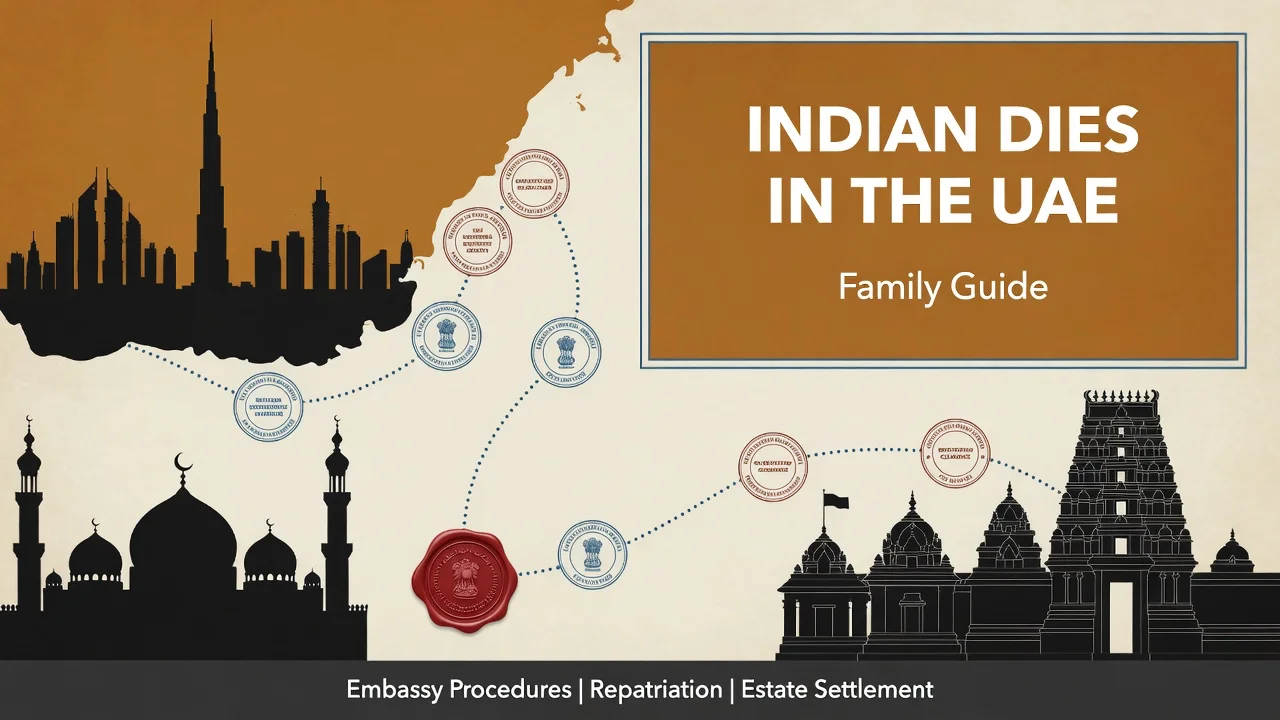
This is the Indian Dies in the UAE — Family Guide — a complete emergency manual built around the one thing no government website, expat forum, or funeral logistics company will give you: the exact document-by-document sequence that connects the UAE police and health authority pipeline to the Indian consular registration, eCARe health clearance, and estate settlement system.
Every step in this corridor depends on the previous one. The health authority won't register the death without police stamps. The Ministry of Foreign Affairs won't attest the certificate without the health authority's original. The Indian consulate won't cancel the passport or issue the NOC without the attested certificate. India's eCARe portal won't grant repatriation clearance without the cancelled passport, the consular NOC, and the embalming certificate. And no Indian bank, insurance company, or EPFO office will process a claim without a legalized UAE death certificate that has passed through all three attestation stages.
This guide maps the entire chain, step by step, office by office, stamp by stamp — so you know what's next, what you're waiting for, and what to bring when you get there.
What You Get
- The First 48 Hours Playbook — whether the death happened in a hospital or outside it, the guide tells you exactly which authority takes jurisdiction, who to call at the Indian Embassy (+971-56-4038863) or CGI Dubai 24/7 emergency line (+971-50-7347676), and how to secure the police NOC that unlocks everything downstream
- Emirate-Specific Death Certificate Workflows — Abu Dhabi (TAMM portal with integrated MoFA attestation), Dubai (DHA portal with pickup at government hospitals), and Northern Emirates (EHS Birth and Death Portal) each have completely different systems — the guide covers all three so you don't lose days applying through the wrong one
- The Full Document Pipeline — a step-by-step map from hospital or police station through health authority, MoFA attestation (AED 300), Indian consular death registration, passport cancellation, and the three-stage legalization chain that makes UAE documents valid in Indian courts
- eCARe Portal Walkthrough — India's e-Clearance for Afterlife Remains system requires high-resolution color scans (no black-and-white), specific file formats (PDF/JPEG/PNG under 512 MB), simple alphanumeric filenames, and registration using your own passport (the system blocks the deceased's passport number) — the guide walks through every screen with the exact upload requirements
- Repatriation Cost Breakdown — transparent AED-by-AED costs: Air India flat cargo rate (AED 1,500 adult / AED 750 child), embalming (AED 1,000–2,000), zinc-lined casket (AED 1,840–4,500), and Dubai Health's repatriation package (AED 3,132.50) — plus a side-by-side comparison with local cremation at Jebel Ali (AED 9,000–15,000 with full Hindu rituals) and carrying ashes home (X-ray-compliant urn materials, consular wax seal procedure)
- Bank Freeze Survival Guide — UAE banks freeze accounts the moment they receive formal death notification; the guide covers how freezes work across sole and joint accounts, the employer gratuity deposit that lands in a frozen account, and the court-ordered Succession Certificate process that unfreezes them
- Dependent Visa Crisis Management — the sponsor's visa cancellation triggers cascading deadlines for spouses, children, and domestic workers — the guide covers the process through GDRFA (Dubai) or ICP (Abu Dhabi and Northern Emirates) and how to avoid overstay fines while managing bereavement
- EPFO Claims Strategy — file Form 20 (PF withdrawal), Form 10D (pension), and Form 5IF (EDLI insurance up to ₹7,00,000) simultaneously, not sequentially — the guide explains why sequential filing costs months of unnecessary delay and provides the complete document checklist for each claim
- Indian Insurance and Bank Claims — step-by-step filing for HDFC Life, ICICI Prudential, and other Indian insurance providers (with the specific foreign documentation they require), plus bank account claims with and without nominees — including the difference between a Legal Heir Certificate (2–6 weeks) and a Succession Certificate (5–8 months)
- Estate Settlement Across Both Countries — UAE probate through DIFC Courts or local courts, Indian property transfer via Probate or Letters of Administration, and how to execute a Power of Attorney at the consulate so a trusted relative in India can handle court proceedings without you flying back for every hearing
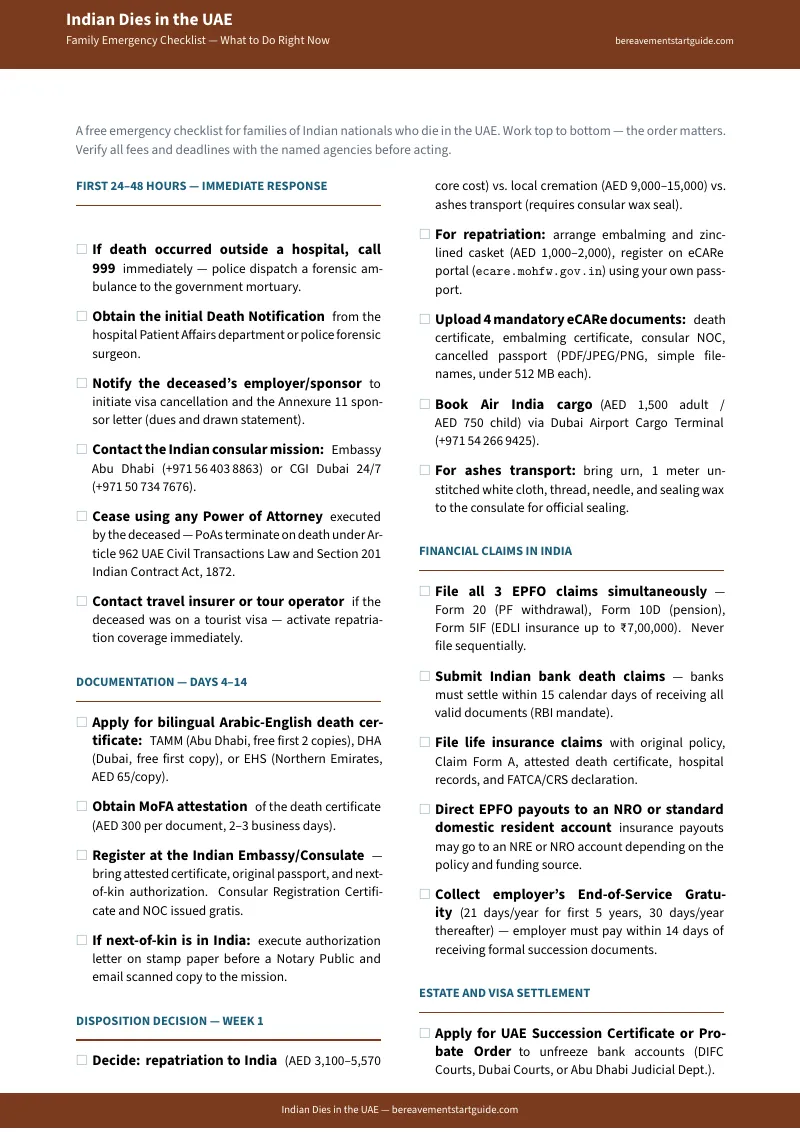
You also receive the emergency checklist — a printable 26-item action list covering every deadline, document, and office across both countries — plus five standalone planning worksheets: an emergency contact and notification tracker, a document collection checklist, an Indian financial claims tracker, a cost and payment log, and a repatriation vs. cremation vs. ashes decision worksheet.
Who This Guide Is For
- Family in India coordinating a UAE death remotely — navigating Arabic-language bureaucracies, unfamiliar government portals, and a document sequence that halts if one stamp is missing
- The surviving spouse or family member in the UAE facing simultaneous visa cancellation and bereavement — needing to secure dependent visa extensions while managing mortuary, police, and embassy appointments
- NRI families who need to claim EPFO benefits, file Indian insurance claims, unfreeze bank accounts, and begin property transfers before statutory deadlines expire
- Corporate HR managers and PROs discharging employer obligations — visa cancellation, gratuity calculation, and funded repatriation for sponsored workers under UAE labor law
- Community leaders and social workers who need a structured document to hand to grieving families instead of scattered advice from WhatsApp groups and Reddit threads
Why Not Just Google It?
You can piece together fragments of this process from Reddit threads, expat forums, and government websites in two countries. Here's what you'll find:
- Government websites that stop at their own borders — the Indian Embassy site lists consular requirements but doesn't explain the UAE health authority workflow you need to complete first; TAMM and DHA portals assume you already have a UAE Pass and know which system applies to you
- Reddit threads that confuse GCC countries — advice for Saudi Arabia or Qatar applied to the UAE, where the police pipeline, health authority structure, emirate-specific portals, and visa rules are completely different
- Funeral logistics companies that steer you toward expensive packages — because full-service repatriation is what they sell, and they don't mention that carrying cremated ashes costs a fraction of the price or that Air India's flat cargo rate undercuts their estimates
- No single source that bridges both countries — UAE government sites stop at their borders, Indian government sites assume you've already completed the UAE side, and nobody explains the EPFO simultaneous filing strategy, the eCARe portal's specific upload requirements, or the difference between a Legal Heir Certificate and a Succession Certificate to families who are still trying to get a death certificate
The guide consolidates the complete cross-border pipeline — UAE police clearance through Indian estate settlement — into a single document with one timeline, one document sequence, and one checklist.
Our Guarantee
If this guide doesn't help your situation — for any reason — email hello@bereavementstartguide.com and we'll issue a full refund, no time limit. If your employer or insurance company takes over the entire process and handles all documentation for you, email us and we'll issue an immediate, respectful refund. No questions, no forms.
Start Now
Download the free emergency checklist to see how the guide is structured. When you're ready for the full document pipeline, emirate-specific workflows, cost breakdowns, EPFO filing strategies, and estate settlement procedures, get the complete guide for .