Two Countries. Seven Offices. One Document You Cannot Lose.
Your family member just died in Thailand, and the Thai civil registration system is already moving. A hospital or police forensics office issues the initial verification. A district office — the Khet in Bangkok, the Amphur outside it — converts that into the official Moranabat, the single death registry document that every subsequent step in both countries depends on. If the body-handling method recorded on that form is wrong, the entire process — embassy certification, repatriation permit, airline cargo clearance, koseki registration — stalls until a correction is issued at the same office that made the entry.
And back in Japan, two deadlines are already running: three months to file the Shibo Todoke on the koseki, ten months to file the inheritance tax return. Miss the first and you face administrative penalties, notarized Letters of Reason, and weeks of additional delay before any bank releases funds. Miss the second and the National Tax Agency assesses penalties on any global estate that falls within scope — including Thai bank accounts and condominium holdings.
Every hour you spend assembling information from embassy pamphlets, expat Facebook groups, funeral home quotes, and outdated blog posts is an hour where hospital storage fees are accumulating, legalisation offices are closing for the day, and decisions you didn't know you were making are locking in costs that range from a few hundred thousand yen to well over a million.
The Cross-Border Emergency Manual
This is not a sympathy pamphlet. It is a 43-page operational manual that walks you through every decision, every document, and every deadline — from the moment the hospital calls through the final estate distribution in Japan.
It exists because no single source covers both sides of this corridor. The Japanese Embassy in Bangkok explains how to file a death report but not how to navigate a Thai district office. Thai government websites describe the Moranabat process but know nothing about koseki deadlines. Repatriation companies quote ¥1,000,000–¥1,500,000 for full-body transport without mentioning that local cremation and hand-carrying ashes costs a third of that. And the cross-border scriveners who handle document legalisation charge professional fees for a process you can manage yourself with the right sequence of offices and forms.
This guide bridges that gap. Every chapter is organized chronologically around when you need the information — not scattered across a Q&A forum or buried in embassy PDFs, but in the order things actually happen when a Japanese citizen dies in Thailand.
The First 48 Hours — Who Has the Body
Natural death at a hospital vs. death outside a medical facility — two entirely different administrative pathways that determine who holds custody, whether an autopsy is mandatory, and how long you wait before anything else can happen. The guide covers the police forensic medicine office hold, the Japanese Embassy's Citizen Protection Unit (and the direct phone number), and the six actions that prevent the most expensive downstream mistakes.
Thai Death Registration
How Form Tor Ror 4/1 (the initial medical verification) becomes the official Moranabat (Form Tor Ror 5) at the district office, why you must verify the body-handling method before the registrar stamps it, why you need the deceased's passport number entered in the remarks column, and how to secure certified duplicates of a document that is issued only once. One wrong entry here and you restart from scratch — this chapter exists to prevent that.
The Legalisation Chain
Thailand does not recognise the Japanese koseki. To prove who you are to Thai hospitals, courts, banks, and land offices, your koseki must go through a three-step legalisation chain: MOFA certification in Japan, Thai Embassy legalisation, and Thai Ministry of Foreign Affairs authentication. This chapter covers the sequence, the offices, the timelines, and how to execute it remotely when you cannot fly to Bangkok.
The Repatriation Decision
Full-body transport vs. local cremation at a Thai temple vs. local burial — each option with real cost ranges, logistics, and the documents each pathway requires. Full-body repatriation typically runs ¥1,000,000–¥1,500,000 covering mandatory embalming, air-cargo casket, customs clearance, and a receiving funeral home in Japan. Standard Thai air-cargo caskets are too large for Japanese crematorium retorts, so the family must purchase a second casket upon arrival. Local cremation and returning with the ashes typically costs ¥300,000–¥500,000. The guide includes a worked side-by-side comparison so you can evaluate the options on facts, not on whatever the repatriation firm is quoting.
Hand-Carrying Ashes Home
Which urn materials pass the airport x-ray scanner, which get rejected at security (metal urns block x-rays and will not be allowed through), the embassy Ashes Certificate you need before checking in, and the airline-specific rules for cremated remains in the cabin. Families who buy the wrong urn at the temple discover the problem at Suvarnabhumi Airport security — with no option but to transfer ashes into a compliant container on the spot.
Koseki Registration and the Three-Month Clock
Why filing the Shibo Todoke through the embassy adds one to two months of routing delay through the Ministry of Foreign Affairs, how to bypass the embassy and submit directly to the municipal office of the deceased's registered domicile using the legalised Moranabat translation, and what happens if you miss the three-month window. The direct submission path cuts the koseki update time from weeks to days — which matters when bank accounts are frozen and the inheritance-tax deadline keeps running.
Why the Koseki Update Speed Determines Bank Access
Every Japanese bank account freezes the moment the institution learns of the death. No one — including co-signers — can access the funds until the koseki is updated to reflect the death and the estate process begins. The guide explains why the speed of your Shibo Todoke filing directly controls how long those accounts stay frozen, and how the choice between embassy filing and direct municipal submission can mean the difference between days and months of inaccessible funds.
Thai Asset Recovery
If the deceased held Thai bank accounts or condominium property, a formal petition to a Thai civil court is required to appoint an estate administrator. This process typically takes four to six months. The guide covers frozen Thai bank accounts, the probate petition process, and the condominium transfer rules that apply to foreign-held property — all of which must be coordinated against the Japanese inheritance-tax deadline running concurrently.
Inheritance Tax Across Both Countries
Japan's ten-month filing deadline, how the ten-year domicile rule determines whether Thai assets fall within Japanese tax scope, and how to prevent double taxation. The guide explains when a cross-border tax advisor is worth the fee and when you can handle the filing yourself.
5 Printable Worksheets
Document status tracker, repatriation cost comparison, cost tracking log, agency communication log, and filing deadline timeline. Fill-in tools designed to keep the entire cross-border process organized from day one.
Who This Guide Is For
- Spouses and adult children managing the immediate aftermath — whether you are in Thailand or coordinating remotely from Japan across a two-hour time difference
- Travel companions and co-workers handling local logistics before the family arrives
- Corporate HR and university international offices with duty-of-care obligations after an employee, business traveller, or student death
- Travel insurance case managers who need a structured family workflow to control rescuer-expense claims
- Funeral directors in Japan who need to understand Thai remains processing before the body or ashes arrive
- Bilingual scriveners and law offices advising on cross-border document legalisation and estate administration
Why Not Piece It Together for Free?
You could spend days assembling information from embassy pamphlets, expat forums, repatriation company brochures, and Thai government websites. People do. Here is what they routinely miss:
- The body-handling method trap. The Moranabat form records whether the body will be cremated locally, repatriated, or buried. If the registrar stamps the wrong method — and they will unless you specify it clearly — changing it requires returning to the same district office with the same documents you needed to register the death in the first place. Families who skip this check discover the error when the airline or embassy rejects their repatriation paperwork.
- The embassy routing delay. The embassy's own instructions describe filing the Shibo Todoke through them as the standard process. What they do not mention is that diplomatic mail routing through the Ministry of Foreign Affairs takes one to two months before the koseki updates — weeks during which bank accounts stay frozen and the inheritance tax clock keeps running.
- The casket swap. Standard Thai air-cargo caskets are built to international shipping dimensions that do not fit Japanese crematorium retorts. Every family that opts for full-body repatriation must purchase a second casket upon arrival in Japan. Repatriation companies include this cost in their quotes but do not explain it; families who arrange transport independently discover the problem at the crematorium.
- The legalisation sequence. Proving next-of-kin status to Thai institutions requires a koseki translation that has been certified by MOFA, legalised by the Thai Embassy, and authenticated by the Thai MFA — in that order. Families who start at the wrong office or skip a step are sent back to the beginning, losing days each time.
Each of these mistakes costs days to weeks of delay and hundreds of thousands of yen — added to a process that is already one of the most stressful experiences a family can face.
What's Included
- The full guide — 43 pages, 14 chapters, covering every step from the hospital or police hold through the final inheritance-tax filing
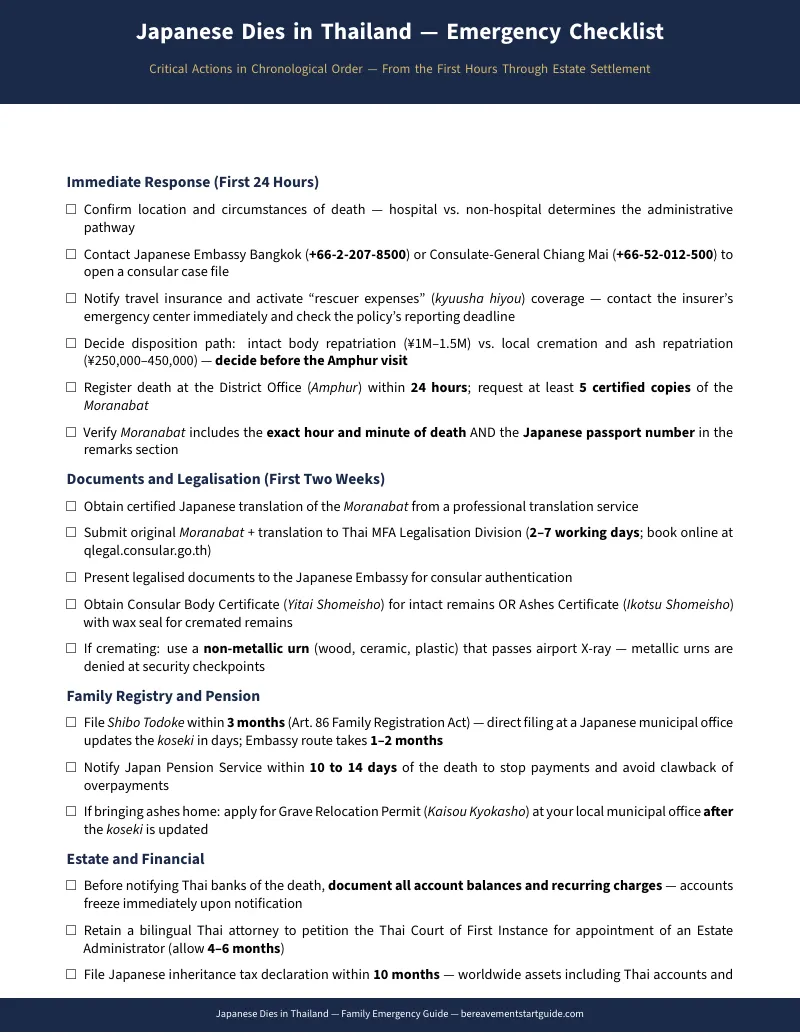
- The emergency checklist — a 2-page printable covering the first 48 hours and the critical documents to secure immediately
- 5 planning worksheets — document tracker, repatriation cost comparison, cost tracking log, agency communication log, and deadline timeline
- Instant download — PDF files you can access on any device, immediately
Full Refund, No Time Limit
If the guide doesn't help, email hello@bereavementstartguide.com for a full refund. No time limit, no conditions.
Download the free emergency checklist to see the format and depth — then decide if the full guide is worth it for your situation.