Two Countries. Two Legal Systems. One Three-Month Deadline.
Your family member just died in the United States, and the American system is already making decisions without you. A county coroner holds legal custody of the body. A funeral home is asking for signatures and a credit card number. Your travel insurer needs a call before you hire anyone — or the repatriation claim is void.
And back in Japan, a clock is ticking: you have three months to file the death on the koseki, or you face administrative penalties, notarized letters of explanation, and weeks of additional delay before you can touch a single bank account or file the inheritance tax return that's due in ten months.
Every hour you spend piecing together information from consulate websites, Reddit threads, and funeral home sales pitches is an hour where storage fees are accumulating, filing deadlines are approaching, and decisions you didn't know you were making are locking in costs that range from a few hundred dollars to tens of thousands.
The Cross-Border Navigation Manual
This is not a sympathy pamphlet. It is a 49-page operational manual that walks you through every decision, every document, and every deadline — from the first phone call to the county coroner through the final inheritance tax filing in Japan.
It exists because no single source covers both sides of this corridor. The Japanese consulate tells you how to file the death report but not how to negotiate with an American funeral home. US government websites explain death certificates but know nothing about koseki registration deadlines. Repatriation companies quote you $10,000–$15,000 for full-body transport without mentioning that local cremation and hand-carrying ashes costs a quarter of that price. And the administrative scriveners in Japan who handle document apostilles charge ¥33,000–¥77,000 per document — for a process you can execute yourself with the right sequence.
This guide bridges that gap. Every chapter is organized chronologically around when you need the information — not alphabetically by topic, not scattered across a Q&A forum, but in the order things actually happen when a Japanese citizen dies in America.
The First 72 Hours — Who Controls What
The medicolegal system that holds jurisdiction over the body, how it differs for hospital deaths vs. unattended or suspicious deaths, the statutory next-of-kin hierarchy that determines who can authorize anything, and the six actions that prevent the costliest downstream mistakes. Includes the California signature-verification trap and the New York exemplification requirement — two state-specific procedural landmines that block apostilles and delay everything.
The Repatriation Decision
Full-body transport vs. local cremation vs. local burial — each option with real cost ranges, logistics, and the regulatory requirements that apply. A worked side-by-side comparison so you can evaluate the options on facts, not on whatever the funeral home is pushing. The guide covers IATA container specs, zinc-lined casket requirements, TSA urn material rules, and the only legal method for mailing cremated remains from the US to Japan via USPS.
Funeral Home Negotiation
How the FTC Funeral Rule protects you from bundled pricing, what a General Price List is and why requesting one changes the negotiation entirely, and which commonly pushed add-ons (embalming for cremation, premium caskets for viewing, "handling fees") you can legally decline. Japanese families unfamiliar with the American funeral industry are systematically overcharged — this chapter exists to prevent that.
The Koseki Registration Deadline
Why filing through the Japanese consulate adds four to six weeks of routing delay through the Ministry of Foreign Affairs, how to bypass the consulate and submit directly to the ward office of the decedent's registered domicile, and what happens if you miss the three-month window. The difference between Pathway A (public documents with state Apostille) and Pathway B (private documents needing notary, Legal Affairs Bureau, and MOFA authentication) — and the one-stop offices in Tokyo, Kanagawa, and Osaka that collapse Pathway B into a single appointment.
Japanese Bank Freezes and the Emergency Withdrawal
Every Japanese bank account freezes the moment the institution learns of the death. The 2019 Civil Code revision created an emergency withdrawal provision that lets heirs access up to ¥1.5 million per institution without waiting for probate — but only if you file correctly. The guide covers the full freeze, the withdrawal procedure, and the complete unfreezing process.
Inheritance Tax in Both Countries
Japan's 10-month filing deadline, the distinction between limited-scope and unlimited-scope taxpayers that determines whether US-based assets are taxable, and the foreign tax credit mechanism that prevents double taxation. Includes guidance on when a cross-border tax advisor is worth the fee and when you can handle the filing yourself.
The Koseki-Probate Bridge
The practical problem: US institutions cannot read a koseki, and Japanese banks cannot verify a US letter of administration. This chapter explains how to prove heir status across both countries — apostilled koseki translations for the US side, and authenticated probate documents for the Japan side — so you don't get caught in a loop of rejected submissions.
5 Printable Worksheets
Document status tracker, repatriation cost comparison, cost tracking log, agency communication log, and filing deadline timeline. Fill-in tools designed to keep the entire cross-border process organized from day one.
Who This Guide Is For
- Spouses and adult children managing the immediate aftermath — whether you're in the US or coordinating remotely from Japan across a 13- to 17-hour time difference
- Siblings and distant relatives serving as executor when no spouse or child is available in the US
- University international offices and corporate HR with duty-of-care obligations after a student or employee death
- Travel insurance case managers and funeral directors coordinating cross-border logistics for the first time
Why Not Piece It Together for Free?
You could spend days assembling information from the Japanese consulate's pamphlets, county vital records websites, Reddit threads, funeral home brochures, and National Tax Agency guidelines. People do. Here is what they routinely miss:
- The consulate routing delay. The consulate's own instructions describe filing the Shibo Todoke through them as the standard process. What they don't emphasize is that diplomatic mail routing through the Ministry of Foreign Affairs takes four to six weeks before the koseki updates — weeks during which bank accounts stay frozen and the inheritance tax clock keeps running. The direct ward-office submission path cuts that to days.
- The urn material rule. TSA officers cannot open a cremation container under any circumstances. If the x-ray scanner cannot see through the urn, it will be rejected at the checkpoint. Families who buy a brass or marble urn at the funeral home discover this at airport security — with no option but to transfer the ashes into a compliant container on the spot or check the urn as cargo.
- The death certificate type. Many vital records offices issue "Informational" copies that carry a watermark stating they cannot establish identity. These copies cannot be apostilled and cannot register a death with any Japanese authority. Families who order the wrong type restart the entire sequence from scratch.
- The funeral home markup. Without the FTC Funeral Rule in hand, families routinely pay for embalming they didn't need (required for repatriation, not for direct cremation), caskets they didn't want (a rental casket is legal for viewing), and "coordination fees" that have no regulatory basis.
Each of these mistakes costs between a few hundred and several thousand dollars, plus days to weeks of delay — added to a process that is already one of the most stressful experiences a family can face.
What's Included
- The full guide — 49 pages, 14 chapters, covering every step from the coroner's jurisdiction through the final tax filing
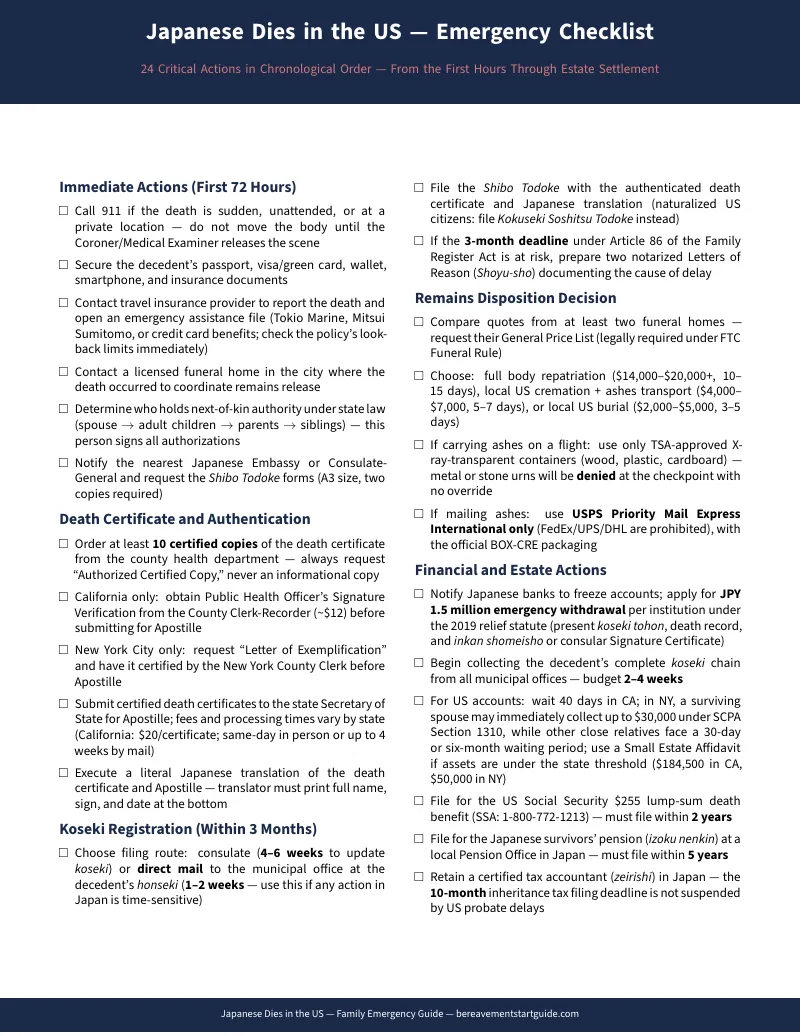
- The emergency checklist — a 2-page printable covering the first 72 hours and the critical documents to secure immediately
- 5 planning worksheets — document tracker, repatriation cost comparison, cost tracking log, agency communication log, and deadline timeline
- Instant download — PDF files you can access on any device, immediately
Full Refund, No Time Limit
If the guide doesn't help, email hello@bereavementstartguide.com for a full refund. No time limit, no conditions.
Download the free emergency checklist to see the format and depth — then decide if the full guide is worth it for your situation.