Two Countries, One Deadline, and Every Wrong Turn Costs You Weeks
Your loved one has died in the United States. Within 48 hours, you need to coordinate with a county coroner or medical examiner, contact the Mexican consulate's Protection Department, and select a funeral home — all while navigating agencies that operate in a language, timezone, and legal system that may be completely unfamiliar to you.
Here is what nobody tells you up front: the US death certificate must list the deceased's full dual-surname exactly as it appears on their Mexican birth certificate and passport — with every Americanized variation recorded under an AKA clause. One missing maternal surname, one transposed letter, and Mexican border authorities can refuse the casket. The civil registry will not register the death. Banks freeze inheritance claims. Insurance companies reject beneficiary filings. A single name discrepancy can stall the entire process for months.
Free resources scatter fragments of this information across fifty different consulate websites, Reddit threads with outdated advice, and funeral home brochures designed to upsell services you do not need. None of them walk you through the complete cross-border sequence — from the moment someone calls to tell you about the death through the final Afore pension claim and Infonavit debt cancellation that most families never realize they are entitled to.
The Binational Document & Recovery System
The Mexican National Dies in the US — Family Guide is a 14-chapter emergency reference that covers the complete US-to-Mexico bereavement corridor in the order you will actually encounter it. It replaces the scattered, contradictory information available online with a single sequential walkthrough — verified against current consular requirements, federal regulations, and Mexican civil law — so you never have to guess what comes next or discover a missed step after it is too late to fix.
What's Inside
- The first 72 hours protocol — which US authorities take jurisdiction, how to activate consular protection and the CIAM emergency line, and how to avoid signing a funeral home contract that locks you into unnecessary embalming and retail casket markups
- The AKA name alignment procedure — the exact form to hand the US funeral director so the death certificate lists every name variation that Mexican institutions require, preventing the document rejections that freeze bank accounts and block border crossings
- Apostille-then-translate sequencing — why this order is non-negotiable under the Hague Convention, how to file with the correct Secretary of State office, and how to verify a perito traductor's credentials through judicial directories so your translation is not rejected
- Repatriation vs. cremation decision worksheet — a side-by-side cost comparison ($5,000–$10,000+ for full-body air cargo versus $1,155–$1,350 for consular cremation packages), with worked examples for each path including TSA urn compliance rules and Known Shipper requirements
- Consular financial assistance — the socioeconomic evaluation for low-income families and the pre-negotiated convenio rates with local US funeral homes that most families never learn about until after they have already paid full price
- Mexican civil registration and digital corrections — registering the US death with the Oficialía del Registro Civil, using the Plataforma Nacional del Registro Civil (launched June 2026) to fix minor spelling errors online from the US, and when you need a full judicial petition with a Power of Attorney instead
- Afore pension recovery — the 10-year statute of limitations, the IMSS Homoclave IMSS-02-012 correction process for database name mismatches, and the exact documents beneficiaries need to claim retirement savings before the clock runs out
- Infonavit debt cancellation — how the Autoseguro por Defunción cancels the remaining home loan balance so the family does not inherit the debt, and what happens when the US death certificate has not been properly apostilled and translated
- US banking, probate, and estate tax — unfreezing accounts without a Payable on Death beneficiary, the ancillary probate process for non-resident heirs, the non-resident executor restriction, and IRS Form 706-NA for US estates over $60,000
- US life insurance claims from Mexico — IRS Form W-8BEN for foreign beneficiaries, preparing for third-party insurance investigations, and setting up the international wire transfer correctly
- Mexican estate settlement — testate vs. intestate succession, what happens when US and Mexican wills conflict, and property transfer taxes
- US Social Security survivor benefits from Mexico — eligibility rules, how to file from abroad, and receiving payments in Mexico after the GPO and WEP repeal
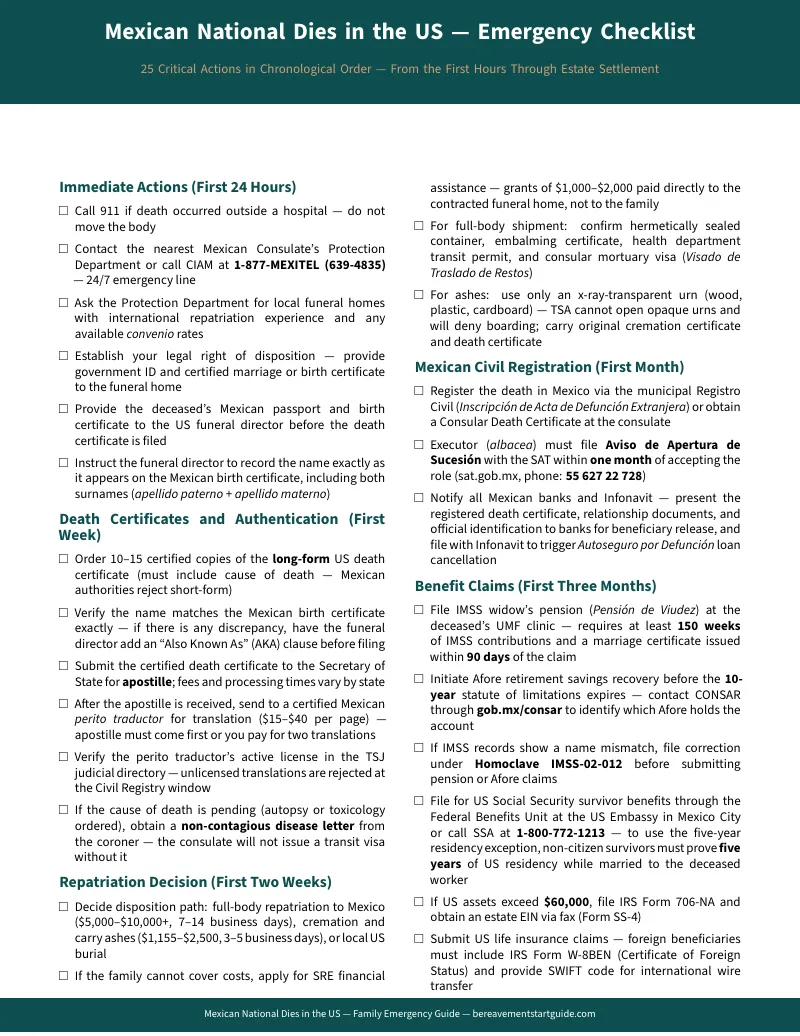
You also receive the emergency checklist — a printable, phase-by-phase action list covering every deadline and document across both countries — plus seven fillable worksheets: the AKA name alignment form to hand the funeral director, a 72-hour emergency action checklist, a document authentication tracker, an agency communication log, a repatriation cost worksheet, a binational estate inventory, and a benefit claims checklist.
Who This Guide Is For
- Family members in Mexico coordinating a US death remotely — navigating English-language bureaucracies, time zone gaps, and agencies that rarely offer bilingual services
- A spouse or relative in the US handling county coroners, state vital records offices, and consular procedures in an unfamiliar system while grieving
- Anyone managing assets in both countries — frozen US bank accounts, Afore pensions with a 10-year deadline, Infonavit loans with a cancellation benefit, life insurance claims filed from abroad
- Funeral directors who need a structured family-facing checklist for the US-to-Mexico repatriation corridor
- Employers, universities, and community organizations helping families of deceased workers, students, or members navigate the cross-border process
Why Free Resources Are Not Enough
Mexican consulate websites provide authoritative but fragmented guidance — scattered across 50+ individual consulates, each with different formatting and coverage. Reddit threads offer real-world experience but routinely include outdated or legally inaccurate advice, including suggestions to transport remains across the border in personal vehicles, which violates federal sanitary regulations. Generic bereavement portals cover domestic US procedures well but completely ignore the apostille-translation sequence, consular visa requirements, and Mexican civil registration that define this corridor.
None of these resources connect the dots between document authentication, repatriation logistics, and the long-tail financial recovery — Afore pensions, Infonavit loans, IMSS benefits, US probate, and insurance claims — that families are entitled to but often miss entirely because the information lives in separate government silos on both sides of the border.
This guide puts the entire cross-border sequence in one document, in the order you need it, verified against the regulations that actually govern the US-to-Mexico corridor today.
Satisfaction Guarantee
If this guide does not deliver what it promises — a complete, accurate, step-by-step system for navigating the US-to-Mexico bereavement corridor — you get a full refund, no time limit. Email hello@bereavementstartguide.com and we will make it right.
Get Started Now
Download the free emergency checklist to see the complete phase-by-phase action list. When you are ready for the full 14-chapter guide — with the AKA alignment procedure, apostille sequencing, repatriation cost worksheets, Afore recovery instructions, and every document template — get the complete toolkit for .