The hospital is charging daily storage. The embassy says it cannot move the body. And you are seven hours behind Bangkok trying to work out who to call first.
A British family member just died in Thailand. You are sitting in the United Kingdom, trying to piece together a process you have never seen before. The GOV.UK page lists phone numbers and general services. A funeral home in Bangkok is quoting a price in baht. Reddit has old threads from people who handled a different situation in a different province. Meanwhile, Thai hospital morgues are charging daily cold-storage fees and the seven-hour time gap means every day you spend researching is a day the costs accumulate and the procedural window narrows.
The Cross-Border Authority Sequencer exists because Thailand's death administration system has a specific order of operations — and contacting the wrong authority at the wrong time creates bottlenecks that compound costs, delay the release of remains, and stall every downstream document.
What makes this different from free government resources
The FCDO publishes guidance pages and phone numbers. It does not tell you the order in which to contact Thai police, the hospital, the forensic institute, the Amphur district office, the Ministry of Foreign Affairs, and the embassy itself. It does not explain that the official Thai death certificate is not issued by the hospital or the police — it is issued by the Amphur, and getting it requires presenting documents from the other authorities in a specific sequence. It does not map the document legalisation chain that makes a Thai death certificate acceptable to UK probate courts, banks, and pension administrators. And it does not cover the UK-side procedures — Tell Us Once registration, probate submissions, passport cancellation, or Thai-side estate administration.
The Cross-Border Authority Sequencer is a procedural system — it puts every Thai and UK authority in order, with timelines, cost ranges, and the specific sequencing mistakes that other families made so you do not repeat them.
What's inside
The First 72 Hours — Emergency Triage Protocol
Who to contact first depending on whether the death occurred in a hospital, a hotel, a private rental, or on the street. How the hospital-death track differs from the forensic-investigation track — because a death outside direct medical supervision triggers a mandatory police investigation and forensic autopsy that adds days to the timeline. The asset security checklist for locating and safeguarding the deceased's passport, phone, financial documents, and personal property before they are lost or cleared by hotel management.
The Post-Death Power of Attorney from the UK
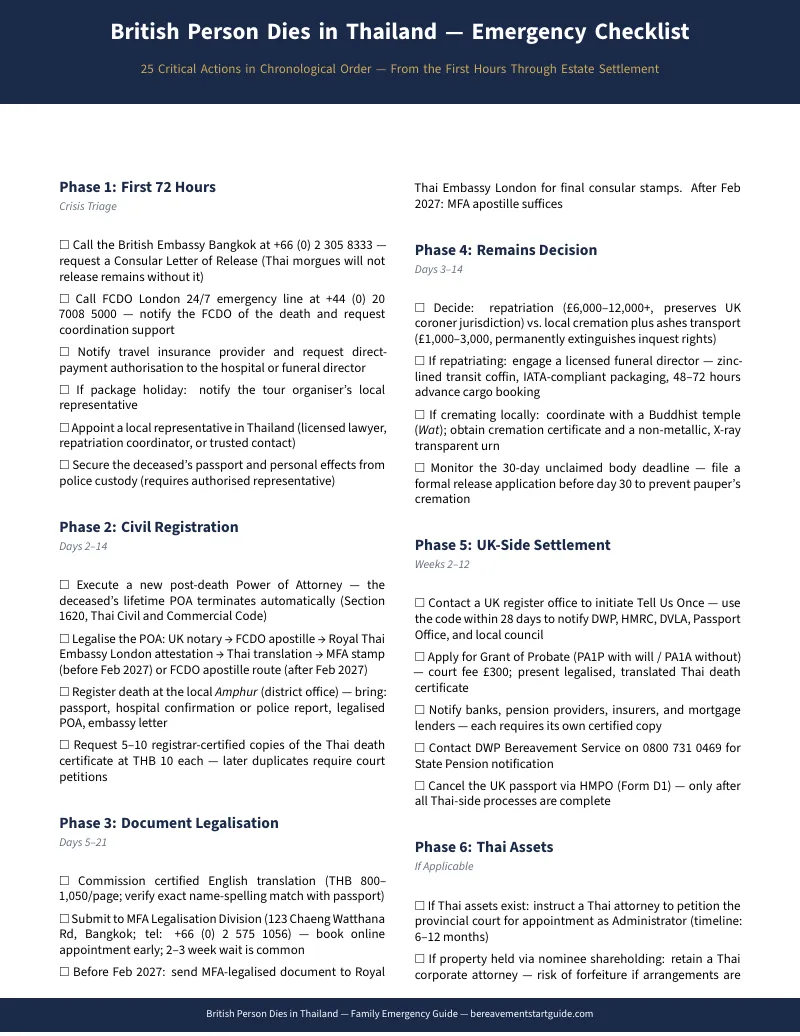
Any Power of Attorney the deceased held automatically terminates upon death. You need to execute a new post-death POA from the United Kingdom — notarised by a UK notary public, apostilled by the FCDO, attested by the Royal Thai Embassy in London, translated into Thai by a certified translator, and stamped by the MFA in Bangkok. Skip any step and Thai banks, courts, and municipal offices reject your representative's authority. The guide maps the full chain, the costs (£150–£300 per document), and the simplified post-February 2027 Apostille route.
Thai Death Registration — The Amphur System
Thailand's death administration runs through a strictly sequential chain: local police → hospital or forensic facility → British Embassy Consular Letter of Release → Amphur death registration → MFA legalisation. Skip a step and the system stalls — the Amphur will not register the death without the police report, UK institutions will not process claims without a legalised certificate. The guide maps every node in this chain and tells you exactly what each authority needs.
The Document Legalisation Chain — Current and Post-Apostille
Thailand acceded to the Hague Apostille Convention on 30 June 2026. Until 28 February 2027, documents must follow the multi-step legalisation process — certified translation, MFA stamp, Royal Thai Embassy attestation in London. After that date, a single Apostille certificate replaces the chain. The guide maps both paths and the transitional rules for documents filed close to the cutoff. Follow the wrong path for your filing date and the package is rejected.
Forensic Investigation and Autopsy Procedures
Most foreign-national deaths outside a hospital trigger a mandatory forensic examination. The police authorise the autopsy, not the family. The Police Forensic Institute may retain tissue samples for toxicology testing without family consent. Remains are typically released in two to five days, but the full written autopsy report takes 45+ business days. The critical distinction: you do not need the final report to move the remains. Do not wait for it before making your repatriation or cremation decision.
Repatriation vs. Local Cremation — Costs and Decision Framework
Full-body repatriation from Thailand to the United Kingdom costs £6,000 to £12,000 — including local mortuary fees, embalming, zinc-lined shipping coffin, air cargo, and UK funeral home receiving. Local Buddhist cremation runs £700 to £1,200. Ashes repatriation costs £1,000 to £3,000 via commercial courier, or £100 to £300 if a family member carries them home. The guide breaks down every cost category, explains the embalming standards gap, covers IATA packaging requirements and airline cargo specifications, and includes the carry-on checklist for transporting ashes — including the X-ray transparency requirement that blocks metallic urns at security.
UK Estate Settlement with Foreign Documents
UK banks, pension administrators, and probate registries will not release assets against an unverified foreign death certificate. The guide covers the Tell Us Once registration process, the 28-day code window, passport cancellation with HM Passport Office (Form D1), presenting translated and legalised Thai documents to UK institutions, and managing name-spelling discrepancies between the Thai certificate and the deceased's UK passport that trigger document rejections.
Thai-Side Estate Administration
Thai bank accounts freeze when the bank is notified. Thai succession law and UK inheritance law may conflict on distribution — especially for property, Thai bank accounts, and Thai-registered vehicles. The guide covers the interaction between Thai and UK wills, the process for releasing frozen accounts under Thai probate law, and why you need multiple certified copies of the death certificate before leaving the Amphur.
Who this is for
- The spouse or adult child coordinating from the UK — You are managing everything by phone across a seven-hour time difference, you have never dealt with Thai civil authorities, and you need the complete procedural sequence with the authority hierarchy and the steps you can delegate to a local representative versus the ones that require your direct involvement through the embassy.
- The family dealing with a non-hospital death — The body is in a forensic facility and the police investigation is underway. You need to know how to get the body released, how long the autopsy will take, what happens to tissue samples, and the 30-day unclaimed body deadline.
- The executor managing a cross-border estate — You need to know which documents each UK and Thai institution requires, in what sequence, and how to prevent the rejections that send you back to square one with frozen accounts and stalled pension claims.
- The family trying to control repatriation costs — A funeral home quoted you a price in baht that you cannot evaluate. The cost comparison framework lets you identify where markup lives and understand the realistic cost range for each disposition option.
Why free resources fall short in this corridor
- GOV.UK pages list consular services and phone numbers. They do not provide a sequential family workflow, do not explain the Amphur death registration system, do not map the document legalisation chain, and do not cover UK-side estate settlement, Tell Us Once registration, or Thai-side probate.
- Thai funeral home websites list services with variable pricing. They will not explain how Bangkok rates differ from provincial surcharges or help you evaluate whether their quote is competitive.
- Expat forums and Reddit threads are anecdotal, province-specific, frequently outdated on the Apostille transition timeline, wrong on forensic autopsy procedures, and inconsistent on costs and timelines.
- Generic "death abroad" checklists cover embassy phone numbers. They do not touch Thai civil registration, the Amphur system, the forensic investigation process, airline cargo specifications for human remains, carry-on ash transport rules, or cross-border estate settlement mechanics.
Satisfaction guarantee
Full refund, no time limit. If the guide does not give you the procedural clarity you need, email hello@bereavementstartguide.com and we will refund the full purchase — no questions, no expiration, no hoops.
Start working the process within minutes
The guide costs — once, no subscription. It covers every procedure, every document, every deadline, every cost range, and the specific corridor mistakes that cost other families time and money — plus seven printable tools including the emergency checklist, document collection tracker, repatriation cost worksheet, agency communication log, UK estate notification checklist, and legalisation chain tracker.
Not ready for the full guide? Download the free Emergency Checklist — a printable reference with the critical actions, contacts, and deadlines for the first 72 hours. The full guide is there when you need the complete cross-border procedure.