You just got a call that your family member died in Japan. You have 7 days before the paperwork window closes.
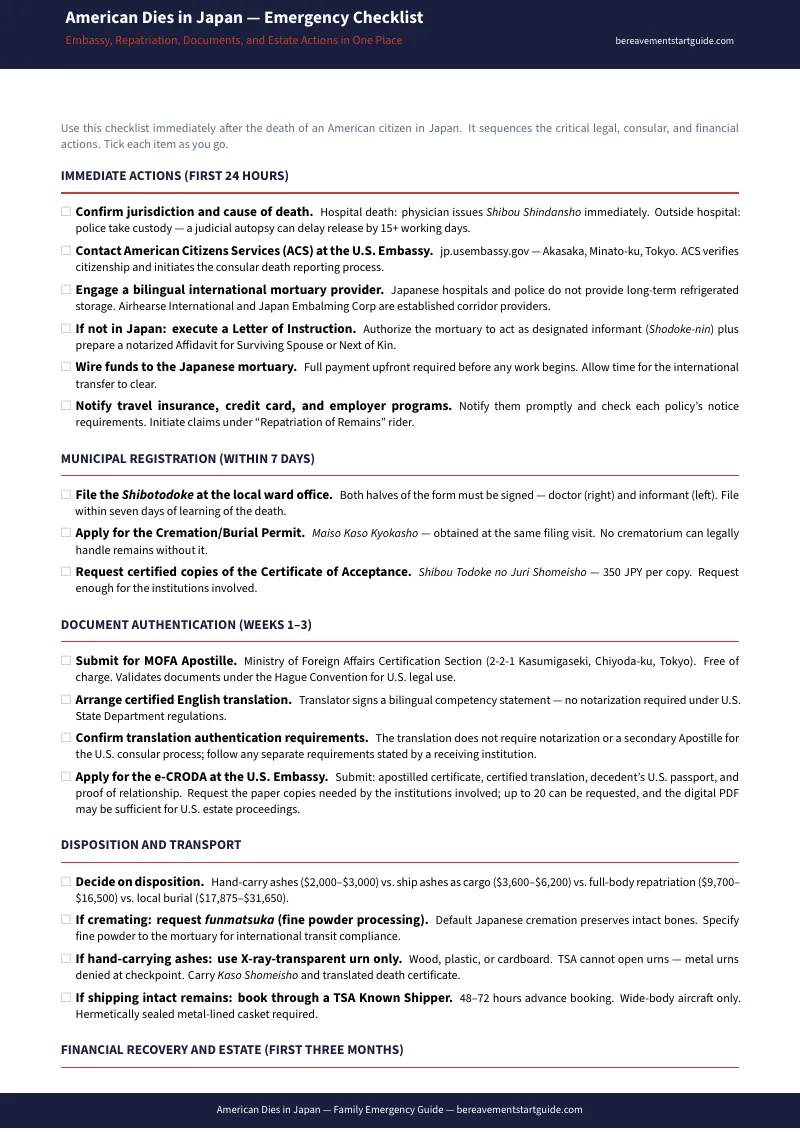
Right now, the hospital or police have custody of the remains. Japanese law requires a Notification of Death (Shibotodoke) at the municipal ward office within 7 days. No one at the ward office speaks English. The U.S. Embassy can open a case file, but they cannot choose a funeral home, pay for services, or coordinate anything on your behalf. And if the death was unattended or suspicious, the prefectural police may have ordered a judicial autopsy that will hold the body for weeks before you can make any decisions at all.
Meanwhile, you're trying to figure out whether to cremate in Japan or ship the body home — and the cost difference is staggering. Full-body repatriation runs $14,000 to $20,000. Local cremation with ashes return can be $4,500 to $8,000. Hand-carrying the urn yourself brings it close to zero. But every option requires a precise sequence of Japanese documents, English translations, apostille authentication, and U.S. consular paperwork — and getting any step out of order means starting over.
The American Dies in Japan — Cross-Border Emergency System was built for exactly this crisis: a U.S. family managing a death in Japan, operating across two legal systems, two languages, and one of the most culturally distinct funeral traditions in the world.
What makes this different from embassy pages and forum advice
The U.S. Embassy publishes a factsheet. Reddit threads share fragments of personal experience. Repatriation companies quote you $18,000 without mentioning that hand-carrying ashes on a passenger flight is legal and virtually free. None of these sources give you the complete, sequenced workflow — from the first phone call to the last probate filing — with every Japanese and U.S. document in the correct order, every agency contact, and every cost broken down so you can make real decisions instead of panicking.
That's what the Cross-Border Emergency System does. It's the document sequencing blueprint, the bilingual reference toolkit, and the cultural preparation guide in one place — built specifically for the U.S.–Japan corridor, not adapted from a generic death-abroad overview.
What's inside
- 48-hour emergency triage protocol — the exact contact sequence for the embassy duty officer, local police, hospital administration, and ward office, with every Japanese legal term transliterated and explained so you or someone on the ground in Japan can navigate each agency without confusion
- Japanese death registration pipeline — securing the Death Certificate (Shibo Shindansho), filing the Shibotodoke, and obtaining the Cremation/Burial Permit (Maiso Kaso Kyokasho) in the correct order and within the legal deadlines, because the sequence is rigid and each step unlocks the next
- Dual-apostille authentication workflow — the Gaimusho apostille for public documents and the separate Notary Public → Legal Affairs Bureau → Gaimusho chain for certified translations, including the June 2026 online verification system, so U.S. banks, insurers, and probate courts accept your documents on the first attempt
- CRODA coordination guide — what the U.S. Embassy needs from you, how long the Consular Report of Death Abroad takes, and how to use it alongside the authenticated Japanese death record in U.S. probate, because both documents serve different institutional purposes and neither replaces the other
- Repatriation decision matrix — full-body shipping ($9,700–$16,500), cremation with ashes return ($2,000–$6,200 depending on hand-carry vs. cargo), and local burial in Japan ($17,875–$31,650) with a breakdown of every cost component — embalming, hermetically sealed casket, airline cargo, crematorium fees, municipal permits — so you can compare real numbers instead of a funeral director's first quote
- Airline cargo and TSA compliance — Known Shipper requirements for JAL and ANA, casket dimension specifications, TSA-scannable urn materials (wood, plastic, cardboard — not brass, bronze, or stone), and the documentation package each carrier requires, because a non-scannable urn gets denied at the security checkpoint and TSA officers are prohibited from opening it even with your permission
- Shuukotsu cultural preparation — a direct, sensitive explanation of the Japanese bone-picking ceremony where family members use chopsticks to transfer intact skeletal remains into the funeral urn, because families who are prepared often describe it as deeply meaningful, but families who are blindsided report severe distress that compounds their grief for years
- Japanese funeral etiquette guide — proper funeral attire (Mofuku), the condolence money (Koden) envelope and wrapping rules, and the critical chopstick taboo that you need to understand before attending any Japanese funeral or memorial service
- Frozen Japanese assets protocol — how to prove next-of-kin authority through the family registry (Koseki) system, work with an administrative scrivener (Gyoseishoshi), and assess inheritance tax exposure for globally held assets when the deceased was domiciled in Japan
- U.S. estate settlement roadmap — Social Security survivor benefits under the post-2025 framework (WEP and GPO are repealed for benefits payable from January 2024), the manual filing path for surviving spouses who never applied, bank account and life insurance claims using authenticated foreign death documents, and IRS notification requirements
- Bilingual reference section — Japanese-English glossary of every legal term you'll encounter and agency contact directory with direct numbers for crematoriums, ward offices, and funeral directors
- 8 printable worksheets — fill-in tracking tools for the 48-hour emergency period, document authentication, repatriation cost comparison, funeral home evaluation, airline cargo coordination, insurance claim filing, estate asset inventory, and agency communication log
Who this is for
- Spouses and family members in the U.S. who just received the worst phone call of their lives and need a clear first action within hours, not a reading list
- Adult children coordinating from the U.S. who don't speak Japanese and are managing agencies, costs, and family decisions across a 14-hour time difference
- Travel companions on the ground in Japan who need the emergency contacts, bilingual terminology, and notification sequence right now
- Executors and probate attorneys handling cross-border filings where the document authentication chain is unfamiliar and one wrong step means weeks of delay
- Corporate HR directors and study-abroad risk managers supporting a family through institutional crisis protocols after a worker or student death
- U.S. funeral directors receiving remains from Japan who need to understand the Japanese documentation package and cargo transit requirements
Why free tools and forum advice aren't enough
The U.S. Embassy factsheet lists what documents you need but doesn't sequence them. It doesn't explain the dual-apostille chain, the difference between public and private document authentication, or the specific order that prevents rejections. It doesn't mention costs.
Reddit threads contain fragments of genuine experience, but they routinely treat the repealed WEP and GPO as active law, recommend repatriation companies without mentioning the hand-carry option, and mix anecdotes from different decades and different consular districts. The advice is unstructured, often contradictory, and impossible to follow under time pressure.
Repatriation brokers have a financial incentive to recommend the most expensive option. They won't tell you that cremation in Japan followed by hand-carrying the urn home is legal, straightforward, and can save your family $10,000 or more. The cost comparison in this guide shows you every pathway with real numbers — including the options that commercial providers don't mention.
Full refund, no time limit
If the guide doesn't help, email hello@bereavementstartguide.com for a full refund. No time limit, no forms, no questions about why.
Get started now
Download the free emergency checklist to see the notification sequence and a high-level overview of each phase. When you're ready for the full document sequencing blueprint, bilingual reference materials, and cultural preparation guide, get the complete toolkit — .