
Your Patient Died. Your Training Didn't Cover What Happens Next.
A patient or client you cared about has died, and you are navigating two crises at the same time. The first is logistical: HIPAA obligations that survive for 50 years after death, a clinical record that needs to be secured before anyone touches it, a malpractice carrier that may need to hear from you today. The second is personal: a grief that does not have a socially recognized name, because the person you lost was someone you were paid to help — and your profession does not have a script for mourning that kind of relationship.
You could try to assemble what you need from a therapy practice blog, a Reddit thread, an outdated hospice pamphlet, and a legal FAQ written for families — not for the professionals who were in the room. Or you could open one resource that covers the compliance obligations, the clinical documentation, and the professional grief in the sequence you actually need them.
The Clinical Transition Framework
This is not a grief book that ignores your professional obligations. It is not a compliance manual that treats a patient's death like a file to close. It is a clinical transition framework — a structured toolkit that pairs every regulatory requirement with the emotional reality underneath it, because you cannot separate the HIPAA question from the fact that you just lost someone whose voice you knew better than most of your neighbors'.
Built for the specific complexity that a patient or client death creates: post-mortem confidentiality under HIPAA and 42 CFR Part 2, postvention protocols after client suicide, the power-of-attorney termination trap that catches families off guard, nursing home debt liability under the NHRA, and the disenfranchised grief that your supervisor will never bring up first.
What You Get
- First-24-Hour Triage Sequence — when to call the hospice on-call line instead of 911, pronouncement-of-death procedures, chain-of-custody documentation, how to secure the clinical record before making changes, and the notification sequence for your supervisor, risk management, and malpractice carrier. Written for crisis cognition: one action per sentence, in the exact order it needs to happen.
- HIPAA and 42 CFR Part 2 Post-Mortem Guide — what you can and cannot share with the deceased's family, the personal representative exception, the difference between the medical record and psychotherapy notes under the Privacy Rule, heightened protections for substance-use disorder records, and scripts for declining a family's request without damaging the relationship.
- Postvention After Client Suicide — a structured protocol for the clinician-survivor experience, covering immediate malpractice notification, how to document without defensive editorializing, peer consultation frameworks, the Coalition of Clinician Survivors model, the timeline of self-doubt and clinical hypervigilance, and what the evidence says about returning to risk-assessment work. Research shows one in five mental health professionals lose a client to suicide during their career.
- Clinical Documentation and Record Management — how to write the final clinical note, when to close the chart, the difference between a factual summary and a defensive narrative, retention periods by profession and jurisdiction, and what happens to records when you retire or close a practice.
- Professional Grief and Disenfranchised Loss — why losing a patient or client produces real grief that your professional culture will not acknowledge. The relief-guilt paradox for end-of-life clinicians. Attachment patterns in long-term therapeutic relationships. The Dual Process Model applied to professional mourning. Somatic symptoms your body produces when your brain is not allowed to grieve openly.
- POA Termination, Account Freezes, and Estate Traps — for family caregivers and professionals who managed the patient's affairs: the power of attorney terminated at death, bank accounts are about to freeze, and probate can take months. How to protect against nursing home debt liability under the NHRA. Medicaid estate recovery defenses, mandatory exemptions, and hardship waivers.
- Communication Scripts — templates for every difficult conversation: notifying colleagues, responding to the family's grief without crossing clinical boundaries, team announcements in group practices and hospital units, and the institutional ripple — how a death affects every other client or patient on your caseload.
- Funeral Boundary Decision Framework — whether to attend, what to say if you do, how to handle the family's invitation without making a boundary decision under emotional pressure. Grounded in what clinicians actually report about attending, not the vague ethics committee guidance.
- Hospice Medication Disposal — the 2018 SUPPORT Act rules for controlled substances, the FDA flush list, drug take-back kiosks, and what to do when the hospice nurse is not present.
- Financial and Legal Traps for Families — rights of disposition hierarchies, cremation authorization conflicts in blended families, the nursing home debt-collection playbook, and Medicaid estate recovery exemptions that protect surviving spouses, minor children, and disabled dependents.
- Long-Term Recovery — rebuilding clinical confidence after a patient death, the anniversary effect, returning to caseload, identity work after the caregiving role ends, and the continuing-bonds framework for honoring a professional relationship that mattered.
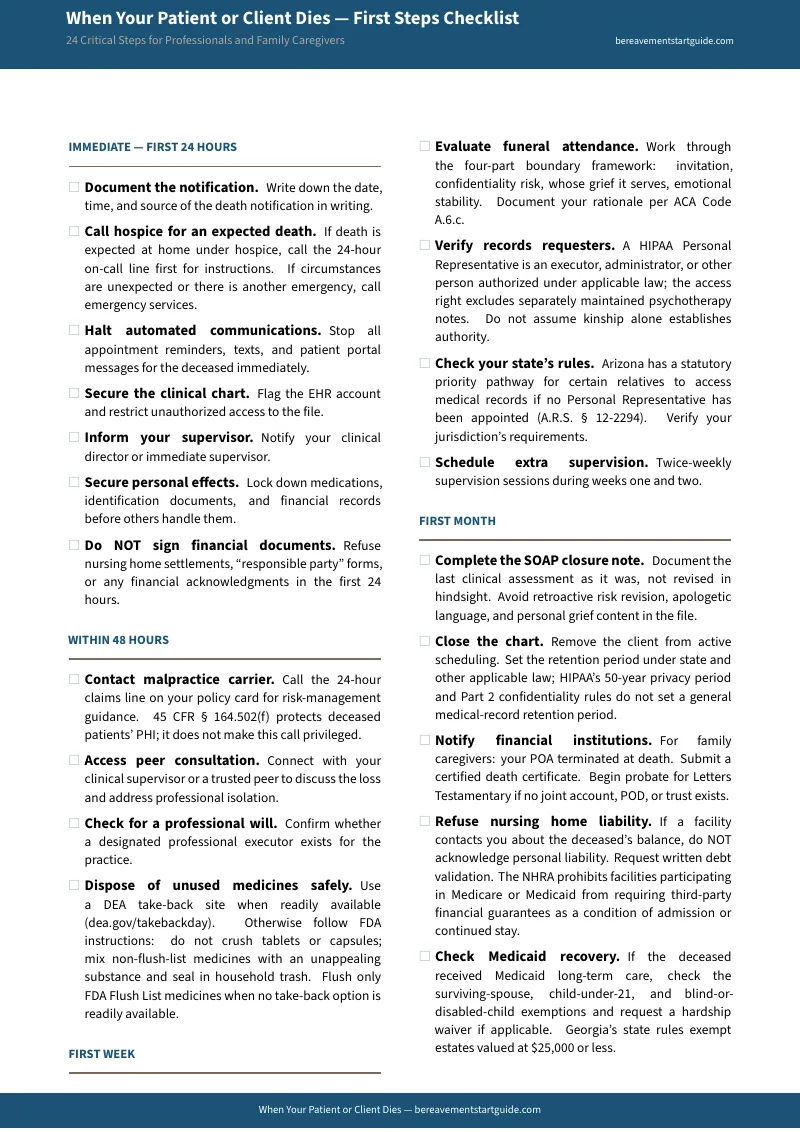
- Printable Checklist — 24 prioritized action items across five phases, from the hour of death through the first year. Designed for your office wall or clinical binder.
- 7 Standalone Printable Worksheets — A 30-day clinical support plan, anniversary and milestone calendar, funeral attendance decision matrix, SOAP closure note template, records request response tracker, family caregiver first-month roadmap, and nursing home debt response protocol. Each one is a fillable tool you can print and use immediately — separate from the guide so you can bring exactly the right sheet to the right conversation.
Who This Is For
- Therapists, psychologists, and counselors who have lost a client to illness, suicide, or any cause — and are navigating their own grief alongside professional obligations
- Nurses, physicians, and home-health aides who provided direct patient care and are processing a loss that their workplace treats as routine
- Social workers and case managers who held the family's trust and are expected to close the file and move on
- Financial advisors, elder law attorneys, and estate planners whose client relationship spanned years and whose death triggers both personal grief and fiduciary obligations
- Family caregivers who managed the patient's care, held the power of attorney, and are now facing frozen accounts and a probate system they have never encountered
Why Not Free Resources?
Free resources exist. Therapy practice blogs cover professional grief in scattered articles designed to generate therapy appointments. Hospice handouts address family logistics but ignore the clinician's experience entirely. Reddit threads offer peer solidarity and zero guidance on malpractice notification, post-mortem confidentiality, or clinical documentation protocols.
The gap is structural. No single free resource combines the professional grief psychology, the regulatory compliance, the clinical documentation guidance, the family-side legal protections, and the communication scripts in one place. This toolkit fills that gap because you do not have the bandwidth to assemble five different resources while your caseload keeps running and your own grief keeps waiting.
Satisfaction Guarantee
Full refund, no time limit. If this toolkit does not help you, email hello@bereavementstartguide.com and you will get your money back. No questionnaire, no justification required.
Start With the Free Checklist
Download the free checklist to see the format and the most critical first steps. When you are ready for the full clinical transition framework — the 47-page, 12-chapter guide covering HIPAA post-mortem obligations, postvention protocols, clinical documentation, professional grief, POA termination, nursing home debt defenses, communication scripts, and long-term recovery — the complete toolkit is here. It costs less than a single consultation hour and you keep it for life.