
A Student Has Died. The Institution Is Moving — and Nobody Warned You About What Comes Next.
A student has died, and within hours the institution has launched its crisis protocols. The housing office wants the room cleared. The registrar is processing a withdrawal. The financial aid office has paused disbursements. The loan servicer is generating statements. And every one of these systems is running on its own clock, indifferent to the fact that the people closest to this student cannot think straight.
You could spend the next weeks assembling guidance from a university crisis manual written for administrators, a grief book that assumes a natural death at old age, and scattered forum posts from people who went through this and wish someone had told them earlier. Or you could open one resource that combines the institutional protocols, the financial resolution, and the grief support in the order you actually need them.
The Student Bereavement Response System
This is not a grief book. It is not a crisis manual written for deans. It is a response system — a structured toolkit that gives educators, families, roommates, and peers exactly what they need, in the sequence they need it, with the legal and institutional context that determines whether they lose weeks to preventable bureaucratic spirals. Every chapter pairs the institutional reality with the human experience underneath it, because you cannot separate the FERPA request from the parent who just wants to see their child's last semester.
Built for the specific operational complexity a student death creates: crisis response team activation, classroom notification scripts that prevent contagion, FERPA rights that shift dramatically between K-12 and postsecondary, federal loan discharge procedures that most families do not know exist, private loan co-signer traps that most advisors miss, housing and belongings protocols for both campus and off-campus situations, suicide postvention frameworks that balance clinical guidelines with a community's need to mourn, and the secondary traumatic stress that quietly burns out every counselor in the building.
What You Get
- First-72-Hour Crisis Response Sequence — how to verify the death through official channels, convene and structure a five-role Crisis Response Team, hold the all-staff briefing before students arrive, deliver classroom notifications in small groups (never the PA system, never a school-wide assembly), open safe rooms, and disable automated campus accounts before a library hold notice lands in a grieving parent's inbox. Written for crisis brain: one action per sentence, in exact operational order.
- FERPA Record Access — K-12 vs. Postsecondary — the distinction that blindsides most families. In K-12, parents retain full FERPA authority over a non-eligible student's records after death. In higher education, the student's privacy rights expire at death, but state laws and institutional policies impose their own barriers. What documentation you need (death certificate, proof of relationship, Letters Testamentary), where to start for transcripts, financial aid records, disciplinary files, and counseling records, and how to avoid weeks of back-and-forth by understanding the institution's specific policy before you make your first request.
- Federal Student Loan Discharge Guide — every federal loan type (Direct Subsidized, Direct Unsubsidized, Direct PLUS, Perkins, Grad PLUS) is fully dischargeable upon the borrower's death at no cost. The step-by-step process: identifying which servicer holds each loan through the Federal Student Aid Information Center, submitting the death certificate, understanding the R2T4 timeline, and the post-2025 tax treatment. For Parent PLUS loans, discharge is also available upon the death of the student on whose behalf the parent borrowed.
- Private Student Loan Risk Assessment — unlike federal loans, private loans carry no guaranteed death discharge. Every promissory note must be checked individually for a discharge clause. How co-signer liability works, what to look for in the fine print, and what to do when a lender pursues collection against a grieving family. The difference between a lender's voluntary forgiveness policy and a contractual discharge right.
- Tuition Refunds and Institutional Write-Offs — how tuition insurance works (and its strict notice deadlines), the institution's internal tuition write-off policy, financial aid reversal procedures, and what families can realistically expect to recover. What falls through the cracks if nobody asks the right questions within the first 30 days.
- Housing and Belongings Protocol — when to seal the room, how to coordinate with law enforcement if the death occurred on campus, the double-audited belongings cleanout procedure (two staff present, itemized inventory, supervisor sign-off), off-campus shared lease obligations under joint and several liability, and how a surviving roommate can request a lease modification or release from the deceased's rent share.
- Suicide Postvention and Contagion Prevention — evidence-based protocols grounded in clinical research: approved language ("died by suicide," never "committed"), what to never disclose (method, location, note contents), screening for vulnerable cohorts (witnesses, close friends, roommates, LGBTQ+ youth without strong support networks), and how to navigate the tension between clinical postvention guidelines that caution against public memorials and a community's genuine need to mourn publicly.
- Memorialization Boundaries — what the research says about memorial walls, scholarships, retired jersey numbers, and anniversary observances. How to honor the student without romanticizing the death, work within institutional restrictions on campus memorials, and create continuing bonds activities that sustain the community rather than concentrating grief into a single overwhelming event.
- Secondary Traumatic Stress for Educators — the occupational hazard that crisis manuals rarely mention. How to recognize STS symptoms in yourself and colleagues, the three-level escalation model (peer check-ins, EAP referral, crisis intervention), and the written boundary framework that prevents administrators from burning out every counselor in the building during the first two weeks.
- Boundary Setting with Families, Media, and Extended Networks — scripts for declining media inquiries, managing student newspaper reporters, redirecting extended family questions, and designating a single family liaison. How to protect grieving families and students from the secondary trauma of unwanted public attention and social media rumor cycles.
- Grief Patterns, Continuing Bonds, and Long-Term Recovery — why student death grief does not follow a neat timeline, the Dual Process Model of oscillating between loss and restoration, complicated grief markers that warrant professional referral, and a 12-month milestone planning framework (birthday, death anniversary, graduation of their class, major school events).
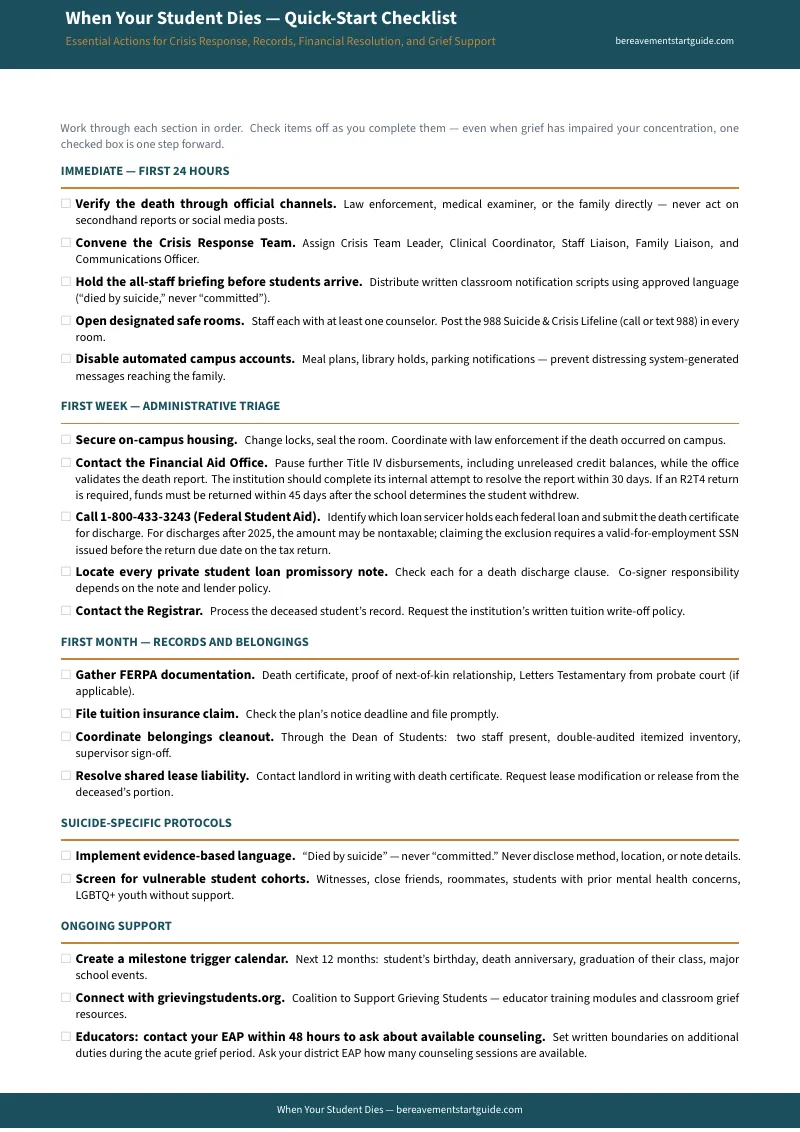
- Printable Checklist — 19 prioritized action items across six phases, from the first 24 hours through ongoing support. Designed for a crisis binder or an office wall, not a PDF that gets opened once.
- Eight Printable Worksheets — a crisis team role assignments sheet, a FERPA record request tracker, a federal loan discharge tracker, a private loan exposure worksheet, a belongings inventory template, a student vulnerability screening form, a 12-month milestone trigger calendar, and a first 30 days support plan for educators. Each is a standalone PDF you print, fill in by hand, and keep in your crisis binder.
Who This Is For
- School administrators and principals who just learned a student has died and need a step-by-step roadmap for crisis response, classroom notifications, and the weeks of institutional follow-through that determine whether the school community stabilizes
- University deans and residential life staff handling on-campus deaths — housing protocols, FERPA requests, Title IV complications, and campus-wide postvention
- Parents and next-of-kin navigating federal and private loan discharge, tuition recovery, probate documentation for academic records, and belongings retrieval
- Surviving roommates facing shared lease liability, room clearing timelines, and campus counseling access while processing grief in the same physical space
- Siblings and close friends whose grief is routinely sidelined by institutional triage, and who need clear guidance on academic leave, coursework extensions, and finding their own support
- School counselors and educators managing the crisis response while processing their own secondary traumatic stress
Why Not Free Resources?
Free resources exist. The university crisis manual covers postvention protocols in clinical language written for administrators, and says nothing about federal loan discharge, private co-signer liability, or what a roommate's lease obligations actually are. Grief books address the emotional landscape — and offer zero guidance on FERPA access, tuition write-off procedures, or contagion prevention protocols. Financial aid office websites explain one rule at a time and assume you already understand the R2T4 process.
The gap is structural. No single free resource combines the crisis response protocols, the financial and legal resolution, the institutional navigation, and the grief support in one place. This toolkit fills that gap because you do not have the bandwidth to assemble five different resources while your school community is falling apart.
Satisfaction Guarantee
Full refund, no time limit. If this toolkit does not help you, email hello@bereavementstartguide.com and you will get your money back. No questionnaire, no justification required.
Start With the Free Checklist
Download the free checklist to see the format and the most critical first steps. When you are ready for the full response system — the 44-page, 13-chapter guide covering crisis response, FERPA access, federal and private loan discharge, tuition recovery, suicide postvention, secondary traumatic stress, and a 12-month milestone framework — the complete toolkit is here. It costs less than a single hour of counseling and you keep it for life.