You Lost Your Twin — and Everyone Keeps Handing You the Wrong Grief Book
Your twin has died, and nothing in the sibling-loss pamphlets, the hospice handouts, or the five-stages-of-grief books describes what you are living through. You lost the person who shared your first heartbeat. The person whose face you see every time you look in a mirror. The person whose absence your body registers before your mind can form a thought.
Generic grief resources tell you to "process your feelings" and "take it one day at a time." But they were not written for someone whose nervous system is signaling that a part of them is physically missing — someone who cannot look in the mirror without seeing their dead sibling staring back, who is being told by family to "live for both of you now," and who cannot explain to a three-day bereavement leave policy that they lost the most fundamental relationship a human being can have.
When Your Twin Dies is the Twin Loss Survival Companion — a structured, practical toolkit designed specifically for the neurological and relational reality of losing a co-twin. It is not a memoir to read when you have the energy. It is not a therapist's intake form. It is the operational bridge between the moment of death and the point where you can begin to rebuild — short sentences, single actions, everything in the order you actually need it, built for a brain that cannot hold a thought for more than thirty seconds.
What Makes This Different from Everything Else
Free grief resources and generalist apps do not understand twin loss. The Twinless Twins Support Group takes up to 72 hours to process a registration. Therapy practice blogs want to funnel you into $200/hour sessions. Joan Woodward's foundational research is brilliant but requires reading energy you do not have right now. Hospice pamphlets group your twin under "siblings" — the same tier as a cousin you saw at holidays.
This toolkit closes the gap between clinical understanding and immediate, usable support:
- Twin-specific somatic guidance — mirror triggers, depersonalization, the phantom-limb sensation of a missing co-twin. No other grief resource addresses what happens when your own reflection becomes a trauma trigger.
- Zero-reading-endurance design — every chapter opens with a one-page summary. The checklists are single-sentence actions. The scripts are copy-and-paste. You do not need to read a 300-page book to find the one thing you need tonight.
- Immediate delivery, no gatekeeping — download the PDFs right now and start using them. No registration forms, no waiting for a coordinator, no subscription fees, no sharing your trauma on a forum before you get help.
What's Inside
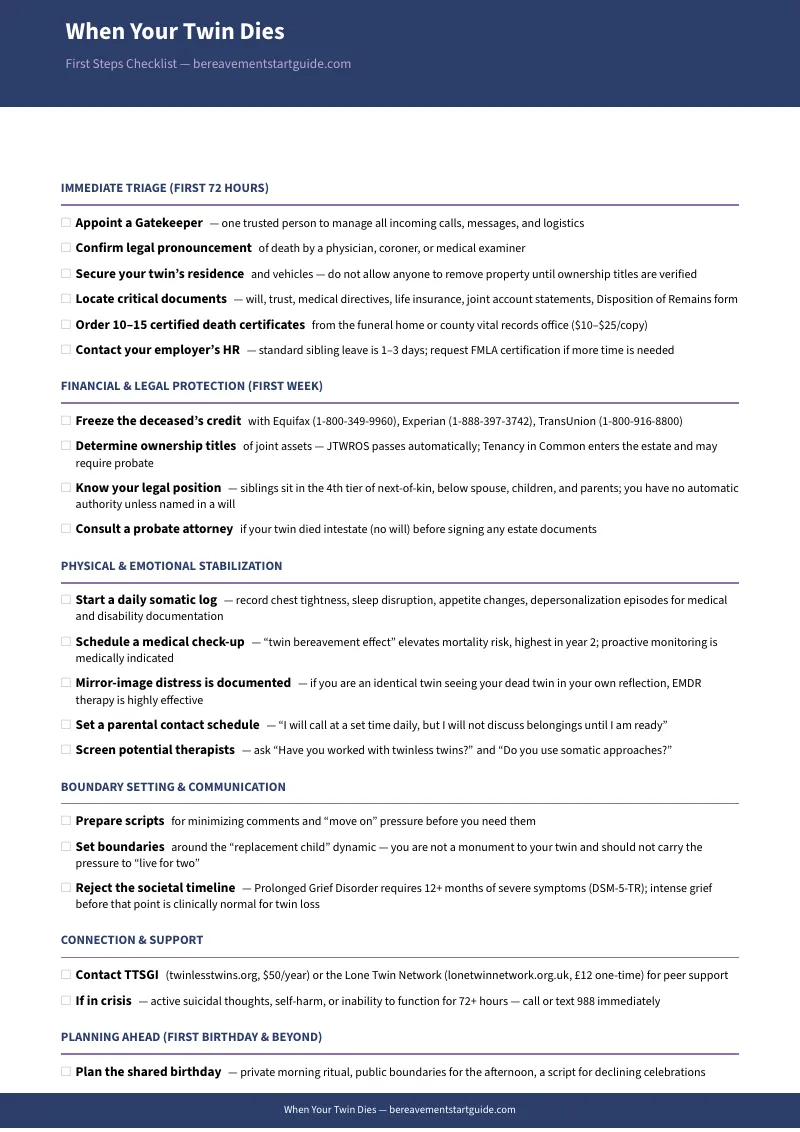
- First-72-Hour Triage Sequence — the six calls you must make, the decisions that cannot wait, and the ones that can. Written for the cognitive collapse that twin loss produces: one action per line, no paragraph longer than three sentences, everything sequenced so you do not have to think about what comes next.
- Mirror Trigger Management — why looking at your own face triggers a grief response that other bereaved people never experience, the neuroscience behind it, and practical techniques that let you function without avoiding every reflective surface in your home.
- Family Boundary Framework — how to handle the parent who needs you to carry your twin's unfulfilled ambitions, the relative who keeps saying "at least they have you," and the well-meaning friend who asks you to speak at the funeral because "you knew them best." Pre-written responses for every scenario, so you never have to improvise when your emotional reserves are empty.
- Workplace Return Scripts — what to say to the HR department that gave you three days of bereavement leave, the colleague who keeps calling you by your twin's name, and the manager who thinks you should be back to normal by month two. Includes a sample bereavement leave extension letter and boundary-setting language that protects your job while honoring your grief.
- Executor and Next-of-Kin Roadmap — death certificates, probate timelines, financial account closures, shared asset division, and digital estate management. Sequenced across the first twelve months so nothing falls through the cracks during the period when your working memory is at its worst.
- Survivor's Guilt Integration — the guilt that is nearly universal among surviving twins (and intensified for identical twins who share genetic disease risk). Why relief after a long terminal illness does not make you a monster. How to process anger at a twin who died by suicide. A structured approach to the conversations that will never happen.
- Milestone Survival Plans — your first solo birthday, the holidays, the death anniversary, and every milestone your twin will miss. Not platitudes about "honoring their memory" — specific decisions about what to do, who to include, and how to protect yourself from people who do not understand why your birthday is now the worst day of the year.
- Therapy Modality Guide — which therapeutic approaches have evidence for twin-specific grief (EMDR for traumatic loss, somatic experiencing for mirror triggers, continuing bonds for identity reconstruction), how to vet a therapist who understands twin dynamics, and a directory of twin-loss organizations with honest assessments of what each offers.
- Womb Twin Survivors — for those who lost a co-twin in utero, during the perinatal period, or in early infancy. The research shows trauma persists without conscious memory. How to make sense of unexplained separation anxiety and lifelong incompleteness when the loss happened before language.
Who This Is For
- Surviving twins in the first hours or days — in acute shock, needing a step-by-step sequence that works when the brain cannot function
- Surviving twins weeks or months out — managing executor duties, family pressure, workplace re-entry, and an identity crisis that no one around them understands
- Parents who lost one twin — including perinatal, stillbirth, and infant loss — navigating the impossible duality of mourning one child while caring for the survivor
- Partners and spouses of surviving twins — who need to understand the depth of what their loved one is experiencing without accidentally reinforcing the "live for two" pressure
- Therapists seeing a twin-loss client for the first time — the somatic mirror triggers, identity enmeshment, and elevated psychiatric risk that standard training does not cover
Why Free Resources Fall Short
Free grief resources were built for a general audience. They tell you about the "stages of grief" — a framework that was never meant for twin loss and that researchers have moved well past. Here is what they miss:
- Hospice pamphlets group your twin under "sibling loss" — the same category as a distant cousin. They do not address mirror triggers, identity enmeshment, or the elevated mortality risk that surviving twins face.
- Grief apps are built for estate management and task tracking. They are excellent at reminding you to close a bank account. They have nothing to say about what happens when your own reflection triggers a panic response.
- Support group forums offer irreplaceable peer validation — but they require registration, moderator approval, and often 48–72 hours before you can post. When you are at 2 a.m. and cannot sleep because your chest aches where your twin used to be, you need something you can open right now.
- Books on twin loss are clinically valuable and deeply moving — and they require sustained reading energy that you do not have in the first weeks. This toolkit gives you the operational bridge until you are ready for deeper reading.
Our Guarantee
Full refund, no time limit. If this toolkit does not help you, email hello@bereavementstartguide.com and we will refund every penny — no questions, no forms, no waiting period. You are not making an irreversible decision right now. You are giving yourself a tool that might help, with zero risk.
Get the Toolkit
The free checklist covers the most urgent first steps — the calls that cannot wait, the immediate administrative actions, and the first-night survival sequence. It is yours immediately, no purchase required.
The full When Your Twin Dies toolkit — — includes the complete 45-page guide, the 22-item prioritized checklist, and six standalone printable tools: a first-30-days support plan, a somatic symptoms tracker, a household responsibility worksheet, seven copy-and-paste communication scripts, a milestone planner, and an identity reconstruction journal. Eight PDFs total, designed for screen reading and for printing. Yours within seconds of purchase.