
The grief is real. The world just doesn't believe you yet.
Your grandparent has died, and somehow you're supposed to be fine by Thursday. Your workplace gave you one to three days. Your professor wants the assignment by Friday. Your family is splintering into factions over who gets the china cabinet. And beneath all of it, the person who anchored your childhood — the one who remembered your birthday when nobody else did, who kept the family talking to each other, who was the last living link to your earliest memories — is gone.
You're not overreacting. Grandparent loss is the most common family bereavement among college students and young adults, and it carries real, measurable consequences: academic impairment, workplace disruption, sleep fragmentation, and a cognitive fog that researchers call grief brain. The problem isn't your grief. The problem is that every institution in your life — your employer, your university, your family — has decided this loss doesn't count.
The Grandparent Grief Triage System
This is a 42-page practical toolkit that bridges the gap between "I'm sorry for your loss" and the 540 hours of administrative, emotional, and relational work that actually follows a grandparent's death. It's built for the specific shape of this grief — not a generic bereavement pamphlet rebranded with a grandparent on the cover.
Where free articles scatter advice across dozens of tabs you'll never find again, this guide organizes everything into a single chronological sequence you can follow under cognitive impairment. Where therapy blogs focus on diagnosis, this guide focuses on triage. Where hospice handouts assume you're already inside the medical system, this guide meets you wherever you are — at your dorm desk, your office, or your grandparent's kitchen table staring at a house full of belongings.
What's Inside
- 72-Hour Triage Sequence — exactly who to call, what documents to gather, and which decisions have real deadlines versus which ones can wait, laid out for a brain running on cortisol and three hours of sleep
- Grief Brain Decoder — why you can't remember where you put your keys, why you read the same paragraph four times, and why this is a temporary neurobiological response, not a personal failure
- Disenfranchised Grief Toolkit — scripts for responding when someone says "at least they lived a long life," frameworks for validating your own pain when the world won't, and strategies for protecting your grief from people who rank losses
- Family Role Collapse Map — what happens to the family system when the matriarch or patriarch dies, how to support a grieving parent without absorbing their grief, and how to navigate the power vacuum that opens when the communication hub disappears
- Workplace and Academic Scripts — copy-and-paste email templates for professors, HR, and managers that establish your bereavement on record without over-disclosing, plus a breakdown of leave laws across the US, UK, Canada, and Australia
- Inheritance and Estate Roadmap — intestate succession explained in plain language with worked examples, per stirpes distribution for grandchildren, what to do when aunts or uncles contest the will, and when to walk away from a fight that isn't worth it
- Digital Estate Playbook — how to secure cloud accounts, preserve photos and messages, handle social media memorialization, and navigate platform-specific legacy contact procedures
- Home Clearance System — a five-category sorting framework for an entire household, legal requirements for when to start, strategies for dividing belongings without destroying relationships, and emotional pacing techniques for the items that stop you cold
- Boundary Scripts for Toxic Dynamics — exact language for declining unsafe rituals, managing relatives who weaponize grief, and protecting yourself from emotional manipulation during the most vulnerable period of your life
- Continuing Bonds Exercises — evidence-based practices for maintaining your connection to your grandparent through memory, storytelling, and small rituals, because healthy grief isn't about "moving on"
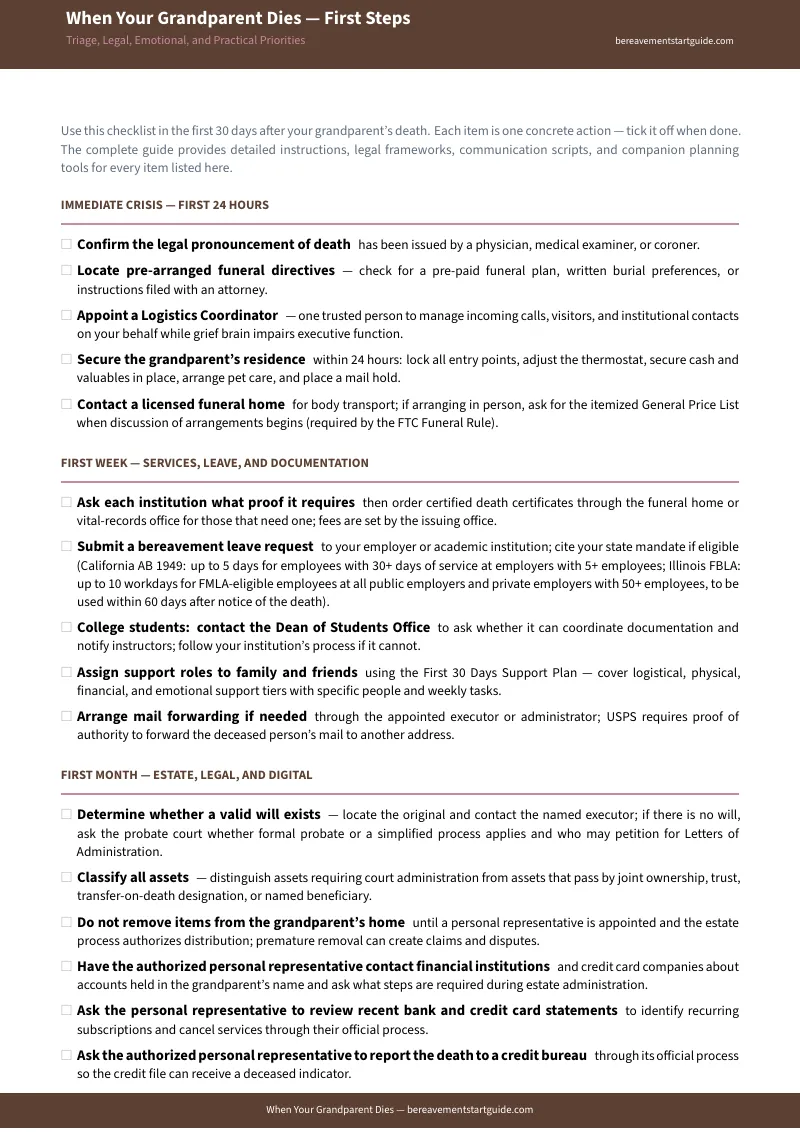
- 22-Item Companion Checklist — a printable, one-item-at-a-time checklist covering notifications, documents, estate tasks, personal wellbeing, and memorial planning
Who This Is For
- College students and young adults facing their first major loss while juggling academic deadlines, limited bereavement policies, and a brain that temporarily can't study
- Working professionals navigating a corporate leave system that treats grandparent death as an "extended family" event deserving one day off — if that
- Parents in the middle generation managing their own deep grief, organizing estate logistics, and trying to explain death to their own children, all at once
- Custodial grandchildren for whom this loss is functionally the death of a parent — with all the legal, financial, and housing complexity that implies
- Friends, partners, and supporters who want to help but don't know what to say or do beyond "let me know if you need anything"
Why Not Free Resources?
Free grief resources exist. They are fragmented across dozens of websites, written for a generic audience, and structured so that a person in acute cognitive fog has to search, evaluate, organize, and synthesize advice across multiple tabs — the exact cognitive task that grief brain makes nearly impossible.
Therapy blogs assume you can process clinical frameworks while you're barely sleeping. Hospice handouts are institutional and cold. Support forums require emotional energy you don't have. Grief books are 300 pages of narrative when you need a checklist you can read at 2 a.m.
This toolkit consolidates the emotional validation, legal roadmaps, communication scripts, and administrative checklists into a single document sequenced for a brain under acute stress. Open it, find your chapter, follow the steps.
Guarantee
Full refund, no time limit. If the toolkit doesn't help, email hello@bereavementstartguide.com and you'll get your money back. No questionnaire, no deadline.
Get Started Now
Download the free First Steps checklist for an immediate action plan, or get the complete When Your Grandparent Dies toolkit for — the full 42-page guide, 7 fillable companion worksheets (triage checklist, support plan, estate tracker, holiday calendar, property ledger, agency log, and memory project), and the companion checklist delivered instantly as PDFs.