
Everyone is asking about your parents. Nobody is asking about you.
Your sibling has died, and the world has decided your grief is secondary. Condolences are addressed to your parents, your sibling's spouse, their children — and you are expected to be the composed coordinator holding the family together. Bereavement researchers call you a "forgotten mourner." More than four million American adults lose a sibling each year, and almost none of them receive the institutional recognition, workplace support, or family acknowledgment that their grief deserves.
Meanwhile, the administrative crisis is landing on your desk. Death certificates that need ordering. An apartment that needs securing before the landlord's clock runs out. Estate administration where siblings rank fifth in the legal hierarchy — behind spouses, children, grandchildren, and parents — meaning you may have no automatic authority over the decisions you are being asked to make. Bereavement leave policies that give you two or three unpaid days when you cannot function for two or three months. Digital accounts locked behind platform-specific legal requirements. Family members who are too shattered to help, or too angry to cooperate.
And your brain is injured. The neurobiological response to losing a sibling — "grief brain" — suppresses working memory, impairs decision-making, and drops functional IQ by 10 to 15 points. You are being asked to navigate a legal and emotional crisis with a brain that cannot reliably remember a conversation from ten minutes ago.
The Forgotten Mourner's Triage System — structured support for the grief nobody prepared you for
The When Your Sibling Dies toolkit is not a book of reflections or a generic grief workbook. It is a step-by-step operational system built specifically for surviving siblings — the people whose grief is real, whose administrative burden is enormous, and whose support infrastructure is nearly nonexistent. Every chapter is structured as a sequence of checklists, fill-in-the-blank forms, and copy-and-paste scripts — because you do not have the cognitive bandwidth to research probate law, draft workplace emails, or mediate family disputes right now. This system does that work for you.
The complete toolkit includes a 45-page guide covering 13 chapters, a companion checklist, and a suite of companion tools — the First-Week Triage Checklist, a Household and Estate Task Allocation Matrix, an Agency Communication Log, a Milestone and Anniversary Coping Calendar, a Memory Project Planner, and a Sensory Continuing Bonds exercise set.
What's inside
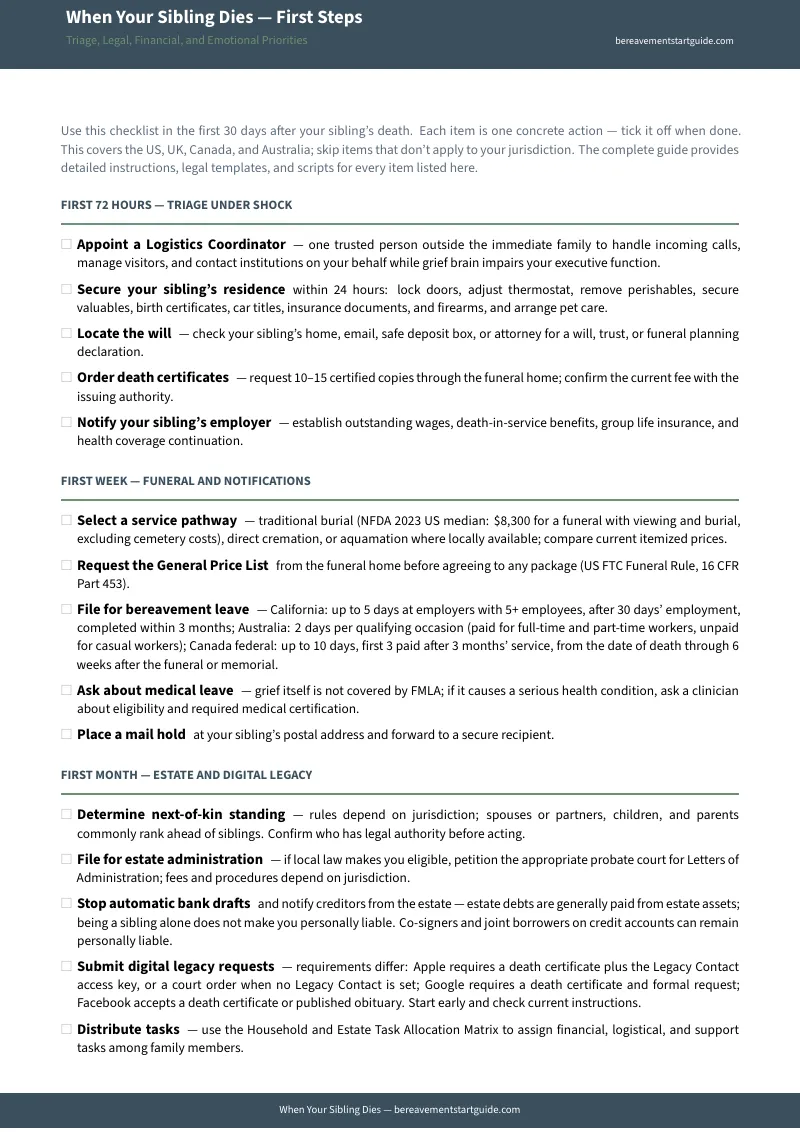
- The First 72 Hours Triage Protocol — exactly what must happen immediately: securing the residence within 24 hours, ordering 10–15 certified death certificates, locating the will, notifying the employer, and appointing a Logistics Coordinator to shield you from incoming calls while grief brain impairs your executive function
- The Forgotten Mourner Framework — why your grief gets overlooked, how the disenfranchisement cycle works, and specific strategies to break the pattern without breaking the family. Because "How are your parents doing?" should not be the only question anyone asks you
- The Legal Authority Map — a clear framework for understanding who controls funeral decisions, estate administration, and body disposition based on whether a will exists, your sibling's marital status, and your jurisdiction. Includes intestate succession rules across the US, UK, Canada, Australia, and New Zealand — so you know your legal standing before you invest emotional energy in a plan someone else has the authority to override
- The Workplace Script Kit — copy-and-paste templates for notifying your employer, requesting extended leave, and handling the return-to-work transition. Includes a four-country bereavement leave framework (US federal provides zero days; California up to 5; Canada federal up to 10 with the first 3 paid; Australia 2 days paid; New Zealand 3 days paid) so you know exactly what you are entitled to before the conversation starts
- The Family Role Shift Guide — structured strategies for resisting the pressure to absorb your deceased sibling's family role, supporting grieving parents without suppressing your own grief, and distributing household and estate tasks across remaining family members using the Task Allocation Matrix
- The Property Division System — four evidence-based methods for dividing personal belongings without destroying relationships: reverse round-robin drafts, colour-coded sticker allocation, sealed-bid auctions for high-value items, and pre-sorting protocols to prevent escalation
- The Digital Estate Guide — platform-by-platform access procedures for Apple, Google, Facebook, X, and LinkedIn, including required documents, what you can and cannot retrieve, and the legal hierarchy that determines access
- Boundary Scripts and Communication Templates — ready-to-use language for setting boundaries with family members who compare your grief unfavourably to a parent's, colleagues who ask invasive questions, and extended relatives who police your emotional expression
- Continuing Bonds Exercises — clinically grounded writing prompts, ritual frameworks, and memory preservation tools for maintaining your connection to your sibling without the toxic pressure of "closure" or "moving on"
Who this is for
This toolkit is for anyone whose brother or sister has died — whether the death was sudden or followed a long illness, whether your sibling was 19 or 79, whether you were close or estranged. It covers the full range of circumstances: accidental death, terminal illness, suicide, overdose, homicide, and military service.
It is also for people who want to help a grieving sibling. Several chapters include guidance specifically for supporters, including scripts for what to say and what to avoid, a task delegation system, and strategies for providing sustained help beyond the first two weeks.
If you are buying this for someone who has just lost a sibling, the toolkit is designed to be gifted — they can start with Chapter 1 and work through it at their own pace.
Why free resources aren't enough
The information in this toolkit exists across dozens of sources — probate attorney blogs, hospice brochures, grief therapy websites, workplace leave statutes, digital estate articles, bereavement support directories. Every single one of those sources assumes you have the cognitive capacity to find it, evaluate its accuracy, determine whether it applies to your jurisdiction, and synthesise it into an action plan.
You do not have that capacity right now. Grief brain measurably impairs working memory, concentration, and executive function. Asking you to assemble your own legal and administrative playbook from scattered free sources is like asking someone with a broken leg to build their own crutch.
Generic grief workbooks make the problem worse, not better. They are designed for spousal or parental loss — they do not address the sibling-specific challenges of legal disenfranchisement, family role absorption, the "forgotten mourner" dynamic, or the institutional reality that your bereavement leave may be two unpaid days. This toolkit addresses all of them.
Satisfaction guarantee
Full refund, no time limit. If this toolkit does not help, email hello@bereavementstartguide.com and we will refund your purchase immediately. No questions, no forms, no waiting period.
You are also welcome to download the free checklist first — it covers the essential first steps and gives you a clear sense of the toolkit's structure and tone before you decide.
Get the toolkit
The full When Your Sibling Dies toolkit is available as an instant download. You will receive the complete guide, the companion checklist, and all companion tools immediately after purchase. The free checklist is available with just your email — no payment required.
For , you get the complete system: every checklist, every script, every timeline, every worksheet. One purchase, lifetime access, no subscription.