When Grief Stops Moving — And Nobody Tells You Why
Everyone says grief gets easier with time. For most people, it does. The waves come less often, the fog lifts, the world slowly regains its color.
But for roughly one in ten bereaved adults, that never happens. The pain does not fade. It stays constant — a presence so heavy that basic functioning becomes an act of will. Getting out of bed. Answering the phone. Walking past the room they used to sit in.
If that describes you or someone you love, what you are dealing with has a name. In 2022, the American Psychiatric Association formally recognized Prolonged Grief Disorder in the DSM-5-TR. It is not weakness. It is not a failure to cope. It is a clinically distinct condition — and it responds to specific treatments that standard depression therapy does not provide.
The problem is that nobody hands you the diagnostic line. Therapists who do not specialize in grief often treat PGD as depression, prescribing antidepressants and general talk therapy that address the wrong pathology. Family members keep waiting for you to "snap out of it." And you keep blaming yourself for not being able to do what everyone else seems to manage.
The Complicated Grief Navigation System
This toolkit was built for the gap between clinical psychoeducation and generic self-help — the gap where most grieving families fall. It gives you the Complicated Grief Navigation System: the validated screening instruments, clinical frameworks, and practical decision tools that separate what is normal from what needs intervention, and then walks you through exactly what to do next.
It is not a therapy replacement. It is a bridge — between the isolation of "something feels wrong" and the structured support of a grief-specific treatment plan. One you can start building tonight.
What the Toolkit Covers
- The neurobiology of grief-brain — why you cannot concentrate, remember, or sequence tasks, explained in clinical terms without clinical coldness. Understanding what is happening in your prefrontal cortex is the first step toward stopping the self-blame.
- The exact DSM-5-TR diagnostic criteria — not paraphrased, not simplified into uselessness. The actual clinical threshold, explained so a non-clinician can understand where the line falls between normal bereavement and Prolonged Grief Disorder.
- Two validated self-screening instruments — the PG-13-Revised (13-item scale, clinical standard) and the Brief Grief Questionnaire (5-item rapid screener). Complete them before your first appointment and bring objective data instead of "I just feel wrong."
- PGD versus depression versus PTSD — they share symptoms but respond to entirely different treatments. The differential diagnosis table helps you (and your therapist) target the right condition from the start, instead of cycling through ineffective protocols.
- Crisis escalation protocol — organized by severity level with specific behavioral thresholds. Not "call a hotline" — a structured decision tree for when to monitor, when to intervene, when to call 988, and when to restrict access to lethal means.
- Verbatim communication scripts — for calling financial institutions to freeze accounts, requesting creditor extensions, establishing family communication ground rules, declining unreasonable pressure during estate settlement, and requesting a bereavement leave extension. Copy them word-for-word or adapt them — they give you a starting point when your brain cannot compose a coherent sentence.
- Estate administration under cognitive impairment — fiduciary liability protection, creditor priority hierarchies, document sourcing, and digital estate management across the US, UK, Canada, and Australia. Because many people navigating complicated grief are simultaneously managing hundreds of hours of estate settlement with a brain that cannot hold a three-step sequence.
- Family conflict resolution frameworks — decision-rights matrices, structured mediation protocols, and sentimental property division systems. Grief accelerates family dysfunction; these tools contain the damage before it becomes litigation.
Who This Is For
You are grieving and it has been months — or more than a year — and the pain has not diminished. You wonder whether something is clinically wrong, but you do not know how to tell, and your doctor has not brought it up.
Or someone you love is stuck. They have withdrawn from friends, stopped engaging with life, and every attempt to help lands wrong. You need a framework — not platitudes — for recognizing the severity and knowing when professional intervention is no longer optional.
Or you are managing estate settlement while your cognitive function is actively compromised by grief. You need practical systems that protect you from fiduciary mistakes when your brain is working against you.
Why Free Online Resources Are Not Enough
The information exists. Scattered across PubMed abstracts, government portals, clinical practice guidelines, and funeral home blogs that stop being useful after the first 48 hours.
The problem is not access. It is assembly. Researching complicated grief while experiencing complicated grief is like reading a map during an earthquake. Every hour spent searching for fragmented answers is an hour your impaired executive function could be directed toward the three or four things that actually matter today.
This toolkit consolidates what a clinical psychologist, an estate attorney, and a family mediator would tell you — if you could afford all three, get appointments with all three, and hold the conversation with all three while your brain is operating at a fraction of its normal capacity.
Start With the Free Checklist
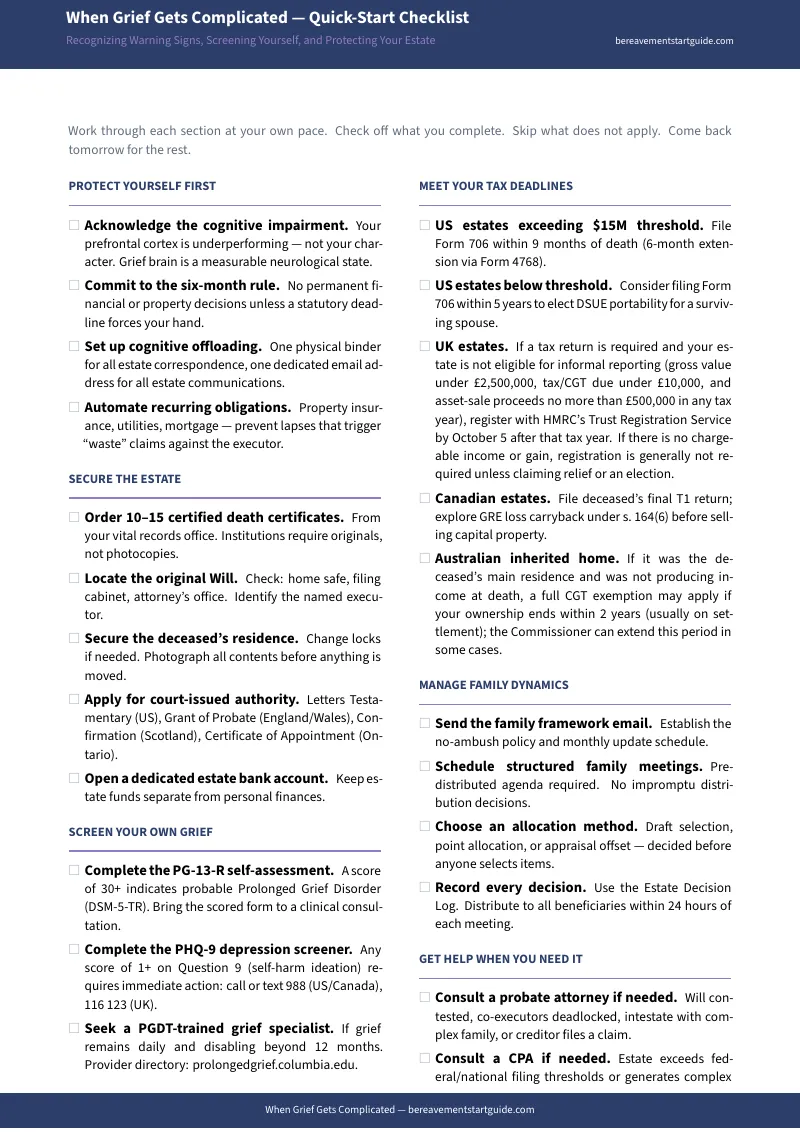
Download the quick-start checklist — 24 prioritized action items across six phases — to see whether this approach fits how you think. It covers what to do and in what order. If you need the why and the how — the screening instruments, the diagnostic frameworks, the scripts, the estate protection systems — the full toolkit picks up where the checklist stops. You get the 47-page guide plus 10 standalone printable tools: fillable screening worksheets, a crisis escalation protocol, communication scripts, document trackers, decision logs, and family coordination templates.
Full refund, no time limit. If the toolkit does not serve you, email hello@bereavementstartguide.com and we will return every penny. No questions, no hoops.
Your grief deserves more than a Google search at 2 a.m. It deserves a system.