You Lost Someone. The World Says It Doesn't Count.
Your partner died and you have no legal standing to claim the body. Your estranged parent named you executor and you don't even know their bank's name. Your friend overdosed and the family has shut you out of everything — the funeral, the apartment, the memories.
The probate system, the hospital, the employer, the landlord — they all have a form for the surviving spouse. They have no form for you.
You are navigating frozen bank accounts, hostile relatives, statutory deadlines, and a brain that can barely form a sentence, while the people around you question whether you even have the right to grieve. This is disenfranchised grief — loss that society does not acknowledge, validate, or support — and it demands a fundamentally different kind of help than a sympathy card or a generic checklist.
The Invisible Mourner's Administrative Shield
This toolkit was built specifically for the person the system ignores. Not a grief journal. Not a legal forms generator. An operational roadmap that merges practical estate administration with the clinical reality of what grief does to your brain — designed from the ground up for people who lack traditional next-of-kin status, face family conflict, or grieve stigmatized deaths.
Every chapter is structured for a brain under siege. Neuroscience shows that acute grief temporarily reduces executive function by 10–15 IQ points, hyperactivates your threat-detection system, and distorts your perception of time. The toolkit accounts for this: decision-rule tables replace dense paragraphs, micro-task breakdowns replace overwhelming to-do lists, and a pacing tracker separates what must happen in 72 hours from what can safely wait six months.
What's Inside
- 72-Hour Survival Roadmap — the exact sequence for securing your housing, arranging dependent care, and navigating funeral planning when biological family excludes you
- Document Acquisition Guides for Non-Traditional Mourners — how to establish "direct and tangible interest" to obtain death certificates, file for Letters Testamentary or Letters of Administration, and access vital records when you are not legally recognized as next of kin
- Estate Tracking Worksheets — asset inventory logs, creditor notification trackers, and IRS Form 4506-T walkthrough for tracing hidden bank accounts, pension plans, and investment accounts you never knew existed
- Copy-and-Paste Communication Scripts — pre-written, neutral-tone templates for notifying banks, employers, landlords, insurance companies, and hostile relatives, so you never have to explain a painful family history from scratch
- Family Conflict Resolution Decision Tree — a structured framework for navigating sibling power struggles, disputed wills, sentimental-item division, and mediation pathways that protect both relationships and legal standing
- Digital Legacy Access Strategies — legally compliant methods for accessing email accounts, cloud storage, social media, and digital financial platforms under RUFADAA and platform-specific legacy contact policies
- Emotional Pacing System — a Dialectical Behavior Therapy-informed toolkit with Opposite Action, Radical Acceptance, and ABC PLEASE skills adapted specifically for the intersection of administrative overload and unvalidated grief
- Professional Consultation Worksheets — structured question lists for estate attorneys, accountants, and trauma therapists, so every billable hour produces maximum clarity instead of fumbled, grief-brain confusion
Who This Is For
- Unmarried partners locked out of a shared home and frozen bank accounts because the legal system treats you as a stranger to the person you built a life with
- Estranged children named executor of an estate you know nothing about, exposed to personal liability for administrative errors in a life you walked away from
- Stigmatized mourners grieving a death by suicide, overdose, or in circumstances the community judges rather than supports — while the family enforces a sanitized narrative
- Same-sex partners in jurisdictions that do not fully recognize your relationship, facing additional layers of legal and social exclusion
- Chosen family members, close friends, ex-spouses, and step-relatives who lost someone deeply important and discovered that the institutional systems have no category for what you are
Why This Exists (And Why Free Tools Fall Short)
Legal forms platforms build wills — they do not help you survive the aftermath when no will exists. Funeral home blogs are generic checklists written for the surviving spouse. Government portals are dense, legalistic, and assume cooperative families with clean paperwork. Grief journals are reflective workbooks without a single asset-tracing worksheet or creditor-notification template.
None of them were built for you — the person who does not fit any of their categories.
This toolkit occupies the gap between sterile legal forms and clinical therapy. It validates the profound pain of your loss while giving you the exact administrative steps to protect your rights, settle the estate, and communicate with institutions that do not understand your situation.
Your Investment Is Protected
Full refund, no time limit. If the toolkit does not help you navigate your situation, email hello@bereavementstartguide.com and you will receive a complete refund. No forms, no explanations, no waiting period.
Start Tonight
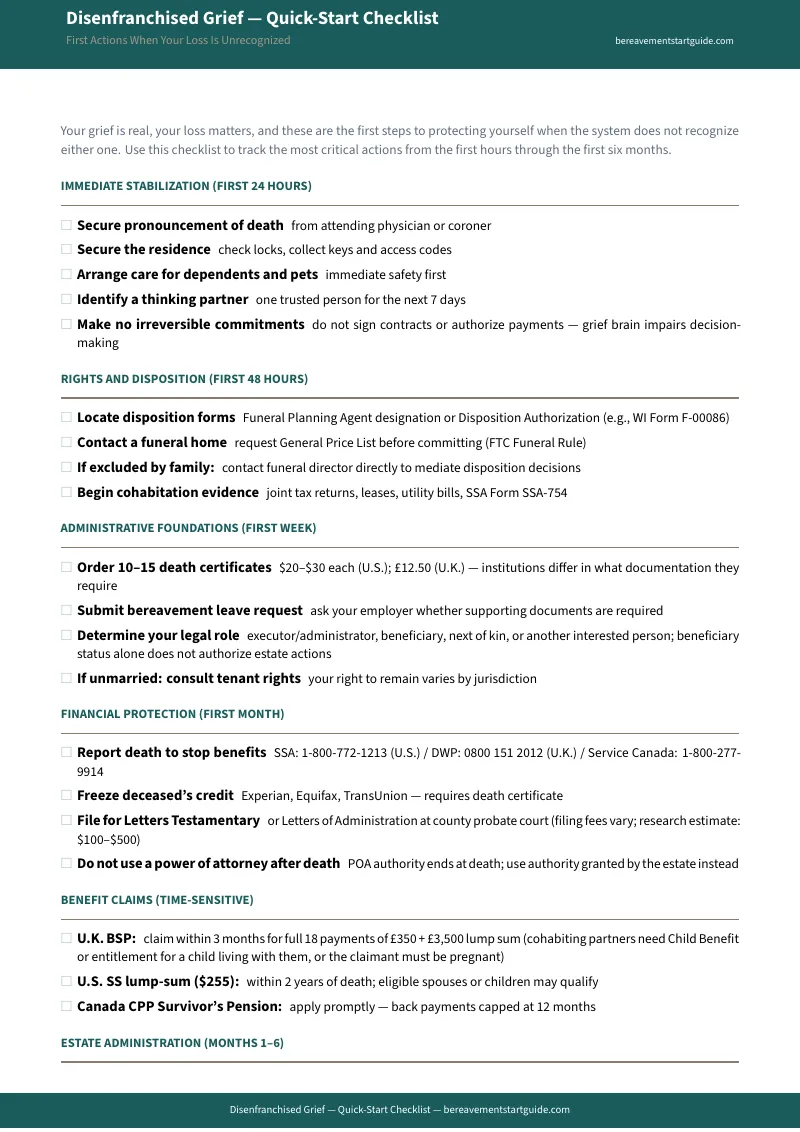
Download the free 27-item checklist to identify your most urgent next steps right now. When you are ready for the full roadmap — the chapter-by-chapter guide with worksheets, scripts, decision trees, and emotional pacing tools — the complete toolkit is available for instant download at .