
Every family thinks they'll handle this part calmly — until three siblings want the same ring
A death fills a house with decisions nobody is prepared to make. The probate court expects a complete inventory with fair market valuations within ninety days. Siblings who haven't argued in years are suddenly negotiating over a dining table, a quilt, a box of photographs. And the executor — who never asked for this role — is supposed to keep everything fair while operating under a level of cognitive impairment that neuroscience has a clinical name for: grief brain.
Free checklists tell you to "distribute personal property." They skip the part where your brother refuses to leave the house, your sister accuses you of hiding jewelry, and a $500 professional appraiser is the difference between a tax audit and a clean filing.
The Fiduciary Shield System
The Dividing Personal Property toolkit replaces emotional guesswork with a defensible process. Every allocation method in this guide — the serpentine draft, the 100-point silent bidding system, the colored sticker method — is borrowed from professional estate mediators and translated into a format any family can run at the kitchen table without hiring one.
When a sibling accuses the executor of bias, the response is simple: the executor did not decide who gets what. The system decided. That shift — from subjective judgment to objective framework — is what keeps families from fracturing over possessions that carry decades of memory.
What's Inside
- Estate Inventory Tracker — a room-by-room system for cataloging every item with photographs, estimated values, and heir interest flags. Designed for cognitive overload: one room per session, fill-in-the-blank fields, no decisions required until the full picture is documented.
- Three Allocation Systems — serpentine draft (heirs take turns in a reversing snake pattern), 100-point silent bidding (each heir distributes 100 priority points across contested items), and preference matching (private lists compared by the executor). Choose the system that fits your family's conflict level.
- Communication Scripts — word-for-word email and message templates for the conversations that derail estate settlements: notifying siblings that locks have been changed, responding to accusations of hiding assets, introducing the allocation process, and requesting that family members stop removing items.
- Sentimental Item Allocation Sheet — a structured worksheet for separating emotional value from monetary value. Matching sets (silverware, china) are declared upfront as single selections or individual pieces, preventing mid-draft arguments.
- Tax and Valuation Guide — plain-language explanations of stepped-up basis under IRC Section 1014, the 28% collectibles rate that catches families off guard, and the difference between inheriting and receiving a gift (carryover basis, which can mean thousands more in capital gains tax).
- Medicaid Estate Recovery Briefing — which assets states can and cannot pursue, the household goods exemption, protected occupant categories (surviving spouse, child under 21, disabled child), and sibling and caregiver home protections.
- Fiduciary Deadline Tracker — every probate deadline mapped across the administration timeline: inventory filing, creditor notification windows, estate tax deadlines, and distribution milestones. Missing one deadline can expose the executor to personal liability.
- Professional Screening Questions — the exact questions to ask a probate attorney, a CPA, an appraiser, and a senior move manager before hiring, so you spend professional fees on genuine expertise rather than basic orientation.
Who This Toolkit Is For
- Executors dividing a household — you have been appointed by the court and need a fair, documented process for distributing personal property among multiple heirs while protecting yourself from breach-of-duty claims.
- Adult children settling a parent's estate — you need to divide decades of belongings with your siblings without destroying the family relationship in the process.
- Families clearing out a home under deadline pressure — the property is carrying costs (taxes, insurance, utilities on a vacant home), the court wants an inventory, and you need a system that moves at the pace your grief allows.
- Anyone dealing with a sibling occupancy dispute — one heir is living in the house rent-free, and you need to understand ouster rules, carrying-cost offsets, and when a partition lawsuit is the only remaining option.
Why Free Resources Leave Families Exposed
Legal blogs explain what probate is. Funeral home articles tell you to "communicate openly." Neither one tells you how to respond at 11 p.m. when your brother texts that he took Dad's tools because "Dad would have wanted it," or how to calculate whether Grandma's jewelry collection triggers the 28% collectibles tax rate, or what to do when a Medicaid lien appears on the house six weeks after the funeral.
The distance between knowing the rules and having a workable process is where families break. This toolkit fills that gap with the forms, frameworks, and scripts that keep the settlement moving and the relationships intact.
Full Refund, No Time Limit
If the toolkit does not help you navigate your family's situation, email hello@bereavementstartguide.com for a full refund. No time limit, no questions asked. You are dealing with enough — a purchase decision should not add to it.
Get the Dividing Personal Property Toolkit — bring structure, fairness, and documentation to the process that every family dreads and no free checklist prepares you for.
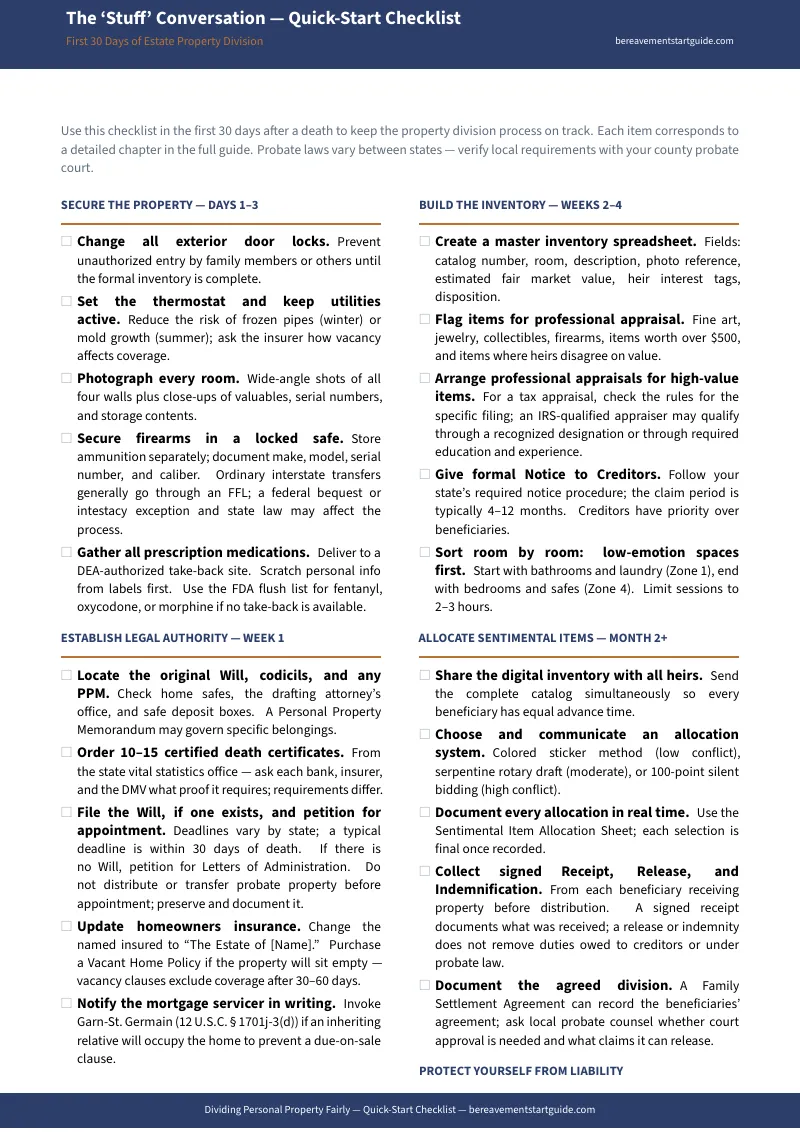
Or start with the free Quick-Start Checklist to see whether the approach fits your situation before committing to the full toolkit.