
The 48-Hour Crisis Navigator
Someone you love just died. In the next two days, you'll face more administrative, legal, and emotional decisions than most people handle in a year — and you'll face them with a brain that's barely functioning.
Neuroscience has a name for what you're experiencing right now: grief brain. Your prefrontal cortex — the part of your brain responsible for planning, decisions, and impulse control — is running on fumes while cortisol and adrenaline flood your system. You can't sleep, you can't eat, and you can barely remember what someone told you ten minutes ago.
And yet: the funeral home needs decisions. Social Security needs notification. The credit card companies need to be told before the scammers move in. Your family needs someone to coordinate — and they're looking at you.
The First 48 Hours toolkit is the emergency plan your family deserves. Not a grief book. Not a legal manual. A crisis navigator — structured for a brain under siege, printed and filled out with a pen, sequenced in the exact order that protects your family, your finances, and your sanity.
What makes this different from a free checklist
Free checklists tell you what to do. They don't tell you how — and they don't tell you what to say when your hands are shaking and your voice is breaking.
The toolkit gives you word-for-word scripts for every difficult phone call, every awkward family conversation, and every institutional notification. It separates the tasks that are genuinely urgent from the ones that can wait — because grief makes everything feel urgent, and the funeral industry profits when you can't tell the difference.
What's Inside
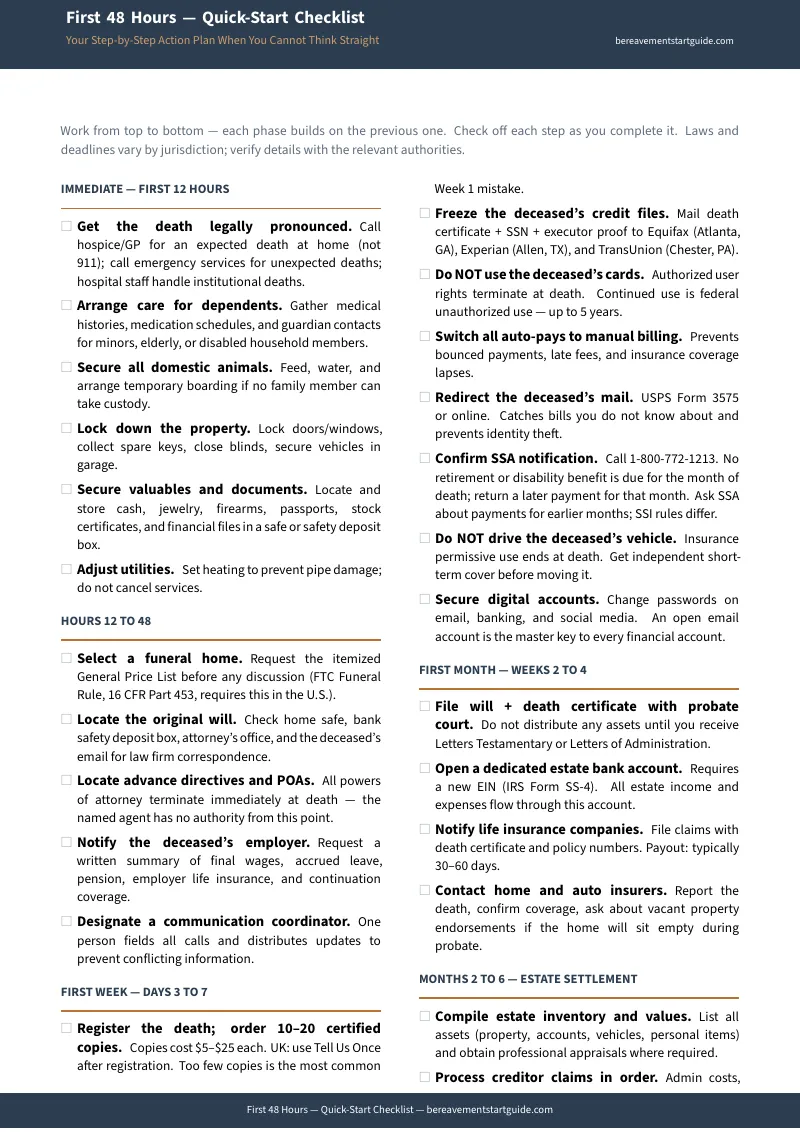
Hour-by-Hour Triage Checklist
A chronological action plan that separates the first 6 hours (secure the home, pronouncement, initial calls) from the next 18 hours (notifications, document gathering) from day two (credit bureaus, mail forwarding, DMV). Every task tells you who to call, what to say, and what document to have in hand.
Copy-and-Paste Notification Scripts
Text messages, emails, and phone scripts for employers, distant relatives, Social Security, the VA, insurance companies, and banks — because at 2 a.m., your brain physically cannot compose a coherent sentence, and these scripts don't require it.
Family Conflict Boundary Templates
Your sister wants cremation, your brother wants burial, your aunt won't stop calling. The toolkit includes the legal hierarchy of who has the right to make disposition decisions in your state — plus word-for-word boundary scripts that defuse tension without yielding control: "I hear how important this is to you. We're not able to do that right now. What we can do is…"
FTC Consumer Rights Shield
Funeral homes must give you an itemised General Price List before you agree to anything. You can buy a casket from a third-party retailer. You don't have to pay for embalming you didn't authorise. The toolkit puts these protections — and the exact language to invoke them — in your hand before your first meeting with a funeral director. Families who don't know their FTC rights routinely overpay by thousands.
Identity Theft Prevention Protocol
Within hours of an obituary going live, scammers can file fraudulent tax returns, open credit cards, and claim benefits in your loved one's name. The toolkit walks you through locking down credit at all three bureaus, notifying the IRS, and writing an obituary that doesn't advertise that the house will be empty during the service.
Document Locator and Tracker
A printable worksheet for tracking down the will, insurance policies, DD-214, Social Security numbers, and account details — with common hiding places and who to contact when documents are genuinely missing.
Fillable Worksheets and Planning Tools
Six standalone printable worksheets designed to be filled out with a pen during the moments when your cognitive energy is lowest: a property audit sheet for the first walk-through, a next-of-kin contact registry, a subscription and account tracker, and an institutional notification log for every call you make over the next month. Each one replaces a task that would otherwise require you to build a tracking system from scratch while grieving.
Emotional Pacing Guidance
Based on the neuroscience of acute grief. The toolkit explains why you're physically exhausted, why you can't remember conversations, and why making permanent decisions right now is dangerous. It gives you clinical evidence — and explicit permission — to slow down, delegate, and separate the urgent from the merely loud.
Who This Is For
- The person who just became "in charge" — executor, eldest child, surviving spouse, or the one everyone is looking at whether you volunteered or not
- Families after a sudden death — car accident, heart attack, overdose, workplace incident — where there was no hospice, no warning, and no time to prepare
- Adult children managing a parent's death from a distance — the phone scripts and delegation framework let you stabilise the situation remotely
- Anyone helping a grieving friend — hand them the checklist or work through it for them; it's designed for a helper, not just the bereaved
- Pre-planners — print it now, store it with your important documents, and spare your family the scramble
Why Not Free Online Checklists
You can piece this together from funeral home blogs (which are sales funnels), government portals (written in bureaucratic language for functioning brains), Reddit threads (with conflicting advice), and estate planning articles (designed to sell you a lawyer).
At 2 a.m., with a brain that can barely process a sentence, you don't have the cognitive bandwidth to filter, sequence, and verify twenty different sources. The toolkit does that work for you — in a format designed for someone who is barely functioning.
The free checklist gives you what to do. The full toolkit gives you how — the scripts, the templates, the rights, the pacing — and it does it in the order that actually matters.
Full Refund, No Time Limit
If the toolkit doesn't help, email hello@bereavementstartguide.com and we'll refund you — no time limit, no questions. You're going through enough without worrying about a return policy.
Less Than a Single Hour With an Estate Attorney
The average estate attorney charges $250–$400 per hour. The average U.S. funeral costs $7,000–$12,000 — and families who don't know their FTC rights routinely leave thousands on the table. This toolkit costs a fraction of either — and it's ready to use right now, not next Tuesday at 2 p.m.
Get the toolkit for . Instant download. Works offline with a pen.