
Your brain is running at half capacity. The estate needs you at full.
The funeral is over. The casseroles stopped arriving. And now, three weeks in, you're discovering what grief actually does — not just to your heart, but to your ability to think. You read a bank letter three times and retain nothing. You forget appointments you made yesterday. A simple question from your sibling about the house sends you into a spiral that swallows the afternoon.
This is not weakness. Neuroscience research has documented that grief suppresses prefrontal cortex activity, floods your system with cortisol, and keeps your amygdala — the brain's alarm center — in a state of chronic hyperactivation. Reading comprehension drops 25 to 30 percent. Working memory degrades. Decision-making capacity collapses at the exact moment the estate, the taxes, the family, and the holidays all demand yours.
This is the Grief Year Navigator — a month-by-month action plan designed for a brain that clinical research confirms is operating under documented neurological impairment. It maps every administrative milestone, family conversation, and emotional shift across all twelve months, sequenced to match the way grief actually moves through the year.
Why month six is worse than month one
Everyone rallies in the first week. By month six, the cards have stopped, people have moved on, and your grief hits a second wave that researchers call the "six-month slump." This is when cortisol levels remain elevated long enough to cause measurable hippocampal volume changes — your short-term memory literally shrinks. It is also when critical tax filing deadlines land, when the question of what to do with the family home becomes unavoidable, and when sibling disagreements about personal property tend to escalate from tense conversations into lasting rifts.
Most bereavement resources are front-loaded: they cover the first week exhaustively and assume the rest takes care of itself. This guide does the opposite. It gives you month-by-month chapters that anticipate the six-month resurgence, the anniversary dread of months ten through twelve, and the administrative deadlines that coincide with each emotional low point — so you are never blindsided by both at once.
What's inside
Month-by-month action plan covering all twelve months — each chapter maps the emotional terrain (what your brain is doing, why this month feels different from the last) alongside the administrative tasks that belong to that period. Month one covers death registration, securing property, and ordering 10 to 15 certified death certificates. Months two and three handle creditor notifications, identity theft prevention, and government agency reporting across the US, UK, Canada, and Australia. Months four through six walk you through full asset inventory, property appraisals, and the probate timeline. Months seven through twelve cover tax filing deadlines, estate closure, and final distributions — plus the holiday navigation and anniversary coping strategies that nobody prepares you for.
The 24-48-7 decision rule — a pacing protocol built on grief neuroscience that protects you from making irreversible choices during periods of peak cognitive vulnerability. Routine decisions get a 24-hour hold. Moderate financial commitments get 48 hours. Major, irreversible moves — listing the family home, distributing heirlooms, liquidating investment accounts — require a full 7-day wait. The guide integrates this rule into every monthly chapter so you never have to figure out which category a decision falls into.
Sibling property division frameworks — the division of sentimental personal property causes more lasting family damage than the financial estate. The guide walks you through five objective methods: sticker preference matching for high-trust families, the snake draft with reversed picking order each round, the token auction that levels the playing field when siblings have unequal financial capacity, heirloom time-share rotations for items that cannot be physically divided, and digitize-before-distributing to neutralize conflicts over irreplaceable originals. Each method includes step-by-step instructions, the family situation it fits best, and its specific risks.
Grief neuroscience explained in plain language — the Dual Process Model of coping, why administrative work is not emotional avoidance but a neurobiological necessity, how cortisol floods degrade your hippocampus and anterior cingulate cortex, and what "grief brain" actually looks like at one month, three months, six months, and twelve months. Understanding the biology of what's happening to you removes the layer of shame that makes everything harder.
Country-specific estate administration timelines — the guide covers statutory deadlines, government notification procedures, and tax filing requirements for the United States, United Kingdom, Canada, and Australia. You'll know whether your jurisdiction uses Letters Testamentary or a Grant of Probate, what the Tell Us Once service covers in England and Wales, how to apply for Canada's CPP death benefit within the 60-day window, and when to notify Services Australia.
Holiday and anniversary navigation — the first Thanksgiving without them. The first Christmas morning. Their birthday. Your wedding anniversary. The one-year mark. Each of these carries a distinct grief pattern, and each demands a different coping structure. The guide gives you concrete strategies — not abstract advice to "be kind to yourself" — for planning, delegating, and creating new traditions that honor the person without destroying the day.
Returning to work after loss — how to navigate bereavement leave (which is far shorter than grief), manage cognitive impairment on the job, handle colleagues who don't know what to say, and decide how much to disclose. Includes a workplace boundary script, a three-touchpoint manager framework, and guidelines for phased return-to-work plans.
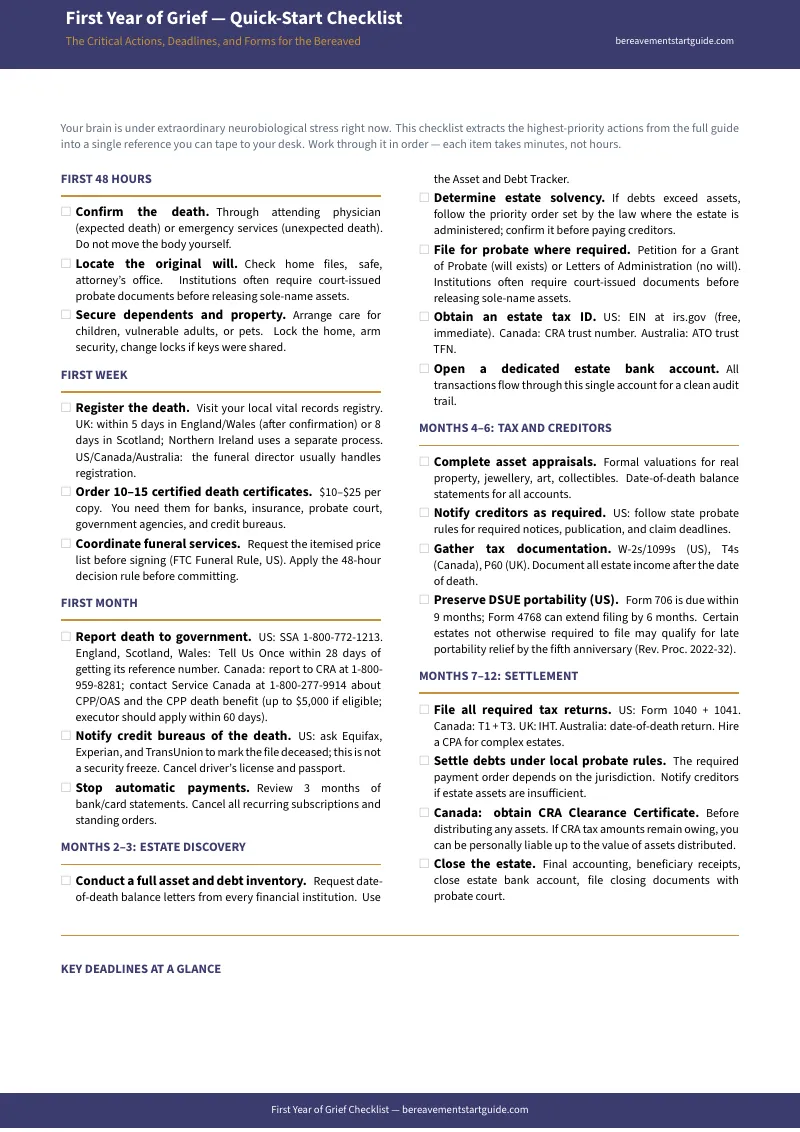
Quick-start checklist — a separate 2-page printable PDF with 24 items that you can tape to the fridge. The checklist tells you what to do. The full guide tells you how, why, and what happens if you don't.
Who this is for
The person who just became responsible for everything — you were named executor, or you're the surviving spouse, or you're the adult child everyone is looking at. You didn't ask for this role. You're not trained for it. And your brain is in a documented state of cognitive impairment. This guide works with that reality instead of pretending it doesn't exist.
Grieving family members who aren't handling the estate — even if someone else is the executor, you still need to understand the timeline. When will the estate close? What's happening with the house? Why is it taking so long? The monthly roadmap gives you visibility into the process without requiring you to manage it.
People who are several months in and drowning — you don't have to start at the beginning. Each month is a self-contained chapter. If you're at month five and just realized you missed the credit bureau freezes, the guide shows you how to catch up without spiraling about what you should have done earlier.
The 2 a.m. searcher — research shows that peak search activity for bereavement logistics happens at 2 a.m. If you're alone with a question that can't wait until morning — how to get into the bank account, whether to pay the medical bills, what to do about the mail — this guide answers it in plain language, without the jargon of a legal portal or the upsell of a funeral home blog.
Why free online information makes things worse
Every fact in this guide exists somewhere on the internet. That's the problem. It's scattered across funeral home blogs designed to sell packages, government portals that assume you speak probate law, legal sites that want a $350-per-hour consultation, and Reddit threads where half the advice is jurisdictionally wrong and the other half is emotionally devastating.
At 2 a.m., operating on three hours of sleep with a brain that cannot hold a paragraph, you do not have the cognitive bandwidth to search, filter, sequence, verify, and reconcile twenty sources. You do not have the capacity to determine which state's creditor notification rules apply to you. You do not have the emotional reserves to stumble onto a forum post that triggers a grief episode because someone else's story hits too close.
The Grief Year Navigator compiles, sequences, and translates. One document. One timeline. Twelve months. Designed for a brain that science says is running at a fraction of its normal capacity.
Satisfaction guarantee
Full refund, no time limit. If the toolkit doesn't help, email hello@bereavementstartguide.com and we'll refund your purchase — no questions, no hoops, no expiration date.
Less than one session with a grief counsellor
A single session with a grief therapist runs $100 to $250. An initial estate attorney consultation costs $250 to $500. This toolkit costs — and unlike either professional, it's available at 2 a.m. when you need it most.
Start with the free checklist
Download the 2-page quick-start checklist at no cost. It covers 24 items across the first year's most critical milestones. If you need the full month-by-month guide, grief neuroscience, property division frameworks, scripts, and tax timelines, the complete toolkit is one click away.