You Shouldn't Have to Google Funeral Etiquette at 2 a.m.
Someone close to you has died. Maybe you're the guest trying to figure out what to wear, what to say at the door, or whether you should bring flowers or a check. Maybe you're the person everyone is calling — the organizer — and between the funeral home contract, the family arguments, and the Social Security paperwork, you haven't slept in two days.
Either way, you're searching for answers that feel both important and impossible to ask anyone out loud. What if I sit in the wrong seat? What if I say the wrong thing? What if my stepmother and my sister won't be in the same room?
This guide was built for exactly that moment.
The Funeral Coordination Framework
Free funeral etiquette articles give you a paragraph on what to wear and a list of things not to say. This guide gives you a complete coordination system — 13 chapters covering every situation that actually causes lasting damage, from the receiving line to the estate paperwork six months later.
The first half is for guests. The second half is for the person running the show while their world is falling apart.
What's Inside
- Condolence scripts that actually work — because "let me know if you need anything" puts the burden on the grieving person. The guide gives you specific, bounded phrases: what to say in the receiving line, what to write in a sympathy card, and what to text two weeks later when everyone else has stopped reaching out.
- Cultural protocol breakdowns for six faith traditions — Western Christian, Jewish, Islamic (Janazah), Hindu, Buddhist, and Sikh services, plus gift customs for Chinese, Filipino, and Korean funerals. What to wear, what head covering to bring, when to stand, when to remove your shoes, and what food to bring (or not bring) afterward.
- A seating chart system for estranged families — structural buffers, aisle placement, and the specific script for delegating physical seating to ushers so the organizer never has to confront anyone directly.
- A 72-hour action plan for organizers — every phone call, deadline, and vendor interaction mapped hour by hour. What to do first. What can wait. What you will regret skipping.
- FTC Funeral Rule consumer protections — your legal right to an itemized price list, to bring your own casket, and to decline embalming. With specific questions to ask the funeral director during the arrangement conference so you don't overpay during the worst week of your life.
- Family conflict decision trees — burial vs. cremation disagreements, budget disputes, and inclusion decisions. Each scenario maps to a clear resolution path, not a vague suggestion to "communicate openly."
- Digital etiquette and social media rules — when it's appropriate to photograph, post, or share. A decision framework that protects the family's privacy and prevents someone learning about a death from your Instagram story.
- Post-funeral administration timeline — death certificates, estate bank accounts, creditor notifications, and tax filings mapped across the first year. Because the funeral is one day, and the paperwork lasts months.
Who This Is For
- Guests attending a funeral who want to show up prepared — especially if the service follows a cultural or religious tradition you're not familiar with
- Grieving organizers (surviving spouses, adult children, executors) who are coordinating the service while processing their own loss
- First-time pallbearers who need to know the physical mechanics and protocol
- Anyone crossing a cultural boundary — attending a Hindu funeral for the first time, a Jewish shiva, or a military service with flag-folding ceremony
Why Free Articles Fall Short
Free funeral etiquette content gives you the obvious rules — wear dark colors, don't talk during the eulogy. But none of it addresses the situations that actually cause lasting damage.
What happens when your father's second wife and your mother are both at the service? What do you say to a coworker's family when you barely knew the deceased? How do you handle a relative who insists on an open casket when the rest of the family wants cremation?
Free articles don't give you the seating template. They don't give you the vendor negotiation scripts. They don't give you the decision tree for when two siblings can't agree on anything and the funeral home needs a signature by Thursday. This guide does.
And it matters because families spend an average of $10,825 on a traditional funeral service. The decisions you make in the first 72 hours — often while your prefrontal cortex is operating at reduced capacity due to acute grief — are binding, expensive, and emotionally permanent. A missed deadline, a blown budget, or an unmanaged family conflict doesn't just cost money. It can fracture relationships that never recover.
Satisfaction Guarantee
If this guide doesn't reduce your stress and bring structure to your planning, email hello@bereavementstartguide.com for a full refund. No time limit, no questions.
Start With the Free Checklist
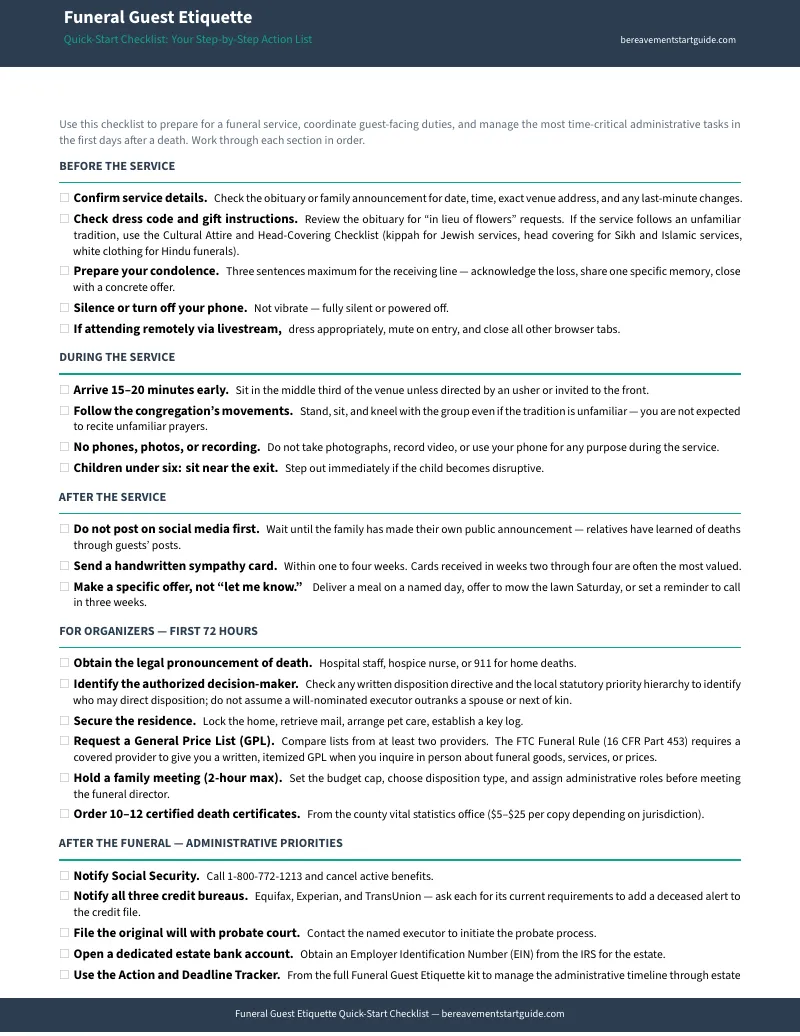
Download the Funeral Guest Etiquette Quick-Start Checklist — a two-page printable with the essential rules for attending any service. If you need the full coordination system, the complete guide is available for .