The funeral home does this every day. You are doing it for the first time, running on grief and no sleep.
The average traditional funeral with viewing and burial costs approximately $9,170. Direct cremation costs $2,200. The difference between what a funeral home will offer you and what the law actually requires can exceed $7,000 — and you are about to negotiate that gap in a single meeting called the arrangement conference, probably within 48 hours of the worst news of your life.
Federal law gives you powerful protections at that meeting. The FTC Funeral Rule requires every funeral home to hand you an itemized General Price List before discussing any merchandise. You can bring your own casket and the funeral home cannot charge a handling fee. Embalming is almost never legally required. But these rights only work if you know they exist before you sit down — and grief brain fog, the neurobiological stress response that suppresses planning and decision-making after a loss, makes it nearly impossible to research consumer protections while you are living through the crisis they are meant to address.
The Arrangement Conference Defense System is a complete toolkit for choosing a funeral home, comparing prices, exercising your consumer rights, and managing the entire procurement process — from the first phone call through the final bill review — built for someone whose cognitive capacity is temporarily impaired by grief and whose timeline is measured in hours, not weeks.
What's Inside the Full Toolkit
- Provider Comparison Tracker — the General Price List is the itemized pricing document every funeral home must give you by law. Most families look at one GPL and accept the total. The tracker lets you compare three GPLs side by side, starting with the non-declinable basic services fee that reveals a funeral home's true pricing floor. Corporate chains, independent family firms, and direct disposition providers price the same services at dramatically different rates — the tracker exposes the pattern in minutes.
- Arrangement Conference Guide — a one-page card to print and bring: the ten questions to ask, the four sentences that protect your budget when the conversation turns to casket upgrades and "honoring" language, and a checkbox to confirm a non-grieving advocate is in the room. Because the arrangement conference is a sales environment, and the person across the table conducts it every week while you are doing it for the first time under the worst possible conditions.
- FTC Funeral Rule Rights Checklist — five non-negotiable federal protections that apply to every funeral home in the United States, with space to tick each one as you exercise it and write the exact language you used. The right to an itemized GPL. The right to choose only the services you want. The right to use a third-party casket without penalty. The right to refuse embalming. The right to accurate information about what the law actually requires. Plus international equivalents in the guide for UK, Canadian, and Australian families.
- Right of Disposition Legal Framework — the person making funeral decisions is not always who you assume. Power of attorney terminates at death. The executor named in the will does not automatically control disposition. Legal authority follows a state-specific next-of-kin hierarchy, and when equal-priority relatives disagree, most states require a majority vote before a funeral home will proceed. The guide maps the hierarchy, the forfeiture rules, and the dispute resolution options.
- Hidden Fee Audit Checklist — the charges that inflate the final bill beyond the GPL total: cemetery opening and closing fees, perpetual care assessments, weekend and holiday surcharges, crematory fees billed separately from the funeral home, "coordination of services" charges for third-party merchandise, and after-hours removal fees. These costs are real, legitimate, and routinely omitted from the initial price discussion. The checklist ensures you account for every one before signing.
- Document Sourcing Checklist — how many certified death certificates you actually need (10 to 12), where to order them, what transit and burial permits are required, how to locate military discharge records for VA benefit claims, and the government benefit claims you are entitled to file. Tick each document as you order it instead of discovering each requirement when the next institution asks for a document you have not ordered.
- Family Decision Log — when siblings disagree about burial versus cremation, when a stepparent asserts authority they may not legally hold, when one family member insists on the most expensive option and others cannot afford it. Record each agreed action, the authority source (majority, designated agent, court order), and who is responsible. The guide's dispute chapter covers the legal hierarchy, the majority rule, structured mediation, and when a probate court filing is the faster path.
Who This Is For
You have never hired a funeral home and you need to choose one this week. The hospital or hospice wants the body moved. You have a list of local mortuaries with no prices, no way to compare them, and a nurse's recommendation that might be genuine or might be the facility's default referral. The toolkit gives you the Provider Comparison Tracker, the consumer-rights checklist, and the Communication Scripts before you sit across the table from a funeral director — so the arrangement conference is a negotiation, not a default acceptance of whatever is presented.
You are handling the funeral and the estate simultaneously. The will, the bank accounts, the insurance claims, the death certificates, the government notifications — and the funeral on top of all of it. The Document Sourcing Checklist maps every certificate, permit, and form in one place, organized by who issues it, where to get it, and how many copies to order. It eliminates the cycle of discovering each requirement when the next institution asks for something you have not obtained.
Your family cannot agree and the funeral home is waiting. Someone wants the cheapest option. Someone wants the most traditional. Someone is not speaking to the others. The guide covers who legally holds decision-making authority in every state, what happens when the designated class of relatives cannot reach a majority, and a structured mediation process that moves the conversation from emotion to logistics.
Why Not Free Resources?
Funeral home websites explain their services — the ones they sell. They do not explain which of those services are optional, how their prices compare to competitors, or what your consumer rights are at the meeting they are inviting you to. Their "educational" content always leads back to the arrangement conference.
The FTC's consumer guide describes your rights in regulatory language. It does not give you the four sentences to say when the funeral director tells you embalming is "required by health code" or that "most families choose" the premium casket. You need the translation, not the statute.
Grief support communities offer solidarity. They do not offer a Provider Comparison Tracker, Communication Scripts, or a fillable FTC Funeral Rule Rights Checklist for telling a funeral director you know you have the right to bring your own casket.
The toolkit is the preparation that grief and time pressure make impossible to assemble on your own — consumer rights, cost comparisons, legal frameworks, and negotiation language in one system, formatted for someone who cannot hold three thoughts in sequence.
Your Decision Is Protected
Full refund, no time limit. If the toolkit does not give you the confidence to walk into the arrangement conference prepared, email hello@bereavementstartguide.com and you will get every cent back. No questions, no deadline.
The Arrangement Conference Has a Date. Your Preparation Doesn't Have to Start From Zero.
The toolkit costs — less than the markup on a single optional service you did not know you could decline. Declining one unnecessary charge at the arrangement conference — embalming you did not authorize, a premium casket for a cremation, a vault the cemetery does not require — routinely saves more than the cost of this toolkit many times over.
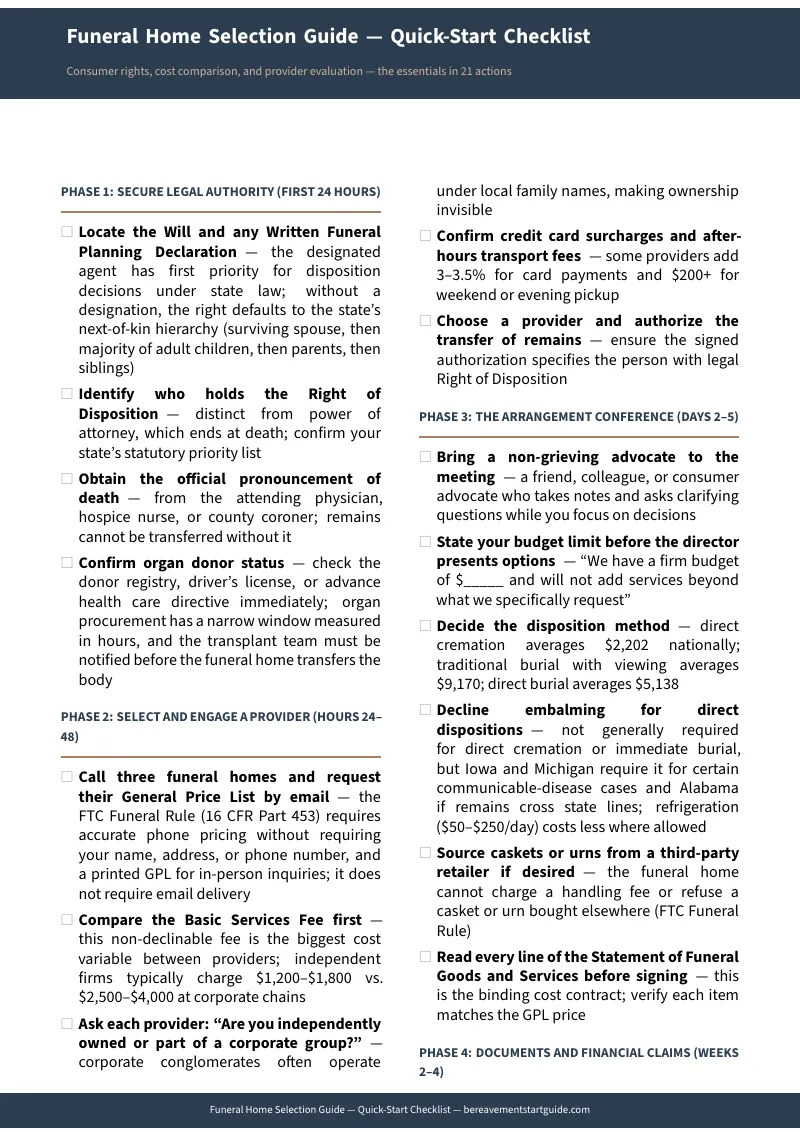
Not ready for the full toolkit? Download the free Quick-Start Checklist — a 2-page, 21-item reference covering the first calls to make, the first documents to find, and the consumer rights to exercise before you sign anything.