The livestream just went silent — and a hundred people are watching
You picked the songs. You coordinated with the funeral home. You set up Facebook Live so out-of-town relatives could be part of the service. And then, forty seconds into "Hallelujah," the audio cut to nothing. A copyright algorithm flagged the song, muted the feed, and now your aunt in Wisconsin is watching a silent funeral on her phone while you scramble to figure out what happened.
This is not a rare glitch. It happens every week at services across the country — because the licensing rules that govern funeral music are invisible until they break. And livestream muting is only one of the ways music planning goes wrong. The organist refuses to play because nobody paid the bench fee. The priest vetoes your mother's favorite song ten minutes before the processional. Two siblings stop speaking over whether the recessional should be a hymn or a Fleetwood Mac track. The USB drive does not work on the crematorium's sound system because it was formatted wrong.
Every one of these problems is preventable. Every one of them has a specific, knowable solution. But those solutions are scattered across copyright law databases, denominational guidelines, AV equipment manuals, and funeral industry resources that no grieving family has time to find — let alone synthesize into a plan — in the three to five days before a service.
The Funeral Music Control System
This is a structured planning toolkit that replaces frantic 2 a.m. searching with a single system. It covers every decision between "what should we play?" and a service where the music runs exactly as planned — legally, technically, and without a family crisis.
Where free "top funeral songs" lists give you ideas without context, this toolkit gives you the framework to evaluate whether each idea is actually usable: Does the venue's license cover this song? Does the denomination permit it during this part of the service? Can the AV system handle this file format? Will the livestream survive it? Is this going to start a fight?
The guide answers every one of those questions before you build your playlist — so you never fall in love with a song you cannot legally, practically, or peacefully use.
What's Inside
- The Three-Layer Licensing Breakdown — performance rights, webcasting rights, and sync rights explained in plain English, so you know exactly what the venue covers, what streaming adds, and what archiving the recording requires. No legal jargon, no guessing.
- FTC Funeral Rule Consumer Protections — your legal right to an itemized General Price List, the no-bundling rule, the outside-purchase right, and the cash advance disclosure requirement for musician and clergy fees. Know your rights before the arrangement conference, not after.
- Denominational Rules for Six Traditions — Catholic (diocesan sacred music lists, the secular music ban during Mass, organ-versus-recorded-music policies), Episcopal, Orthodox, Jewish, Islamic (no music during Janazah), and Hindu service requirements. Check what is permitted before you pick songs, not when the officiant vetoes them.
- The Five-Layer Song Filter — a decision workflow that screens every candidate through denominational rules, licensing, emotional resonance, congregational fit, and format availability. This is why families who use the toolkit do not get blindsided: they never reach the service with a song that cannot be played.
- Curated Song Shortlists by Moment and Genre — processional, reflection, communion, recessional — organized by classical, hymns, contemporary, country, R&B, and instrumental, with licensing notes for each. Not just titles, but the context you need to decide.
- Musician Fee Benchmarks — typical US ranges for church organists, soloists, cantors, bagpipers, and string quartets, plus the bench fee obligation most families do not know about and the clergy honorarium protocol. Budget accurately from day one.
- The Grief-Brain Decision Framework — neuroscience-backed protocols for making sound choices under cognitive fog, including the 30-minute session limit, Track A / Track B triage (urgent logistics versus creative decisions), and the 24-48-7 graduated timeline.
- Family Conflict Resolution Scripts — the "Yes, And" mediation protocol, neutral-buffer techniques that use venue rules to defuse sacred-versus-secular disputes, and ready-to-use conversation starters for the most common disagreements. Stop the argument before it becomes a rift.
- AV and Technical Checklists — USB formatting requirements (FAT32, 32GB max, root directory), file format compatibility tables, sound-check scheduling, and the 10-minute pre-service stream test. No silent surprises on service day.
- Livestream Copyright Survival Guide — how Content ID works, the royalty-free backup playlist using pre-1931 public domain compositions, and platform-specific risks for Facebook Live, YouTube, and Zoom. Protect the stream before you go live.
- Communication Scripts and Templates — ready-to-use emails and talking points for coordinating with the funeral director, officiant, musicians, and family members. Copy, paste, send — when you do not have the mental energy to compose from scratch.
- Seven Printable Planning Tools — Track A/Track B decision matrix, service music planning worksheet, sibling responsibility organizer, musician verification checklist, licensing verification checklist, budget tracker, and shared playlist curation template. Fill them in as you go and bring them to the arrangement conference.
Who This Toolkit Is For
- Designated funeral planners — executors, next of kin, or friends thrust into coordination under a compressed timeline who need the music handled correctly without a visible mistake
- Families navigating disagreements over sacred versus secular music, whose memories count, or who gets final say on the playlist
- Anyone livestreaming a service who needs to understand copyright risks before going live — not after the platform kills the audio
- Planners working with denominational restrictions who need to know what is permitted before committing to song choices the officiant will reject
- Budget-conscious families who want fair musician rates, understand which fees are legally required, and refuse to be surprised by the final invoice
Why Free Resources Are Not Enough
Free funeral song lists tell you what to consider. They do not tell you whether that song is legally playable at your venue, whether the denomination permits it during the formal service, whether the livestream will survive it, or how to handle the sibling who disagrees with the choice. They give you ideas in a vacuum — and ideas without execution produce the exact problems this toolkit prevents.
Funeral home blogs are written to drive you toward their service packages. They will not mention your right to an itemized price list, the bench fee you are about to trigger, or the fact that their performance license does not cover Facebook Live. Government consumer protection guides are accurate but dense — written for a reader who is not sleep-deprived, cognitively impaired by grief, and trying to coordinate with five relatives at once.
This toolkit fills the space between scattered free resources and expensive professional coordination. It is structured, sequential, and written for the reality of making decisions under acute grief — short chapters, clear checklists, and copy-paste scripts for the conversations you do not have energy to improvise.
Our Guarantee
Full refund, no time limit. If the toolkit does not help you plan the music with confidence, email hello@bereavementstartguide.com and we will refund your purchase — no questions, no expiry.
Get Started Now
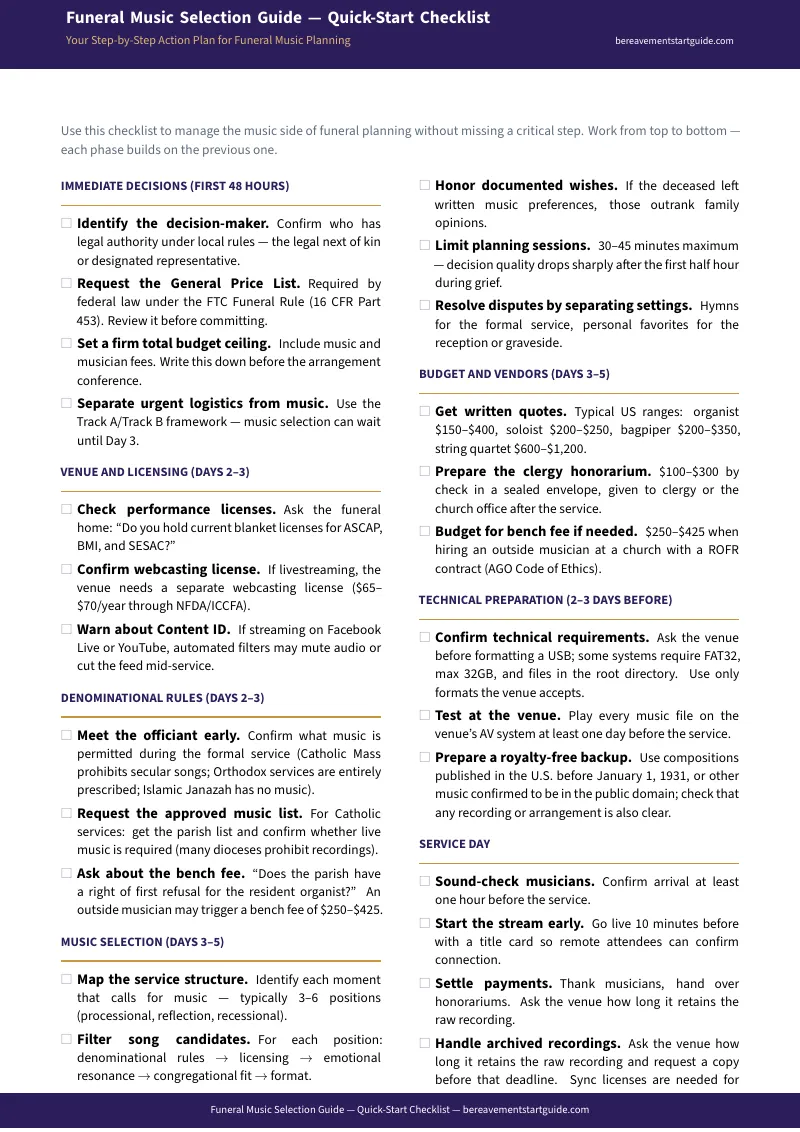
Download the free Quick-Start Checklist to see the 25 essential steps at a glance. When you are ready for the full system — licensing breakdowns, song shortlists, mediation scripts, AV checklists, and planning worksheets — the complete Funeral Music Selection Guide is available for .