The funeral industry profits from your grief. This toolkit protects your wallet.
Within hours of a death, someone in your family will sit across from a funeral director and make financial decisions worth thousands of dollars — under acute cognitive impairment, on a compressed timeline, with no price context and no basis for comparison. The funeral home's entire business model depends on that meeting going one way.
The average traditional funeral costs $7,848 to $10,000 in the US and £4,510 in the UK. Families overspend by $2,000 to $4,000 on optional services they did not know they could decline. Nearly one in five families report lasting financial harm from funeral costs, and 15% take on high-interest debt to cover the gap between what the funeral costs and what the estate can release in time.
The Funeral Planning on a Budget toolkit is a Budget Strategy System — a structured decision-support framework that replaces emotional spending with informed comparison. It combines price-comparison worksheets, word-for-word negotiation scripts citing your federal consumer rights, a clinically informed decision-pacing model, and step-by-step checklists that work even when grief has temporarily impaired your ability to process complex information.
What's Inside
- The Budget Strategy System — the GPL Breakdown & Verification Spreadsheet that standardizes quotes from multiple funeral homes into directly comparable categories, so you see exactly where each provider's pricing falls before you commit to anyone
- FTC Funeral Rule consumer rights reference — plain-language explanations of itemization rights, third-party casket acceptance, embalming disclosure requirements, and the one non-declinable charge on any General Price List, plus UK CMA and Canadian provincial equivalents
- Negotiation scripts — verbatim phone language with fill-in blanks for requesting pricing, declining optional services without confrontation, exercising your right to use a third-party casket, and responding to pressure tactics — because asking for a "discount" damages the relationship, but asking for "itemized alternatives" saves you thousands without the awkwardness
- The 24-48-7 Decision Pacing Framework — a clinically grounded system that categorizes every funeral decision by urgency and permanence, telling you exactly which choices must happen today, which can wait 48 hours, and which should not be made for a full week — preventing the grief-driven impulse spending that funeral homes depend on
- Complete disposition cost analysis — side-by-side cost breakdowns for direct cremation ($800–$3,200), green burial ($1,000–$4,000), alkaline hydrolysis, direct burial, traditional burial, and whole-body medical donation ($0), with jurisdictional requirements for each
- Family conflict resolution protocol — the legal hierarchy of who has decision-making authority, what happens when equal-priority relatives disagree about burial versus cremation, and a structured meeting framework that prevents planning disputes from becoming permanent family fractures
- Public assistance and indigent burial guide — asset thresholds, documentation requirements, application deadlines, and what the default service includes, with the step-by-step process for families who need financial help and do not know where to start
- DIY funeral walkthrough — the legal framework for handling the process yourself in jurisdictions where no funeral director is required, from obtaining the death certificate to transporting the deceased, with the cost savings quantified at each step
- Essential Document Registry and digital-estate steps — what to gather immediately, how many certified death certificates to order (start with 3–5), how to secure digital accounts before mobile service is cancelled, and the administrative steps that most checklists leave out
- Ten printable worksheets — GPL Breakdown & Verification Spreadsheet, Decision Pacing Log, Budget Planning Worksheet, Essential Document Registry, Family Agreement Worksheet, Deadline and Follow-Up Tracker, Outside Casket Delivery Notice, Negotiation Scripts, Public Assistance Eligibility Worksheet, and Agency Contact Log
Who This Is For
Someone who just became responsible for funeral planning and has never done this before. You are grieving, the funeral home needs decisions this week, and the numbers feel high but you have nothing to compare them against. The toolkit gives you the comparison framework, the scripts, and the pacing system to make these decisions without overspending.
An executor managing a modest estate where every dollar counts. The estate cannot absorb a $10,000 funeral without consequences for the surviving family. You need to know exactly which expenses are required by law and which are optional markups — and you need that information before the arrangement conference, not after.
A family dealing with disagreements about cost, method, or both. One person wants burial, another wants cremation, nobody has discussed budget. The toolkit provides the legal authority framework and the structured meeting protocol that turn arguments into decisions.
Someone planning ahead for an aging parent. This conversation is coming. The guide lets you research costs, compare options, and document preferences now — so the family has a plan instead of a crisis when the time comes.
Why Free Funeral Planning Resources Fall Short
The information exists online. It is published by people who profit from your funeral arrangement:
- Funeral home guides explain what services are "available" without mentioning which are optional. They do not tell you that embalming is almost never legally required, that you can buy a casket from an outside retailer and they cannot charge a handling fee, or that their showroom deliberately omits the least expensive options. Their "helpful" articles are sales funnels.
- Generic checklists tell you to "contact a funeral home" and "choose a casket" — without explaining that you should contact three, compare them using a standardized framework, and know your FTC rights before setting foot in an arrangement conference.
- Government consumer pages are accurate and written for compliance professionals. They explain the Funeral Rule without telling you what to actually say when the funeral director suggests embalming is "recommended" for a viewing you did not ask for.
- Grief support resources validate your feelings. They do not tell you that refrigeration typically costs $50 to $150 versus embalming at $775 or more, or that the "protective" casket seal the showroom recommends does nothing useful underground.
Free resources describe the funeral industry. The Budget Strategy System teaches you how to navigate it — with the scripts, worksheets, and decision framework that turn a vulnerable consumer into an informed one.
What You Get
Twelve instant-download PDFs:
- The complete guide — 12 chapters covering grief-brain decision pacing, the FTC Funeral Rule, disposition cost comparison, family-led funerals, public assistance, ash scattering, third-party caskets, documents and authority, small-estate shortcuts, vendor negotiation, worksheets, and key contacts
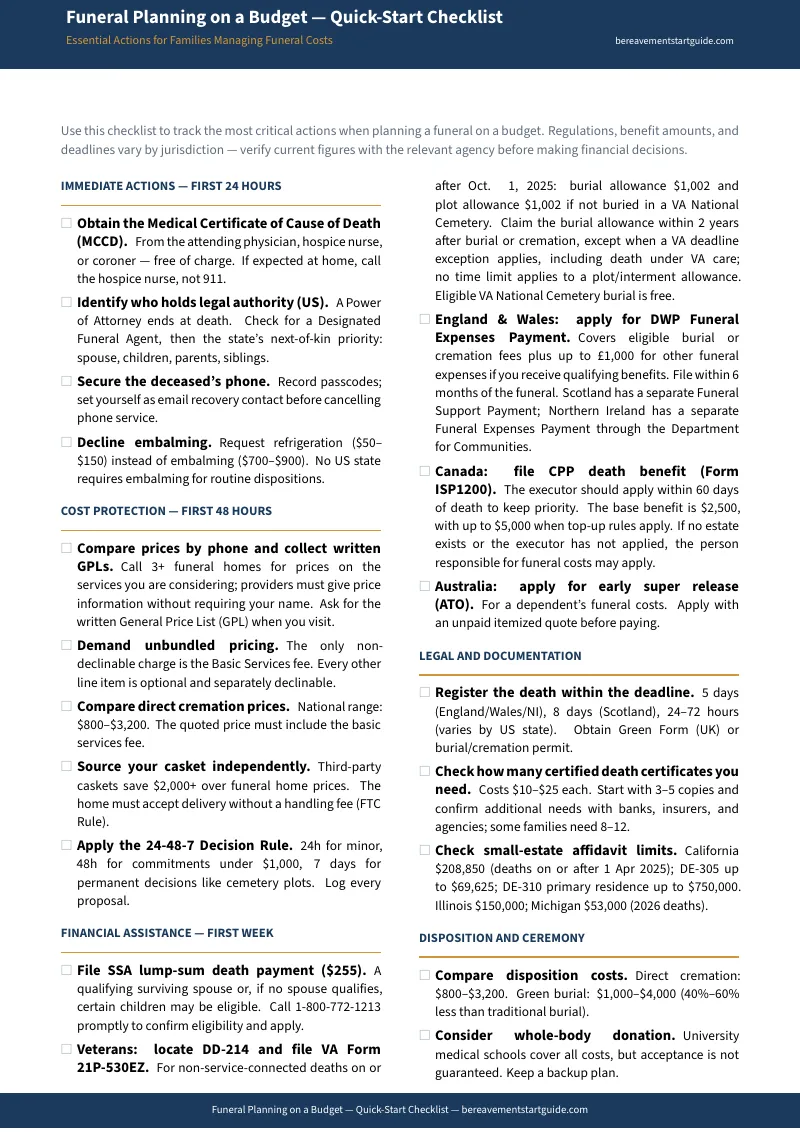
- The Quick-Start Checklist — a 2-page, 24-item action plan organized by urgency, designed for someone who needs to start right now and cannot read a full guide today
- Ten fillable printables — comparison spreadsheet, pacing log, budget worksheet, document registry, family agreement, deadline tracker, casket delivery notice, negotiation scripts, assistance eligibility worksheet, and agency contact log
The guide costs . One purchase, no subscription, no upsells. Full refund if it is not what you need — no time limit, no questions, email hello@bereavementstartguide.com.
Start With the Free Checklist
Not sure if you need the full toolkit? Download the Funeral Planning on a Budget — Quick-Start Checklist at no cost. It covers the first 24 items — which calls to make, which decisions can wait, and which questions to ask before you agree to anything. If you need the full system later, it is here.