The Administrative Triage System That Replaces Thirty Government Tabs With One Chronological Roadmap
When someone dies, nobody hands you a master list of every government agency, financial institution, and utility company that needs to be notified. The funeral director reports the death to Social Security — usually. But that notification does not propagate to the IRS, the DMV, the credit bureaus, the post office, or the dozens of other entities that continue to generate bills, direct deposits, renewal notices, and penalty letters as if your person is still alive.
The result is an administrative project that punishes disorganization with real legal and financial consequences. A Social Security payment deposited after the month of death must be returned in full — the SSA does not prorate. If the bank does not return it, the SSA pursues recovery through a cascade that ends with direct claims against the estate. A power of attorney you thought gave you authority expired the instant the death occurred. A debt collector calls your sister about your father's credit card, and she does not know whether she is legally obligated to pay — she is not, unless she co-signed, but nobody told her that.
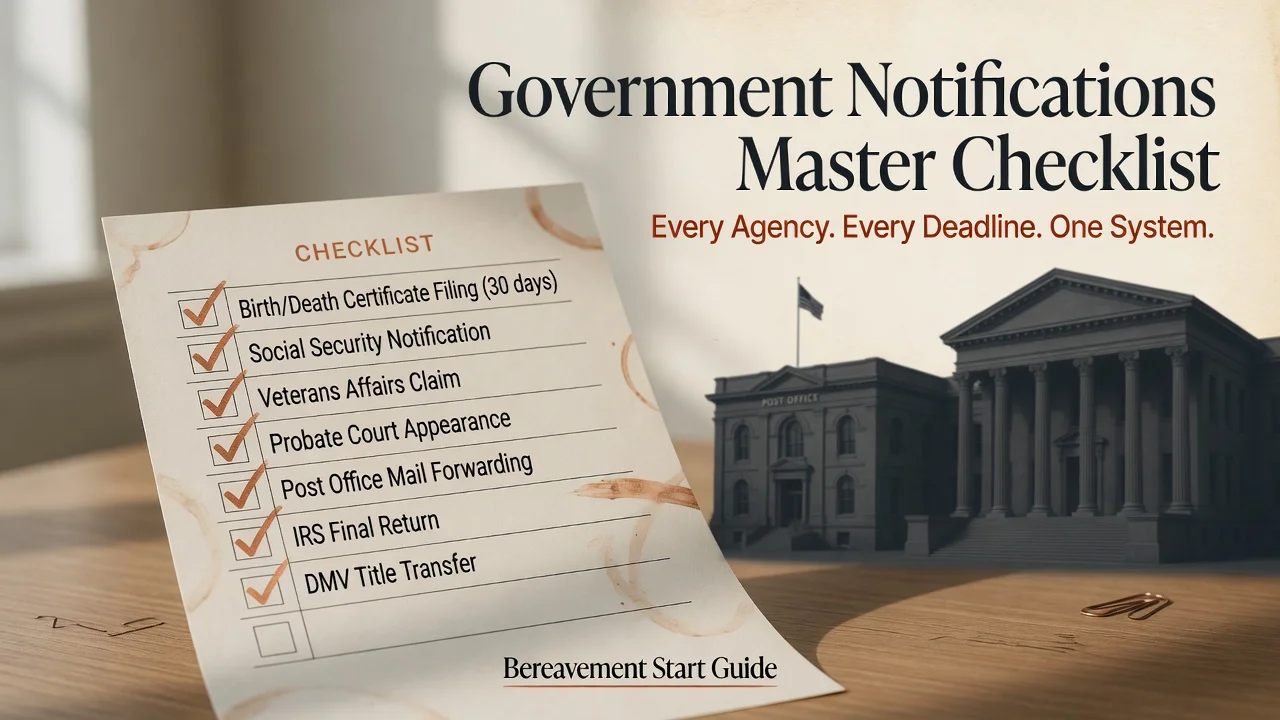
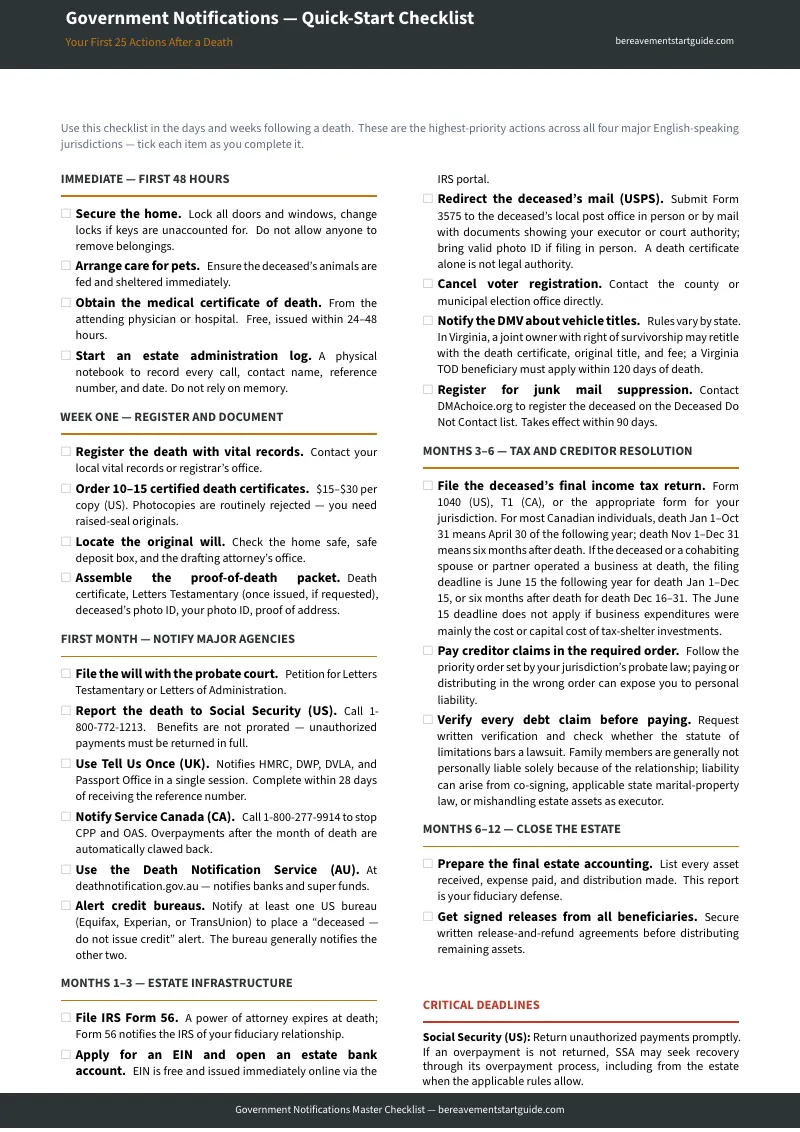
The Government Notifications Master Checklist is a complete administrative triage system that reorganizes the entire notification process into a single chronological workflow. It tells you what to do in the first 48 hours and what can wait six months. It gives you the exact form numbers, the phone scripts so you do not have to explain the death from scratch on every call, and the legal rights you can invoke when an agency or collector crosses a line. It covers four countries — US, UK, Canada, and Australia — so you are not hunting for the equivalent procedure in a different system.
What's Inside the Toolkit
- The Unified Administrative Timeline — a phased roadmap from the first 48 hours through year one, sequenced by legal urgency so you never waste cognitive energy deciding what to do next while operating on grief-impaired memory
- Government Benefit Overpayment Protocol — the SSA non-proration rule explained with worked examples, the exact recovery cascade the agency follows, and parallel instructions for VA, DFAS, OPM, Service Canada CPP/OAS, and UK DWP benefits — including the steps that prevent a routine direct deposit from becoming a federal debt
- Credit Bureau Deceased Alerts and Identity Theft Prevention — the mailing addresses, required documents, and cross-notification mechanism for all three US bureaus, plus the obituary hygiene rules and fraud prevention steps that guard against "ghosting" — deceased identity theft that targets 2.5 million Americans annually
- IRS Form 56 Fiduciary Setup — how to establish your legal authority with the IRS after the power of attorney dies with the principal, when Form 56 applies versus Form 2848, and the EIN application process for estates that generate income
- Mail Forwarding and Physical Asset Management — the legal requirements for redirecting mail via USPS Form 3575 (it must be done in person with court-issued authority), the DMV title transfer procedures by ownership type, voter registration removal, and utility account holds that prevent insurance complications from premature shutoffs
- Debt Collection Defense — a plain-language breakdown of the Fair Debt Collection Practices Act as it applies to estate debts: who is and is not personally liable, the four categories of people collectors can legally contact (surviving spouse, parents of a minor, legal guardian, and appointed executor or administrator), and the written cease-communication demand that ends the calls
- Pre-Written Communication Scripts — phone and email templates for notifying Social Security, credit bureaus, banks, insurers, the DMV, utility companies, and subscription services — designed to get through a call in under ten minutes without emotional improvisation
- Creditor Priority Math — the statutory payment hierarchy with a worked insolvency example showing how to distribute estate assets across administrative expenses, funeral costs, taxes, medical bills, and general creditors without exposing yourself to personal liability
- Family Dispute Resolution Framework — a structured decision tree for dividing personal property that moves through appraisal, equal-value distribution, alternating-draft selection, and professional mediation before anyone reaches for an attorney
- Four-Country Coverage — complete procedures for the US (SSA, IRS, USPS, DMV, credit bureaus), UK (Tell Us Once service, HMRC, DWP, DVLA), Canada (Service Canada, CRA, SIN), and Australia (ADNS, Centrelink, Australia Post), plus cross-border resealing guidance for estates with assets in multiple jurisdictions
- Printable Worksheets — Proof-of-Death Packet Assembly Checklist, Death Certificate Tracking Log, Master Contact Inventory, Deadline and Follow-Up Tracker, Fiduciary Decision Log, Creditor Claim Verification Worksheet, Family Meeting Agenda Template, Beneficiary Update Email Template, Communication Scripts, Estate Administration Log, and the Five-Minute Daily Task Card that makes "one small task per day" an executable system rather than an aspiration
Who This Is For
- You are the executor, administrator, or next of kin and have never done this before — you need the complete list of who to notify, in what order, with what documents, and what to say when you call
- You are managing the estate while grieving and the cognitive fog makes multi-step administrative tasks feel physically impossible — you need a system that breaks the project into five-minute tasks you can complete one at a time
- You are concerned about financial exposure — overpayments the government will claw back, identity theft on the deceased's credit file, or personal liability from paying creditors in the wrong order
- You are dealing with debt collectors who are calling family members and making claims that may not be legally enforceable — you need to know the rules before the next call
- The death involved assets, benefits, or agencies in the US, UK, Canada, or Australia and you need country-specific instructions rather than a US-only checklist
Why Scattered Free Guides Create More Problems Than They Solve
Government agency websites are legally authoritative but deliberately fragmented. The SSA explains its own overpayment rules but says nothing about the IRS fiduciary form you also need to file. The IRS covers Form 56 but does not mention the credit bureau notification that should happen the same week. Each agency assumes you already found the others.
Funeral home checklists — the ones that rank on the first page of every "what to do when someone dies" search — give you a list of ten to fifteen calls. They do not explain the legal consequences of sequence errors: that paying a credit card bill before the estate's administrative expenses can create personal liability, that opening the deceased's mail without court-issued authority is a federal offense, or that the Social Security payment sitting in the joint account is not yours to spend even though the bank accepted the deposit.
Legal blogs intentionally make the process seem more complex than it is. They exist to convince you that you need a probate attorney — and at an average hourly rate over $300, even a few hours of hand-holding costs more than most estates' administrative notifications are worth. For the majority of estates, the notification process is straightforward. It just requires knowing the right sequence.
This toolkit replaces the tab-switching, the contradictory advice, and the expensive attorney consult with a single document that walks you through every notification in the order they actually need to happen.
The Guarantee
Full refund, no time limit. If the toolkit does not help you manage the notification process with less stress and fewer mistakes, email hello@bereavementstartguide.com and we will refund your purchase completely.
Frequently Asked Questions
Is this a legal document or legal advice?
No. This is an administrative guide — it organizes publicly available government procedures, form numbers, and legal rights into a chronological workflow with call scripts and worksheets. It does not constitute legal advice or create an attorney-client relationship. For complex estates (contested wills, significant business assets, multi-state property), the guide includes clear markers for when professional legal counsel is warranted.
How current are the form numbers and agency procedures?
Every form number, mailing address, phone number, and procedural step reflects 2026 rules and contact information. The guide also reflects the repeal of the Government Pension Offset (GPO) and Windfall Elimination Provision (WEP) under the Social Security Fairness Act, signed January 5, 2025 — previously offset beneficiaries should verify SSA's adjustment and retroactive pay back to January 2024.
Can I use this if the death happened in a country not covered by the guide?
The country-specific sections cover the US, UK, Canada, and Australia. The chapters on credit bureau notifications, debt collection rights, identity theft prevention, family dispute resolution, and the administrative timeline are applicable regardless of jurisdiction. For countries outside the four covered, the guide provides a framework you can adapt, though the specific agency names and form numbers will differ.
How is this different from the free checklist?
The free checklist gives you the notification sequence — the agencies, the order, and the documents to bring. The full toolkit gives you the working knowledge behind each step: the overpayment recovery rules with worked dollar examples, the creditor priority hierarchy that determines who gets paid first, the identity theft prevention protocol, the FDCPA rights that stop debt collector calls, the phone and email scripts for every major agency, and the worksheets that track your progress so you do not have to hold the entire project in your head.
What if I am not the executor — can a family member still use this?
Yes. Many families divide the administrative work among several people. The toolkit explains which tasks require formal legal authority (mail forwarding, IRS fiduciary filing, probate court filings) and which can be handled by any family member (canceling subscriptions, notifying the DMV in some jurisdictions, contacting credit bureaus with the required documents). It also explains how to obtain formal authority if you need it.
Get the Toolkit
Download the free Quick-Start Checklist for the immediate notification sequence and first-week priorities, or get the complete 12-chapter system — the full toolkit with call scripts, worksheets, multi-country instructions, and the administrative timeline — for .