You Lost Your Partner. You're Not Sure You've Lost Your Right to Companionship.
The grief books helped — for a while. The support group held you together through the worst of it. The estate paperwork is mostly done, or at least someone else is handling it now. And somewhere in the past few months, a thought arrived that you were not expecting: you miss being touched. You miss laughing with someone at dinner. You miss the particular comfort of having a person who is yours.
The thought was immediately followed by guilt, by a quick glance at the photo on the nightstand, by the imagined faces of your children or your in-laws if they found out. And then the thought came back, because loneliness does not negotiate with loyalty.
The Grief-to-Dating Bridge
This toolkit exists because the gap between "grieving widow" and "person who is dating" is filled with tripwires — emotional, financial, legal, and social — and no single resource covers all of them. The Grief-to-Dating Bridge is a structured system that walks you from honest readiness self-assessment through family communication, asset protection, and partner introduction, with pacing rules and decision checkpoints at every stage so you do not rush into something your grief-impaired brain is not ready for.
What's Inside
- Grief Brain Awareness and Readiness Self-Assessment — the neuroscience of why bereavement impairs romantic decision-making, and a structured screening framework that helps you distinguish between genuine readiness and the desire for escape. Includes the PGD (Prolonged Grief Disorder) screening criteria from the DSM-5-TR so you can identify when professional help is warranted before you add the complexity of a new relationship.
- The Five Psychological Traps That Derail Widowed Daters — saint comparison (measuring every new person against an idealised version of your late partner), survivor guilt (believing that enjoyment is betrayal), widow's fire (grief-driven sexual urgency that can override judgment), fawning (people-pleasing to avoid the pain of another rejection), and replacement seeking (using a new person to fill the exact shape of the one you lost). Each trap includes recognition signals and concrete countermeasures.
- Social Security and Benefit Protection Rules — a plain-language explanation of the remarriage-before-60 rule for U.S. survivor benefits, Canada Pension Plan survivor provisions, UK Bereavement Support Payment timelines, and Australian Centrelink rules. The guide covers the cross-jurisdictional benefit landscape so you understand the financial consequences of remarriage before they become irreversible.
- Estate Protection Framework — QTIP trusts, prenuptial agreement structures, and the Mine-Yours-Ours account system for managing blended finances without endangering your children's inheritance. Covers what to discuss with an estate attorney before a new relationship gets serious, with U.S. and UK structures and notes on Canadian and Australian equivalents.
- Age-Calibrated Family Communication Scripts — different approaches for telling children under twelve, teenagers, and adult children that you are considering dating. Word-for-word scripts for the most common reactions (anger, tears, silent withdrawal, loyalty accusations) and a framework for handling in-law relationships when your late partner's family has opinions about your romantic life.
- The 5-Level Partner Introduction Model — a graduated system for moving from casual mention of a new person through eventual family inclusion, with timing guidance and checkpoint questions at each level. Designed to prevent the two most common mistakes: introducing someone too early (which traumatises children and invites family backlash) and hiding someone too long (which erodes trust when discovered).
- Dating Profile Templates and Online Safety Protocol — practical templates for building a dating profile that is honest about your situation without leading with grief, plus a safety protocol covering identity verification, first-meeting logistics, digital privacy, and what to do if something feels wrong.
- The 48-Hour Decision Rule and Pause Contract — a pacing framework that puts a time buffer between every significant romantic decision and its execution. Includes the decision log (a written record that makes grief-driven choices visible), the pause contract (a commitment to yourself about minimum wait times), and criteria for when a decision is urgent enough to override the rule.
- Boundary Scripts for Every Stage — word-for-word responses for the most difficult conversations: telling someone new that your late partner's photos stay up, explaining to a date that you are not ready for physical intimacy, drawing a line with family members who are monitoring your social life, and ending a relationship that is moving faster than you are comfortable with.
Who This Is For
You lost a spouse or long-term partner. The acute grief has shifted — you are functioning at work, managing the household, maybe even laughing occasionally — but the idea of dating fills you with a complicated mix of longing and dread. You may be a widow or widower at any age: recently bereaved and already feeling pressure from friends to "get back out there," or years past the loss and just now recognising that your isolation is no longer protective, it is punishing. You may be a man whose social support network shrank when your partner died, or a woman whose financial independence makes remarriage feel unnecessary but whose loneliness is real. You need a system that treats this transition with the seriousness it deserves, not a dating coach's pep talk or a grief counsellor's gentle suggestion to "explore when you're ready."
Why Free Resources Fall Short
Grief books cover the emotional journey but ignore the financial tripwires — nobody mentions that remarrying before sixty can permanently end your Social Security survivor benefits. Dating advice sites offer profile tips and conversation starters but have no concept of grief brain, survivor guilt, or the particular vulnerability of someone who just lost the person they trusted most. Estate planning sites protect your assets but will not help you tell your seventeen-year-old that you matched with someone on an app. Support groups validate your feelings but cannot walk you through a prenuptial framework or a partner introduction timeline. The pieces exist, scattered across books, blogs, forums, and professional consultations that cost hundreds of dollars per hour. The toolkit assembles them into one system that accounts for where you actually are: emotionally raw, cognitively impaired, and trying to make decisions that will shape the rest of your life.
Full Refund, No Time Limit
If the toolkit does not help, email hello@bereavementstartguide.com for a full refund. No time limit, no questions, no forms to fill out.
Start With the Free Checklist or Get the Full Toolkit
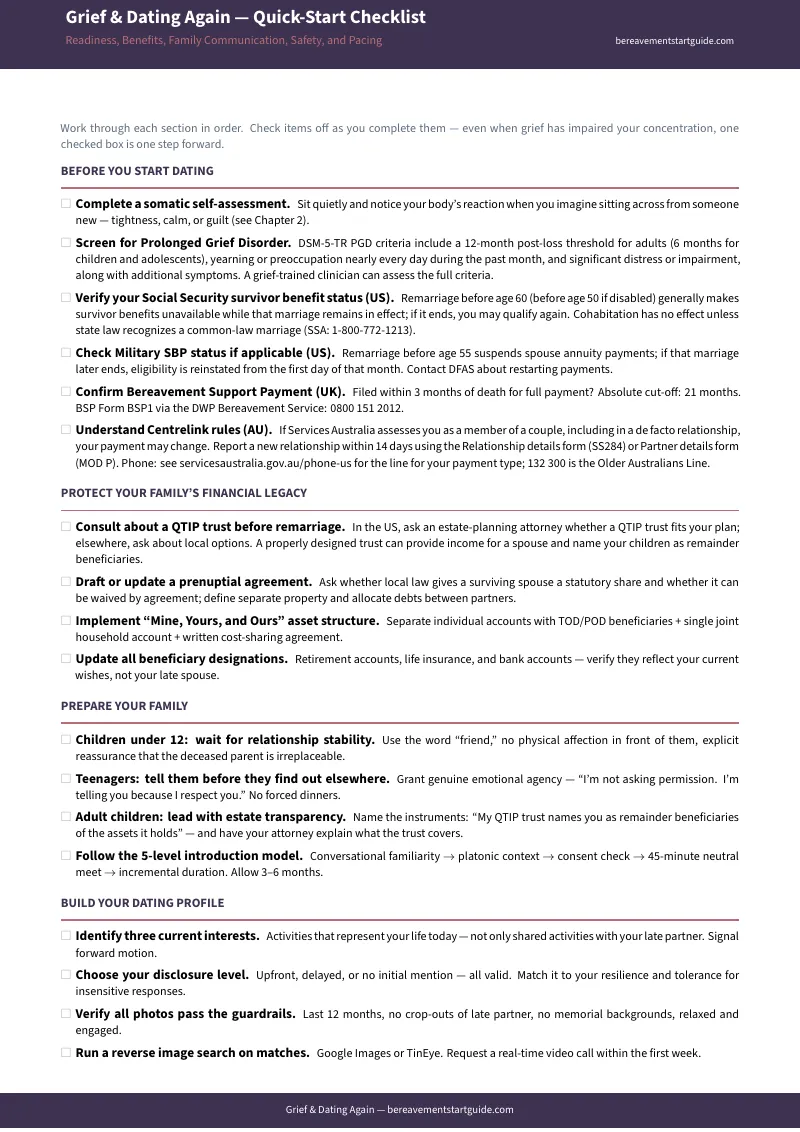
The free checklist gives you 25 prioritised action items across six phases — from emotional readiness through partner introduction — that you can print and work through at your own pace. The full toolkit gives you the 52-page guide behind those action items, plus six standalone printable worksheets: the grief brain science, the readiness assessment, the psychological trap identification, the benefit rules, the estate protection strategies, the communication scripts, and the pacing frameworks. Download the checklist now, or get the complete toolkit for and start using the Grief-to-Dating Bridge tonight.