
You Lost Someone. Then Someone Handed You a To-Do List.
Before you could sit with the loss, the logistics hit. Notify banks. Locate the will. Call the insurance company. File for probate. Close accounts. Manage the family. And everyone is watching to see if you will fall apart — so you do not.
You process grief the way you process everything else: by getting things done. By working the problem. By staying in motion because stopping means feeling it all at once, and there is no room for that when the probate deadline is in 30 days and your brother is calling about the house.
The grief industry was not built for you. Support groups assume you want to talk in circles. Self-help books want you to journal. Therapists ask "how does that make you feel?" when what you need is someone to tell you what paper to file next and whether the bank can legally freeze Dad's account without Letters Testamentary.
The Grief Operations Framework
This toolkit was built around how instrumental grievers actually function — task by task, system by system, one concrete problem at a time. The Grief Operations Framework integrates the administrative reality of estate settlement with the neurobiological reality of grief, so you can manage both without pretending either one is not happening.
It does not ask you to process your emotions on someone else's schedule. It gives you structured systems, pre-written scripts, and jurisdiction-specific procedures — and it explains why your brain is working against you right now, so you stop mistaking a biological response for personal failure.
What the Toolkit Covers
- The grieving styles continuum — instrumental vs. intuitive processing, where you fall, and why the way you grieve is not a character flaw. Based on the Doka-Martin research framework, not pop psychology.
- The somatic reality of grief — chronic headaches, elevated heart rate, immune suppression, insomnia, and cognitive fog explained as neurobiological facts. Your HPA axis is flooding your system with cortisol. Your hippocampus is impaired. This is not weakness; it is physiology.
- First-48-hours action protocol — what to secure, who to call, what to avoid doing. Structured as a single-page decision tree so you can act immediately without reading the full guide.
- Executor and administrator authority — Letters Testamentary vs. Letters of Administration, intestacy procedures, fiduciary liability exposure, and when to hire a professional. Covered across the US, UK, Canada, and Australia.
- Country-by-country filing procedures — IRS EIN applications, Form 1041, HMRC notifications, CRA procedures, and ATO requirements. Plain-English walkthroughs of the forms that government portals explain in legalese.
- Administrative pacing calendars — milestone-based timelines with built-in cognitive rest periods. Designed for a brain running on compromised executive function, not the brain you had six months ago.
- Creditor notification and debt priority — statutory payment hierarchies, insolvent estate procedures, and how to avoid paying debts in the wrong order (which can trigger personal liability).
- Family conflict mediation — why siblings fight after a death, common dispute scenarios with resolution frameworks, the legal boundaries of executor authority, and how to run a family meeting without it becoming an ambush.
- Verbatim communication scripts — word-for-word templates for freezing bank accounts, requesting creditor extensions, declining funeral home upsells, and emailing a sibling about a funeral disagreement. Copy them when your brain cannot compose a coherent sentence.
- Work re-entry strategies — navigating bereavement leave, managing performance expectations, and handling the colleague who says "at least they're not suffering anymore."
- Prolonged Grief Disorder recognition — the clinical threshold between normal grief and PGD, risk factors, and what professional help actually looks like for instrumental grievers. Because "therapy" means something specific, and not every therapist is trained in grief-specific protocols.
Who This Is For
You are the one holding it together. Maybe you were named executor and now you are navigating probate while barely sleeping. Maybe you are managing funeral logistics while your family looks to you for every decision. Maybe you are three months out and your boss expects full performance, but you cannot remember where you parked this morning.
This toolkit is for instrumental grievers — people who process loss through action, through problem-solving, through physical and cognitive labor rather than outward emotional expression. That pattern is more common in men due to cultural reinforcement, but it is not exclusive to men. If you grieve by doing, this is built for how your brain works.
It is also for the people around instrumental grievers. If someone you love is clearly not fine but responds to "let's talk about it" by changing the subject and organizing the garage, this toolkit explains what is happening and how to support them without forcing them into a processing style that does not fit.
Why Free Online Resources Are Not Enough
The information exists. IRS forms are on irs.gov. Probate procedures are on county court websites. Grief support advice is on every funeral home blog published since 2009.
The problem is assembly. Researching estate administration while grief-impaired is a cognitive trap. Your hippocampus is compromised — the structure responsible for memory encoding and sequential reasoning. Every hour you spend hunting for scattered answers across government portals and legal blogs is an hour your damaged executive function could be directed toward the two or three things that actually need to happen today.
Estate attorneys charge hundreds of dollars per hour for tasks you can handle yourself — if you arrive organized. This toolkit replaces the expensive first meeting where the attorney spends billable time asking questions you should already have answers to. Show up with documents located, accounts inventoried, and the right questions listed, and you cut the cost of professional help by hours.
Start With the Free Checklist
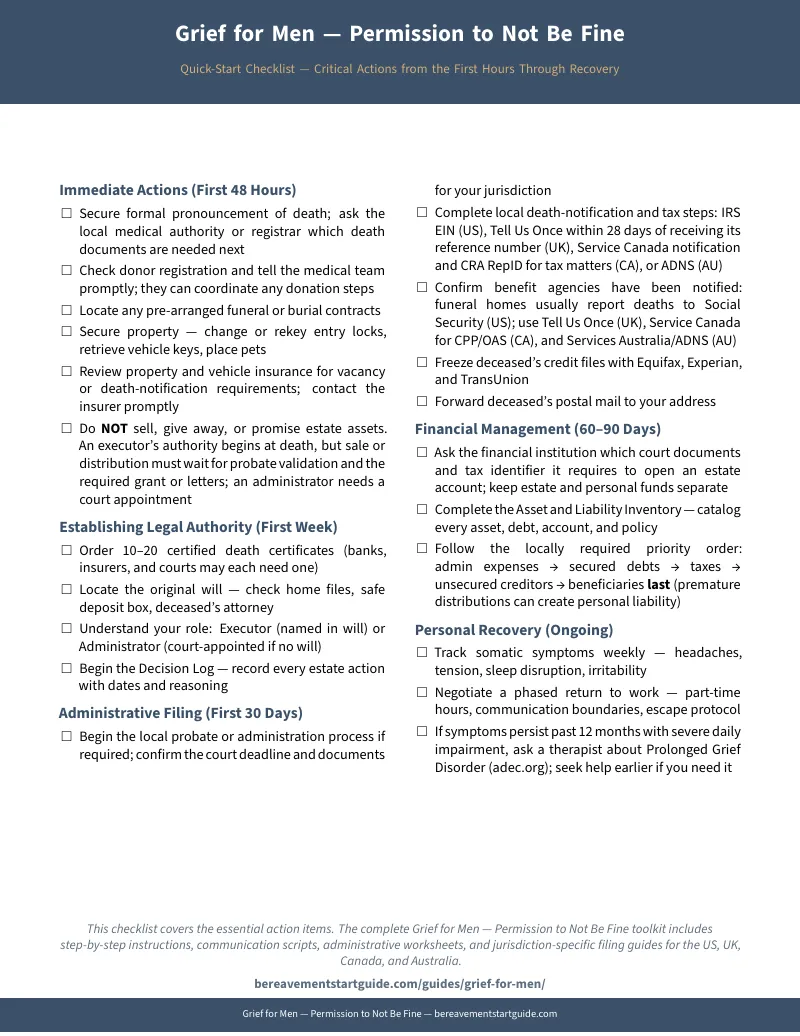
Download the quick-start checklist — 21 prioritized action items across five phases — and see whether this approach fits how you think. It covers what to do and in what order, on a single printable page.
If you need the context behind the checklist — the neurobiological explanation, the jurisdiction-specific procedures, the communication scripts, the family mediation frameworks, the pacing calendars — the full toolkit picks up where the checklist stops. You get the complete guide plus 8 standalone printable tools: an asset and liability inventory log, a decision log, a sibling meeting agenda, a somatic self-check-in tracker, a workplace re-entry plan, a personal project planner, institutional notification scripts, and family communication templates.
Full refund, no time limit. If the toolkit does not serve you, email hello@bereavementstartguide.com and we will return every penny. No questions, no expiry.
You do not have to grieve the way other people expect. You just need the right system.