
You said yes to running the group. Now what?
Someone asked you to lead a grief support group — a church coordinator, a hospice director, your own family — and you agreed because it mattered. But now you are staring at a blank agenda wondering how to screen for suicidal ideation, what to do when two siblings start fighting over their mother's belongings in front of the group, and whether you need HIPAA compliance or just a sign-in sheet.
Free resources give you fragments. A list of icebreakers from one website. A vague "be empathetic" from another. Clinical manuals that assume you have a Master's degree. Nothing that puts the whole picture — the screening, the session plans, the crisis protocols, the legal compliance, the family conflict tools — in one place, structured for someone who needs to facilitate their first session next Tuesday.
The Structured Facilitation System
The Grief Support Group Facilitation Guide is not a book about grief theory. It is an operational system — the screening protocols, session-by-session curricula, crisis scripts, and conflict resolution frameworks you need to run a group that is both emotionally safe and legally sound.
The system works because it addresses the two problems that sink most grief groups: facilitators who freeze during a crisis because they have no protocol, and groups that collapse into conflict because no one structured the hard conversations about estates, belongings, and family dynamics.
What's Inside — and What Each Piece Solves
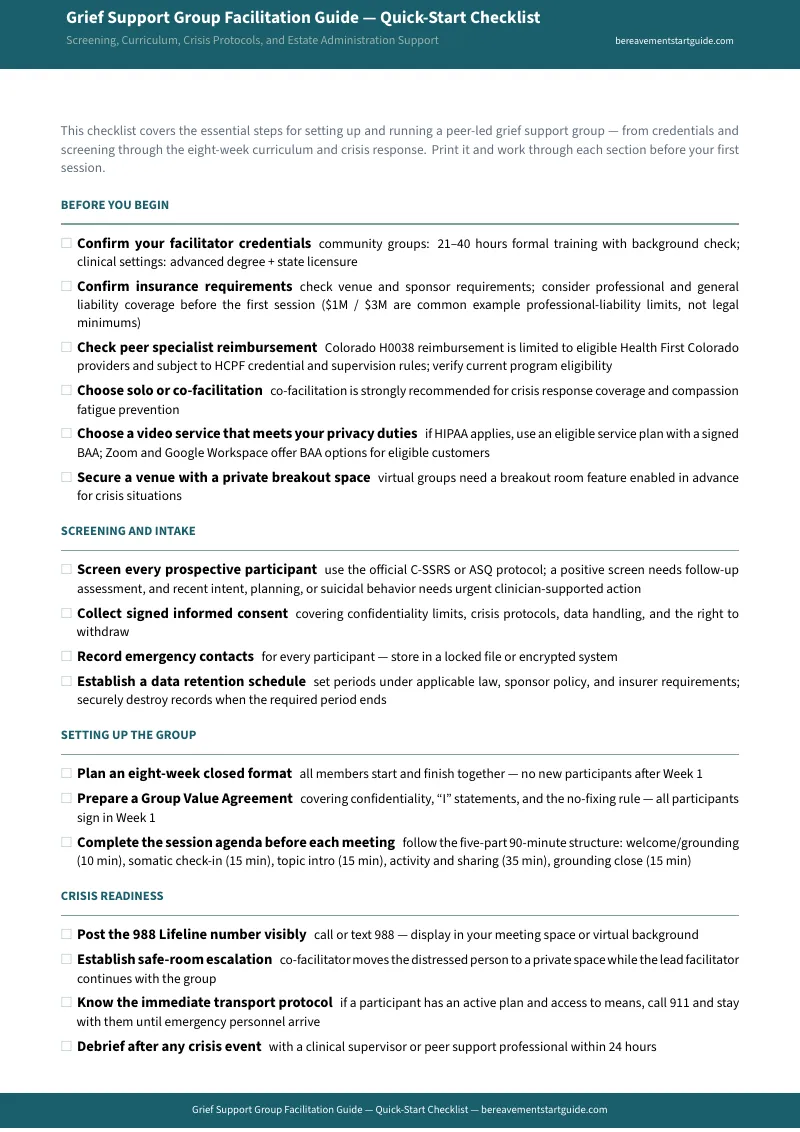
- Pre-group screening with the Columbia Protocol (C-SSRS) and the NIMH ASQ Toolkit — because discovering a participant needs clinical intervention during a live session is the worst possible timing. The screening chapter gives you the exact six questions, the triage decision tree, and the referral scripts so you know who belongs in your group and who needs a different level of care.
- HIPAA and GDPR compliance frameworks — which privacy laws actually apply to your group (it depends on your organization, not just your location), what informed consent must cover, how long to retain records, and what to do if there is a data breach. Includes a ready-to-use informed consent template.
- The neurobiology chapter your participants need you to understand — elevated cortisol disrupts executive function, shrinks working memory, and makes grief physically exhausting. This chapter explains exactly how bereavement changes cognition so you can design sessions that work within those limits, not against them.
- Estate administration facilitation tools — many of your participants are simultaneously grieving and managing probate filings, creditor notifications, and frozen bank accounts. The guide covers the executor's administrative journey so you can support participants through the dual crisis of grief and logistics without crossing into legal advice.
- Family conflict resolution frameworks — round-robin property allocation, the three-question valuation method, and colored-sticker systems for dividing personal belongings. These are structured, objective methods that replace emotional arguments with fair processes. Personal belongings trigger five times more disputes than money — these tools are built for exactly that.
- Eight-week session curriculum — weekly themes from "naming your loss" through "building a continuing bond," with facilitator scripts, group activities, journaling prompts, and take-home exercises for every session.
- 90-minute session structure — the five-part format (welcome/grounding, somatic check-in, topic introduction, activity and sharing, grounding close) with minute-by-minute timing so you never wonder what comes next.
- Crisis protocols for suicidal disclosure, acute distress, and disruptive behavior — step-by-step procedures with warm-handoff scripts for clinical referral and documentation templates. When someone says something that stops the room, you will know what to say and what to do.
- Trauma-informed communication scripts — exact language for setting boundaries with dominant speakers, supporting someone in acute distress, navigating grief-style clashes, and redirecting when someone gives unsolicited advice.
- Twelve standalone printable worksheets — participant intake forms, informed consent agreements, insurance trackers, records access logs, decision pacing worksheets, grieving brain handouts, executor task timelines, weekly session agendas, group value agreements, crisis incident reports, support network maps, and agency communication logs. Print them, fill them in, file them.
Who This Is For
- First-time facilitators — counselors, social workers, chaplains, hospice volunteers, or community leaders starting a grief group and needing the complete operational framework, not just good intentions
- Experienced facilitators who want structured crisis protocols, validated screening tools, and conflict resolution methods they can implement immediately
- HR professionals building workplace bereavement support programs and needing a structured group facilitation model
- Church and community coordinators asked to "run something" for bereaved families and wanting a system that ensures safety and structure from session one
- Family leaders coordinating estate settlement meetings across siblings with competing grief styles, timelines, and claims on personal property
Why Free Resources Fall Short
The internet gives you grief support in fragments. An icebreaker list from a hospice blog. A checklist from a funeral planning site. A clinical manual that assumes licensure you may not have. None of it addresses what actually breaks grief groups: a facilitator with no crisis protocol when someone discloses suicidal thoughts, no screening process to match participants to the right level of care, and no framework for the estate-related family conflicts that hijack emotional healing.
Piecing together resources from twelve websites takes hours of research, produces gaps you do not realize exist until a crisis reveals them, and leaves you personally exposed if something goes wrong. This guide puts the complete system — screening, compliance, curriculum, crisis response, conflict resolution — in a single download designed for the reality of holding a room full of grieving people together.
Your Purchase Is Protected
Full refund, no time limit. If the guide does not give you the structure you need to facilitate with confidence, email hello@bereavementstartguide.com and we will refund your purchase. No forms, no waiting period.
The guide is — a one-time download. No subscriptions, no cloud accounts, no data uploads. Print it, keep it in your facilitation binder, and use it at the table where the real work happens.
Get Started
Download the free Quick-Start Checklist to see the 26-item preparation framework. When you are ready for the complete system — screening protocols, eight-week curriculum, crisis scripts, and every worksheet — get the full guide.