
Your teenager is grieving. You are buried in paperwork. Nobody told you how to handle both at once.
The death hit your household like a detonation. One moment you had a functioning family; the next you are standing in the wreckage trying to figure out which fires to put out first. The probate court wants an asset inventory within 90 days. The school is calling because your teenager has not shown up in a week. Social Security survivor benefits require an in-person appointment you have not had the bandwidth to schedule. And somewhere between the funeral arrangements and the insurance claims, your teenager stopped talking to you entirely — or started punching walls, or disappeared into their phone for twelve hours a day, or told their friends a version of events that makes your stomach drop.
You went looking for help and found two kinds. There are clinical grief books that speak beautifully about the stages of loss and offer nothing for the probate deadline bearing down on you. And there are legal forms sites that walk you through estate administration with the emotional warmth of a tax return. Nobody built the thing you actually need: a single resource that treats the teenager's emotional crisis and the estate's administrative demands as one interconnected problem — because that is exactly what they are.
The Dual-Track Caregiving System
This toolkit is built around a simple structural insight that no competitor has implemented: every legal and financial task you face has a direct emotional consequence for the teenager in your care, and every behavioral shift in that teenager has practical implications for your estate timeline. A blocked inheritance account does not just delay probate — it creates a household liquidity crisis that destabilizes the teenager's daily life. A teenager who refuses to return to school does not just miss assignments — it triggers academic accommodation requirements that must be formally documented before the next grading period.
The Dual-Track Caregiving System pairs every administrative step with its emotional counterpart. You never handle a financial task without understanding how it affects the teenager. You never address a behavioral concern without knowing which logistical actions to take alongside it. The result is a toolkit that keeps both tracks moving forward in sync, instead of forcing you to choose between comforting your teenager and meeting a court deadline.
What's Inside
- The Adolescent Grief Decoder — a clinical framework explaining why teenagers grieve in ways that look nothing like sadness. Anger, numbness, humor, risk-taking, academic collapse, and emotional withdrawal are all documented grief responses in the 13-to-17 age bracket. This chapter gives you the developmental context so you stop interpreting normal grief as pathological behavior.
- First-Conversation Scripts — word-for-word language for the disclosure conversation, including what to say when the death was sudden, when it was expected, when it involved suicide, and when the teenager already heard from someone else before you got to them. Concrete phrases replace the vague "just be honest" advice that leaves you staring at the ceiling at 3 a.m.
- School Reintegration Framework — a step-by-step process for coordinating with teachers and counselors, including US Section 504 accommodation requests, guidance on when a formal IEP referral is more appropriate, and a template for the initial notification email. Most schools will accommodate a grieving student, but only if someone advocates in writing with the right language.
- Social Security Survivor Benefits Walkthrough — the complete filing process for minor child benefits (up to 75% of the deceased parent's primary insurance amount), including the document checklist for the mandatory in-person or phone appointment. SSA does not accept online applications for survivor benefits, and most families lose weeks figuring this out on their own.
- Property Guardianship Decision Tree — when a minor inherits assets above the state threshold (frequently around $10,000), the surviving parent does not automatically control those funds. The court appoints a guardian of the property with strict fiduciary duties and blocked-account requirements. This chapter walks you through the petition process and explains the restrictions before you make an irreversible mistake.
- Grief-vs-Crisis Diagnostic — a structured checklist for distinguishing normal adolescent grief from complicated grief that requires professional intervention, including the specific behavioral markers that indicate substance experimentation, self-harm ideation, or clinical depression. Includes questions to ask a grief-specialized therapist before your first appointment so you spend less time and money reaching the right diagnosis.
- Family Conflict Mediation Scripts — when extended family members disagree about custody, guardianship, estate distributions, or parenting methods, the teenager absorbs every conflict. These scripts help you de-escalate disputes with concrete language instead of the usual advice to "set boundaries."
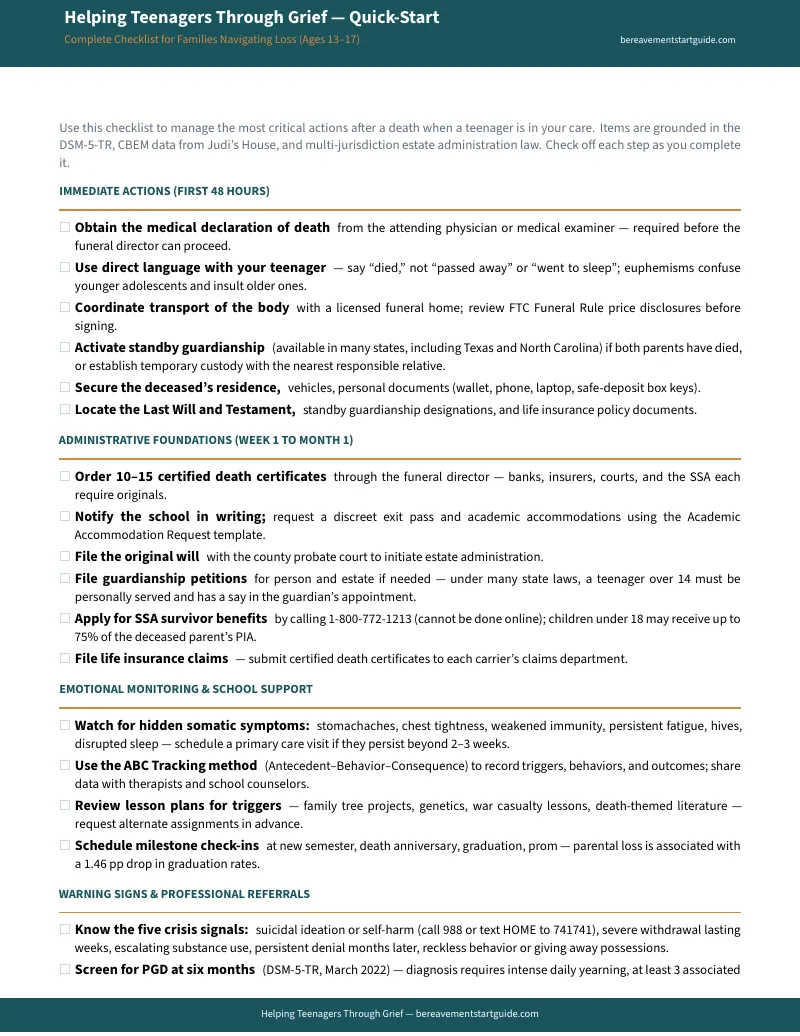
- 23-Item Quick-Start Checklist — every critical action item organized by urgency, from the first hours through the six-month mark. Designed for someone operating under extreme cognitive load who needs to see the next right step without reading a full chapter.
- 7 Standalone Worksheets — printable, fillable tools designed to be used alongside the guide: an estate and custody transfer checklist, a deadline tracker, an academic accommodation request letter template, a structured family meeting agenda, a grief-based decision log, a behavioral tracking sheet, and reflective journaling prompts for the teenager.
Who This Is For
This toolkit is for the surviving parent, grandparent, aunt, uncle, stepparent, or family friend who just became the person responsible for a grieving teenager and a stack of legal paperwork. It is written for caregivers operating under decision fatigue, sleep deprivation, and the kind of cognitive overload that makes a trip to the grocery store feel impossible — let alone a probate filing.
If the teenager in your care is between 13 and 17 years old and someone important to them has died or is about to die, this is the resource that meets you where you actually are.
Why Free Articles Are Not Enough
The free resources you have found so far fall into predictable categories, and each one fails you in a specific way. Funeral home articles are compassionate but shallow — written to drive local business, not to help you through month four when the teenager's grades are still dropping. Government agency pages list document requirements in bureaucratic prose without explaining what to do when the bank freezes the account before you have the Letters Testamentary. Estate planning blogs focus on pre-planning (choosing a trust, naming a guardian) rather than the chaotic reality of managing an estate while raising a grieving adolescent. General grief books offer deep clinical insight with zero operational utility — no school email templates, no probate checklists, no survivor benefit filing instructions.
Compiling the information yourself from these scattered sources requires dozens of hours of research during a period when your cognitive energy is at its lowest point. Bereaved caregivers report memory lapses, decision paralysis, and avoidance cycles that make even simple administrative tasks feel insurmountable. This toolkit consolidates everything into a single, structured system designed to be scanned rapidly under exactly those conditions.
Satisfaction Guarantee
Full refund, no time limit. If the toolkit does not help you, email hello@bereavementstartguide.com and we will process your refund. No forms, no justification required.
Get Started Now
Download the free Quick-Start Checklist to see 23 prioritized action items immediately. When you are ready for the full guide — the scripts, the legal walkthroughs, the diagnostic frameworks, and the school coordination templates — get the complete toolkit for .