
You Are Now Legally Responsible for Someone Else's Entire Financial Life
The person you loved has died, and you are holding their will. The document is dense with legal language — revocation clauses, demonstrative legacies, residuary bequests, abatement priorities — and every phrase carries consequences you cannot see yet.
The banks will not release a dollar until you produce court documents you have never heard of. Your siblings want to know when they will receive their share. Your mother's mortgage payment is due in ten days, and the estate account is frozen. You have no idea whether paying it from your own pocket creates a liability or whether not paying it creates a bigger one.
Here is the part no one mentions: if you distribute assets to beneficiaries before the estate's debts and taxes are fully settled, you are personally liable for the shortfall. Not the estate. You. And the beneficiary who received the overpayment is under no obligation to return it.
The average non-professional executor spends 570 hours over 16 months settling an estate — and 87% of them describe the process as highly stressful. You do not need more stress. You need a structured system that tells you what to do, in what order, and how to protect yourself at every step.
The Estate Execution Roadmap — A System Built for the Grieving Brain
The How to Read and Execute a Will toolkit is not a legal textbook or a collection of generic articles. It is a structured operational system — a 14-chapter roadmap that walks you through every phase of estate execution, from the day someone dies through the final court accounting and estate closure.
Every chapter is built around concrete actions, not abstract explanations. Every template is ready to send. Every checklist is sequenced so you cannot accidentally skip a step that creates liability later. And the entire system is designed for a brain running on cortisol and three hours of sleep — short paragraphs, clear action steps, and a pacing protocol that keeps the work manageable without letting deadlines slip.
What's Inside
- The Will Reading Myth Debunked — there is no dramatic family gathering in a lawyer's office. This chapter explains what actually happens after someone dies, where to locate the original will, and the critical first step of filing it with the court — with procedures for the U.S., U.K., Canada, and Australia
- Clause-by-Clause Will Decoder — how to read revocation clauses, appointment clauses, the four types of gifts (specific, demonstrative, general, and residuary), trust provisions, and the witness rules that can void an entire bequest without anyone realizing it until distribution day
- The Authority Gap Explained — being named in the will does not give you legal authority. This chapter walks you through Letters Testamentary, Letters of Administration, and Grants of Probate — what each one is, how to apply, what they cost, and why acting before you receive yours can trigger personal financial liability
- Abatement Priority System — when the estate cannot fulfill every gift (more common than most executors expect), this section explains which beneficiaries get reduced first, what happens to contested gifts, and exactly how to communicate the shortfall to family without destroying relationships
- Asset Marshalling Framework — systematic procedures for locating every asset the deceased held: bank accounts, retirement funds, insurance policies, real property, vehicles, digital accounts, and the accounts nobody remembers until a statement arrives months later
- Creditor Notification Protocol — how to publish notice to creditors, evaluate incoming claims, negotiate settlements, and protect yourself from paying debts the estate does not legally owe — because debt collectors will pursue you regardless
- Tax Filing Roadmap — which returns the estate must file, critical deadlines by jurisdiction, and how to coordinate with a CPA to minimize the estate's tax exposure and avoid penalties that come out of your pocket
- 4 Communication Scripts — ready-to-send letters for notifying beneficiaries of will terms and timeline, declining pressure for early distribution, requesting creditor extensions, and setting firm boundaries with unsolicited vendors
- The Decision Log System — a documented record-keeping protocol that protects you from future legal challenges by proving that every decision you made was reasonable, informed, and made in good faith. If a disgruntled beneficiary sues you three years from now, this log is your defense
- Family Conflict De-escalation Scripts — structured approaches for handling impatient heirs, disagreements over personal property, the sibling who will not leave the family home, and the relative who accuses you of self-dealing every time you make a distribution decision
- The One-Hour Daily Protocol — a grief-aware pacing system that limits executor work to a single structured daily block with clear stopping points, so the estate does not consume your life but court deadlines do not slip either
Who This Is For
- You have been named as executor and need to understand the will before you take your first official action
- A parent, spouse, or close family member has just died and you are responsible for the estate
- The estate spans multiple jurisdictions — a person who lived in one country with assets in another
- Beneficiaries are calling every day demanding their share and you need to know what you can and cannot distribute
- You want to handle the estate yourself to save on legal fees but cannot afford to make a mistake
- You are a co-executor and need a shared framework so both of you work from the same system
Why Googling at 2 a.m. Makes It Worse
The free information available online is written by law firms to generate billable-hour consultations, not to help you complete the work yourself. They explain "Letters Testamentary" without walking you through the filing process. They mention "creditor notification periods" without telling you what to publish, where to publish it, or how long the window stays open. They describe personal liability risks without giving you the documentation system that prevents them.
The result is six browser tabs open at midnight, each from a different jurisdiction, none quite matching your situation — while your brain is physically impaired by grief. Research shows that bereavement floods the body with cortisol, suppresses the prefrontal cortex (the planning center), and impairs short-term memory. You are trying to navigate the most complex administrative process of your life with a brain that is running at half capacity.
This toolkit replaces fragmented Googling with a single structured system. Every chapter connects to the next. Every template is ready to use. Every decision point is flagged with the consequences of getting it wrong — and the specific action that gets it right.
What You Get
- The Complete Guide (49 pages) — 14 chapters covering every phase of estate execution from will reading through final distribution, with procedures for the U.S., U.K., Canada, and Australia
- 7 Printable Worksheets and Trackers — Statutory Deadline Log, Asset Inventory Worksheet, Creditor Claim Tracker, Beneficiary Communication Log, Executor Fee Calculator, Heirloom Distribution Log, and Decision Log — each designed to print and fill in alongside the estate
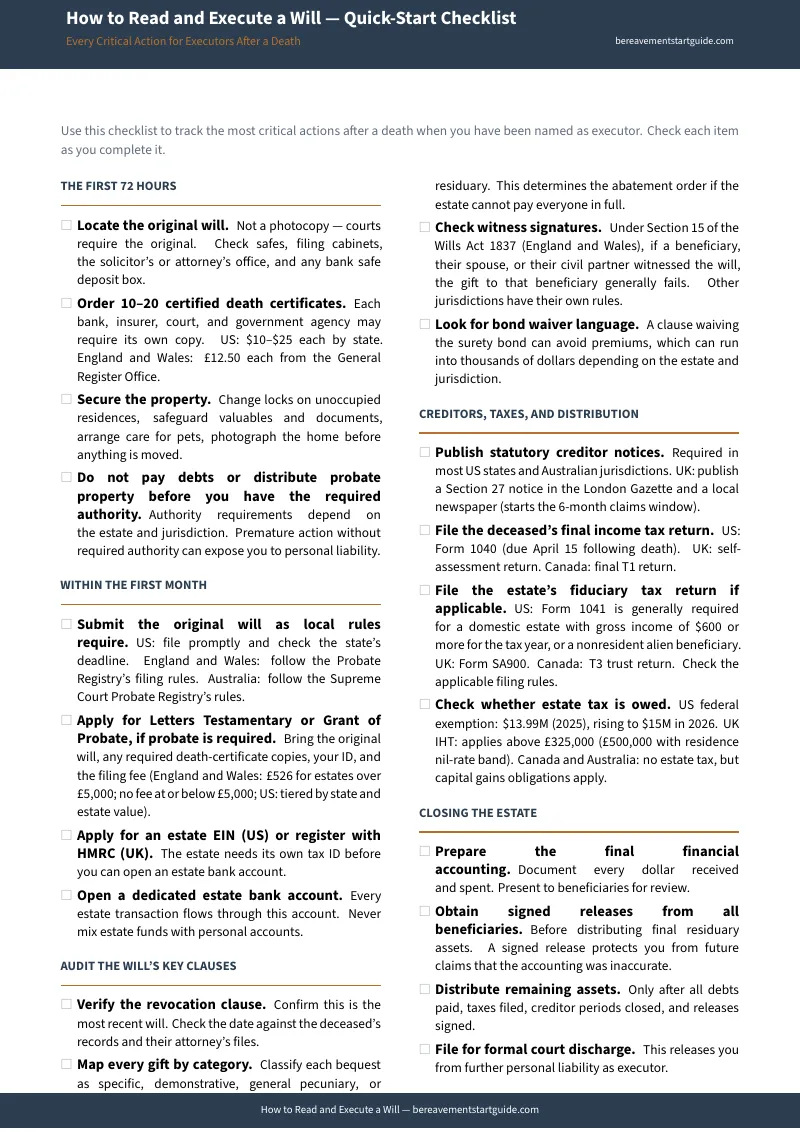
- Quick-Start Checklist (2 pages) — the condensed, action-ordered version of the first steps every executor must take, included free with every download
Satisfaction Guarantee
If this toolkit does not give you the clarity and structure you need, email hello@bereavementstartguide.com for a full refund — no time limit, no questions, no forms to fill out. You are going through enough already.
Download the free Quick-Start Checklist to see the structure and approach. When you are ready for the complete system — every chapter, every template, every script — get the full toolkit.