You were asked to speak. The service is this week. You have no idea where to start.
Someone died and someone chose you to stand at the podium. You have never written a eulogy. Your brain is not working the way it normally does — grief suppresses the prefrontal cortex, the part responsible for word-finding, planning, and memory retrieval. You opened a blank page and nothing came.
The internet has eulogy "examples." They were written for uncomplicated relationships and speakers who are not currently impaired by acute grief. They do not help when the deceased was your estranged father, when the death was a suicide, when your siblings disagree about what should be said, or when you are terrified of breaking down in front of a hundred people.
The Eulogy Writing System replaces the blank page with a structured process designed for grief-impaired cognition: a memory-gathering protocol that externalizes recall, fill-in frameworks calibrated to a 140-word-per-minute grief-adjusted speaking pace, templates for every difficult scenario, and physical techniques for delivering the speech when your voice wants to break.
What's Inside the Toolkit
The Memory Collection Protocol
Instead of sitting alone trying to summon memories under extreme stress, you run a single structured meeting with two to four people who knew the deceased from different periods. The protocol includes a fact sheet, targeted interview questions that force sensory specificity instead of vague reminiscence, and a verification checklist that catches the name, date, and rank errors that destroy audience trust in the first minute. Your brain does not need to work well. The system does the work.
The 140 WPM Framework
Most eulogies run over time because people write at their normal reading pace. At a grief-adjusted rate of 140 words per minute — slower than a normal 160 WPM because emotional pauses, voice breaks, and audience reactions consume time — a 7-minute eulogy is roughly 980 words. The toolkit gives you structural frameworks with built-in word budgets, transition templates, and pause markers so your speech fits the officiant's program window without cutting or rushing.
Templates for Complicated Legacies
The hardest eulogies are not the longest — they are the ones where the truth is complicated. The toolkit provides specific phrasing for eulogizing an abusive parent, an estranged family member, a person who died by suicide, and a death from addiction. Each template is honest without being inflammatory, dignified without rewriting history, and tested against the reality that the audience includes people who loved the deceased and people who did not.
The Grief-Brain Speaking System
Chapter 6 covers what every public-speaking guide ignores: how to deliver a speech when you are operating on three hours of sleep and your body is flooded with cortisol. Breathing protocols that prevent hyperventilation. Physical positioning that reduces voice breaks. The backup reader system — a designated person who continues if you cannot, triggered by a non-verbal cue that transfers the role without interrupting the service. What to do when you lose your place mid-sentence.
Family Conflict Resolution
A structured decision tree for every funeral-week dispute: who speaks, what gets said, religious versus secular formats, and the sibling who demands you remove a paragraph from your draft. The chapter covers the authority question (who actually decides), the de-escalation techniques that work before the service, and the role the funeral director can play as a neutral buffer when direct conversation has failed.
The Obituary Cost-Saving System
Newspaper obituaries cost between $300 and $800 or more. The guide details the "print notice plus online story" model: publish a brief notice in the newspaper with a link to a full online tribute — unlimited text, photo galleries, and interactive guestbooks. Chapter 8's worked example: a $500 full-print obituary versus a $75 print notice plus a $99 online memorial ($174 total, $326 saved).
Ready-to-Adapt Templates
Three ready-to-adapt templates: the Standard Tribute (5 minutes / ~700 words), the Complicated Relationship (3 minutes / ~420 words), and After Suicide (4 minutes / ~560 words). Each is pre-calibrated to the 140 WPM standard with structural transitions, section headers that keep you oriented during delivery, and pause markers where your voice is most likely to break. You are not starting from scratch — you are filling in a structure that already works.
The Quick-Start Checklist
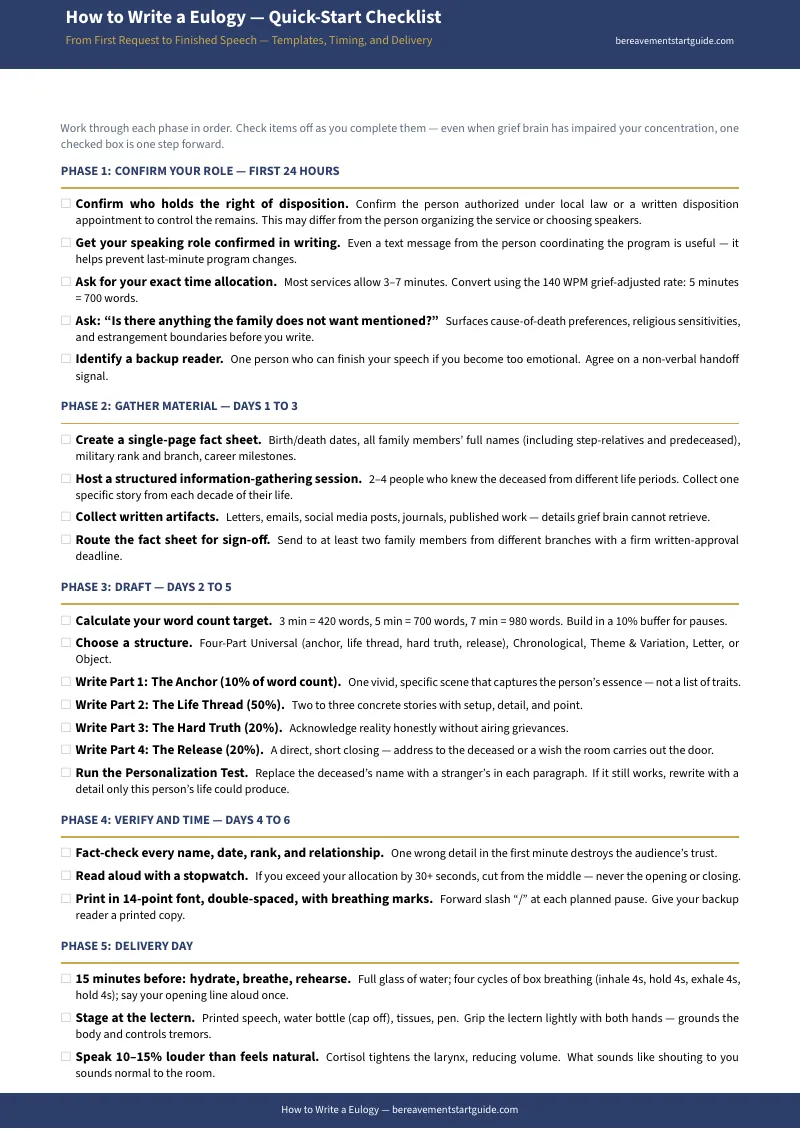
A 2-page, 22-item reference for the first 48 hours, in five phases: confirm your role, gather material, draft, verify and time, and delivery day. Print it. Carry it. Use it even before you open the full guide.
Who This Toolkit Is For
- The person asked to speak this week — you have never written a eulogy, the service is in days, and you need a system that works faster than staring at a blank page
- The adult child eulogizing a complicated parent — the "loving tribute" template does not fit because the relationship was not a loving tribute, and you need language that is honest without starting a family confrontation
- The person speaking after a suicide, overdose, or violent death — the cause of death dominates the room whether you mention it or not, and you need phrasing that names it gently without causing harm
- The family that cannot agree on what should be said — the dispute is delaying everything, and you need a framework for resolving it before the service
- The person terrified of breaking down at the podium — you are not a public speaker and you are not sure you can get through the first paragraph, and you need the backup reader system and the physical techniques
- The person also handling the obituary — you are writing both the speech and the death notice, and you do not know how newspaper pricing works or what to prioritize
Why Not Just Use the Free Examples Online?
The examples exist. A system that assembles them into something you can use under grief, under deadline, and under cognitive impairment does not.
Generic eulogy examples are finished speeches written for someone else's relationship. They work when the death was expected and the speaker is composed enough to adapt on the fly. They do not cover estrangement, suicide, addiction, or the physical mechanics of speaking through active grief.
Funeral home blogs offer localized advice and sample eulogies — and exist to generate leads for their arrangement conference. The funeral home explaining how to write a eulogy is the same business that profits from your emotional state during tomorrow's meeting.
Professional eulogy writers produce custom speeches for $250 to $500 — but require you to conduct an intimate emotional interview with a stranger during the worst week of your life. The toolkit lets you do this privately, at home, on your own schedule.
YouTube tutorials cover eye contact and pacing for speakers who are not currently experiencing documented cognitive impairment. They do not cover what happens when you hyperventilate at the podium, when your ex-spouse is in the third row, or when the family demands you rewrite your draft the night before.
Your Guarantee
Full refund, no time limit. If the toolkit does not help you write and deliver the eulogy, email hello@bereavementstartguide.com and you will receive a complete refund. No form, no justification, no friction. You are going through enough.
From Blank Page to Finished Speech
The toolkit costs — once, no subscription, no consultation fee. It covers the complete writing system: memory gathering, structural frameworks, three fill-in templates, grief-brain management at the podium, family conflict resolution, obituary economics, and eight printable worksheets. Instant download. Printable PDF.
Not ready for the full toolkit? Download the free Eulogy Quick-Start Checklist — a 2-page, 22-item reference with the conversations to have, the facts to verify, and the structural framework to get started. The full toolkit is there when you need the complete system.
You did not plan to be the one at the podium. But the service is this week, and every hour you spend searching for examples is an hour you are not spending on the speech. The toolkit turns the search into a system.