Their identity is exposed. You have days, not months, to lock it down.
The moment someone dies, their financial identity enters a vulnerability window. Funeral directors notify the Social Security Administration, but they do not notify credit bureaus, banks, utility providers, or the DMV. That falls on you — the executor, the surviving spouse, the adult child — while you are simultaneously managing grief, funeral logistics, and family obligations.
Criminals know this. They monitor obituaries for exact dates of birth and maiden names. They scan probate filings for asset details and beneficiary information. They intercept physical mail arriving at the deceased's empty residence. With a full name, date of birth, and geographic location, a fraudster can assemble enough to open credit cards, file fraudulent tax returns, or build a synthetic identity that runs for years before anyone notices.
The Federal Trade Commission documented over 1.35 million identity theft complaints in 2025 alone, with losses exceeding $15.8 billion. Deceased identities are among the easiest to exploit — and among the hardest to detect — because the victim cannot receive fraud alerts, check credit reports, or dispute unauthorized charges.
The Dead Name Defense System — every notification, every letter, every deadline, already mapped
This toolkit replaces the dozens of hours you would spend researching which agencies to contact, what forms to file, and what language to use in each letter — with a system that tells you exactly what to do, in what order, with the exact documents you need at each step.
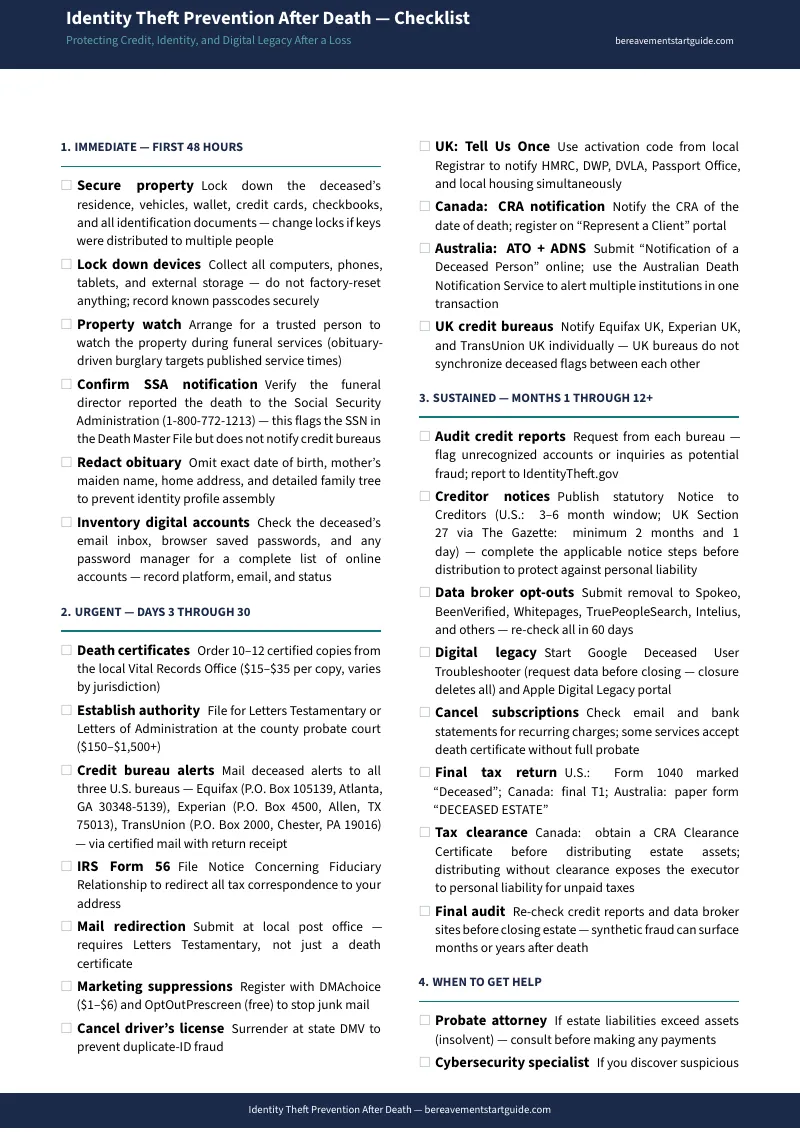
It is built around the three phases of posthumous identity protection: the 48-hour physical and digital lockdown, the 30-day credit and government notification sprint, and the sustained data broker suppression and monitoring that continues through estate closure.
What's inside
- Chronological Task Planner — the three-tier Immediate / Urgent / Sustained sequence. The first three days determine whether the vulnerability window stays open for weeks or closes in days, so you are not guessing what comes first when everything feels equally critical.
- Pre-Drafted Credit Bureau Letters — the correct mailing address, required enclosures, and exact phrasing for deceased alerts at Equifax, Experian, and TransUnion (U.S.), plus the equivalent bureau procedures for Canada, the UK, and Australia. Customize with the deceased's details and mail them — no research required.
- IRS Form 56 Walkthrough — a field-by-field guide to filing Notice Concerning Fiduciary Relationship, the form that redirects all IRS correspondence to your address and prevents fraudsters from intercepting tax refunds, plus a fillable Form 56 Cover Letter you mail with the packet. Most executors do not know this form exists until a refund check goes missing.
- Data Broker Opt-Out Tracker — pre-filled removal rows for seven named aggregators (Spokeo, BeenVerified, Whitepages, TruePeopleSearch, FastPeopleSearch, PeopleFinder, and Intelius), plus the California DELETE Act's DROP platform, with blank rows for any others you find. Data brokers re-harvest and re-list — the tracker includes a 60-day re-check protocol.
- Digital Account Lockdown Guide — how to secure Google accounts (Inactive Account Manager vs. Deceased User Troubleshooter), Apple devices (Digital Legacy Program and the 88-character access key requirement), social media memorialization, and subscription cancellation across major platforms.
- Communication Scripts — exact language for calling financial institutions to report a death, requesting payment extensions from creditors, emailing family members about security protocols, and declining pressure from aggressive collectors. These scripts are designed for someone who is grieving — they are firm and clear without requiring you to argue.
- Creditor Notification Templates — statutory notice requirements by jurisdiction (U.S. state-by-state windows, UK Section 27 via The Gazette, Canadian and Australian equivalents), with the fill-in templates to publish and mail them. Completing these notices before distributing assets protects you personally from creditor claims.
- Credit Bureau Notification Tracker — a worksheet that logs every notification you send, the date it was mailed, the return receipt number, and the date the bureau confirmed the deceased alert. When you are mailing certified letters to three or more bureaus and a dozen financial institutions, this tracker is the difference between knowing you are covered and hoping you remembered everyone.
- Obituary Safety Checklist — a printable checklist of the biographical details to strip from a public obituary (exact date of birth, mother's maiden name, home address, family tree with cities, employer), with a private-memorial write-in and a house-watch line for the service.
- Fraud Discovery Response Protocol — if identity theft has already occurred, this chapter covers filing an FTC identity theft report, disputing fraudulent accounts, requesting fraud-flagged credit reports, and notifying the IRS Identity Protection Specialized Unit — with pre-drafted letters adapted for posthumous fraud.
Who this is for
- Executors and administrators managing an estate and responsible for protecting the deceased's financial identity through probate and distribution
- Surviving spouses and adult children handling the immediate aftermath of a death and needing to secure accounts, mail, and digital access before formal probate begins
- Families where no executor has been appointed yet — the toolkit covers the protective steps anyone can take before the court issues Letters of Administration
- Estate planning attorneys and financial advisors looking for a structured client handout that covers the identity protection steps their standard checklists miss
Why not the free tools?
The free checklist from this site gives you the sequence — what to do, in what order. Funeral home blogs give you sympathy and high-level guidance. Enterprise platforms like Empathy offer comprehensive support but lock it behind monthly subscriptions or employer partnerships.
None of them give you the letters. None of them give you the scripts. None of them map the data broker opt-out process site by site. None of them tell you which bureau needs which enclosures, which IRS form redirects tax correspondence, or how the credit freeze process for a deceased person differs from the one-click online freeze you can do for yourself.
This toolkit replaces the research with execution-ready tools — every letter written, every address filled in, every deadline mapped — for a one-time cost that the estate can reimburse as a legitimate administrative expense.
Full refund, no time limit
If the toolkit does not help you protect the estate, email hello@bereavementstartguide.com for a full refund. No time limit, no questions beyond how we can do better.
Get started now
Download the free checklist to see the sequence. When you are ready for the full system — the letters, the scripts, the trackers, the Form 56 cover letter, and the jurisdiction-specific templates — get the complete Identity Theft Prevention After Death toolkit for .