The caregiving is over. Why does it feel like you've disappeared?
You spent years — maybe a decade — organizing medications, managing doctors, monitoring alarms through the night. Your entire daily structure revolved around keeping one person alive. Every other part of your identity — your career, your friendships, your own health — got compressed into the margins, then squeezed out entirely.
Now the person you cared for is gone. Everyone expects grief. Nobody warned you about the rest: the disorientation of having no schedule, no role, no purpose to wake up to. The phantom hypervigilance at 2:00 a.m. The guilt you feel for being relieved. The pile of legal paperwork you cannot concentrate on because your brain refuses to function.
This is post-caregiver syndrome. It is not a personal failure. It is a predictable neurological and psychological response to years of sustained crisis-level stress — and it requires a structured recovery, not just time.
The Cognitive Scaffolding System
The Post-Caregiving Identity Crisis toolkit is built as a cognitive scaffolding system — an external structure that does the organizing, sequencing, and decision-pacing your depleted brain cannot do right now. It bridges the gap that every other resource leaves wide open: practical estate administration on one side, emotional and identity recovery on the other, all designed for a brain operating at a fraction of its normal capacity.
Where generic grief books offer reflection prompts and legal blogs offer dense procedural instructions, this toolkit integrates both into a single workflow — short chapters, visual checklists, fill-in worksheets, and word-for-word phone scripts — all calibrated for grief brain.
What's Inside
- The 24-48-7 Decision-Pacing Rule — a graduated waiting-period system that prevents you from making irreversible financial or legal decisions while your prefrontal cortex is suppressed by grief. Minor commitments wait 24 hours, moderate financial decisions wait 48, and anything with lasting consequences waits 7 days.
- 90-Day Estate Administration Protocol — a complete, plain-language walkthrough of probate timelines, asset inventories, creditor notifications, EIN applications, and tax filing obligations. Each step includes the exact phone script for the institutional call, so you never have to figure out what to say when you are already overwhelmed.
- Sibling Communication Templates — copy-and-paste scripts for boundary setting ("I can do X, but not Y"), task delegation using the Specific Ask Formula, and the Sentimental Asset Fair-Share Blueprint — a structured rotating-selection system for dividing heirlooms without the fight.
- Identity Pie Exercise and Values-to-Roles Mapping — a structured method for identifying which parts of your pre-caregiving identity atrophied, reconnecting with dormant values, and building concrete next steps toward each one. Not therapy homework — practical career, social, and personal planning.
- Relief-Guilt Reframing Module — evidence-based worksheets that separate physiological relief from moral self-judgment. Your HPA axis spent years in continuous activation. The relief you feel is your nervous system standing down from crisis — not evidence that you did not love them enough.
- Physical Recovery Screening Checklist — the specific medical appointments, blood panels, and sleep hygiene protocols your body needs after years of cortisol rhythm disruption, immune suppression, and sleep architecture fragmentation.
- Prolonged Grief Disorder Self-Screening — the clinical markers that distinguish normal post-caregiving grief from PGD (the 12-month persistence rule, functional impairment criteria), so you know when professional help is warranted — and how to find it.
- Professional Consultation Worksheets — pre-formatted fact sheets for meetings with probate attorneys, CPAs, and therapists. Arrive organized instead of paying professionals to sort your papers.
Who This Is For
You were the primary caregiver for a parent, spouse, or close family member through a prolonged illness — dementia, cancer, ALS, or any condition that demanded sustained daily care. The caregiving has ended (through death or permanent institutional placement), and you are now facing some combination of:
- An identity vacuum — purposelessness, invisibility, "who am I without this role?"
- Grief brain — cognitive fog, memory lapses, inability to concentrate on paperwork
- Estate and administrative obligations you cannot focus on
- Family dynamics destabilized by grief — sibling tension, conflicting expectations
- Physical exhaustion and health symptoms you deferred for years
- Relief-guilt — feeling glad the burden is lifted, then ashamed of feeling glad
If more than two of those describe your current situation, this toolkit was designed for exactly where you are.
Why Free Resources Don't Work Here
The free grief articles assume a sudden loss. They address the emotional arc of bereavement — denial, anger, bargaining — but not the identity vacuum that follows years of role engulfment, the phantom hypervigilance of a nervous system still wired for crisis, or the specific administrative burden that lands on the person who was already doing everything.
The legal and estate planning blogs assume a functioning brain. They present dense procedural instructions, filing deadlines, and financial checklists — without acknowledging that the person reading them cannot hold three pieces of information simultaneously because their hippocampus is temporarily impaired by cortisol.
You could piece together both categories from scattered sources. But grief brain makes that research project nearly impossible — and every hour spent hunting for the right checklist is an hour you do not spend recovering. The toolkit eliminates the search entirely: everything is in one place, in the right order, at the right cognitive load.
The Guarantee
Full refund, no time limit. If the toolkit does not help you navigate the post-caregiving transition, email hello@bereavementstartguide.com and you will get your money back. No forms, no justification required.
Start With the Free Checklist — or Get Everything Now
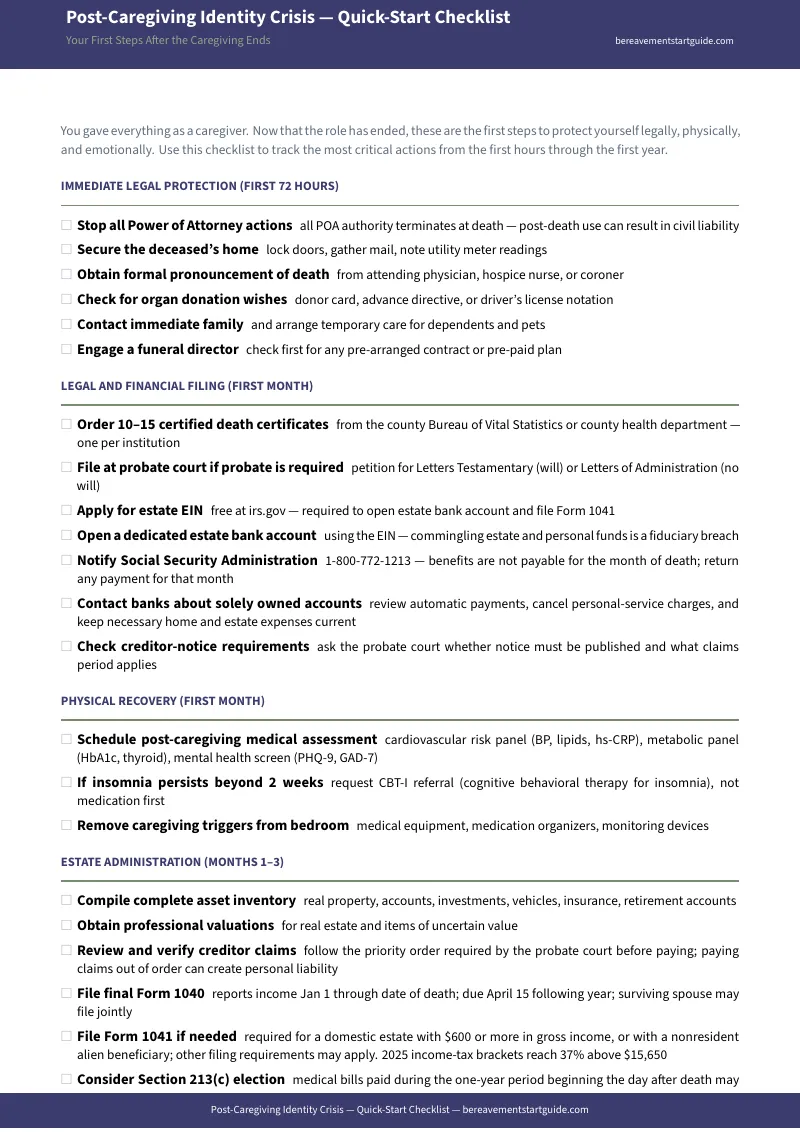
The free checklist gives you the 25 most critical action items. It tells you what to do. The full toolkit shows you how — with the decision frameworks, phone scripts, communication templates, identity exercises, and recovery protocols that turn a chaotic transition into a structured path forward.
You spent years holding everything together for someone else. This toolkit holds it together for you while you rebuild.