
The house won't wait for your grief to pass
The mortgage payment is due in 14 days. The insurer needs to hear from you within 30. A reverse mortgage lender wants a formal response this month. And somewhere in a filing cabinet you've never opened, there's a deed whose title type determines whether you need probate court or a one-page affidavit.
You're Googling legal terms at 2 a.m. with a brain that can barely remember where you parked the car. That's not a character flaw — it's grief neuroscience. Your prefrontal cortex, the part responsible for planning and decision-making, goes partially offline during intense bereavement. Everything that requires sequencing, comparing options, or reading dense text becomes exponentially harder.
Free checklists tell you what to do. They don't tell you how — or in what order, or what to say when you call the mortgage company, or how to handle the sibling who wants to sell while you want to keep the house.
The Inherited Property Transfer System
This is not a legal textbook or a generic estate checklist. It is a structured decision system — built for people whose cognitive bandwidth is running at a fraction of normal — that walks you from the first 48 hours of property security through final title transfer, tax filing, and family resolution.
Every chapter opens with a quick-reference action summary so you can act on the urgent items without reading the full explanation until you're ready. The worksheets stand alone: print one, fill it in, and move to the next. The notification scripts are copy-paste — you don't need to draft anything from scratch when you're running on grief and caffeine.
What's inside
- 48-Hour Property Security Protocol — a perimeter checklist, property guardian designation form, and premature-offer shield so you don't lose equity before you even open the will
- Probate Authority Roadmap — how to determine whether you need full probate, a small estate affidavit, or no probate at all, with a deed-type decision matrix covering Joint Tenancy, TODDs, Revocable Trusts, and Sole Ownership
- Mortgage Assumption Toolkit — your rights under the Garn–St. Germain Act and CFPB Regulation X, plus copy-paste scripts for notifying the servicer, requesting successor-in-interest confirmation, and filing a complaint if they stonewall you
- Reverse Mortgage Emergency Playbook — the 30-day response window, your three options (buy at 95% appraised value, sell, or deed in lieu), and a sample formal response letter
- Vacancy Insurance Conversion Guide — how to notify the carrier within the critical 30-day window, transition to a probate vacant home policy, and document the weekly inspections that keep coverage active
- Stepped-Up Basis Tax Worksheet — how IRC Section 1014 resets your cost basis to date-of-death value, why you need an appraisal immediately, and a calculation worksheet that shows exactly what you'll owe (or won't owe) when you sell
- Medicaid Estate Recovery Defense — which states use probate-only recovery versus expanded recovery, the exemptions that protect surviving spouses and minor children, and how to file a hardship waiver
- Co-Heir Resolution Framework — sibling buyout templates, co-ownership LLC structures, mediation scripts, and the financial reality of a partition lawsuit so you can resolve disagreements before they become courtroom battles
- Keep vs. Sell Financial Analysis — a structured worksheet that compares carrying costs, rental income potential, capital gains implications, and family sentiment so you can make a decision based on numbers rather than pressure
Who it's for
- Adult children inheriting a parent's home and navigating probate for the first time
- Surviving spouses who need to retitle joint property or assume an existing mortgage
- Executors managing real estate for the estate, whether you volunteered or were named in the will
- Families dealing with co-ownership disputes, a reverse mortgage, or a Medicaid lien
- Anyone who's been told "just call a lawyer" but needs to understand the landscape before spending on billable hours
Why free tools fall short
Court self-help portals give you the forms but assume you already know which forms you need and in what order to file them. Estate planning blogs explain what a revocable trust is — they don't tell you what to do at 7 a.m. on Tuesday when the mortgage servicer calls and refuses to talk to you because you're not on the loan. Executor guides from Nolo and AARP cover estate administration broadly but bury the property-specific rules inside 400 pages of general estate content.
This toolkit focuses exclusively on real property. Every section is written for the person who's holding a death certificate in one hand and a mortgage statement in the other, and who needs to know exactly what to do next — not what estate planning means in theory.
Your protection
Full refund, no time limit. If the toolkit doesn't help, email hello@bereavementstartguide.com and you'll get every penny back. No forms, no explanations, no waiting period.
Your information stays private. We don't sell contact details to real estate investors, attorneys, or any third party. Downloads are between you and us.
Get started now
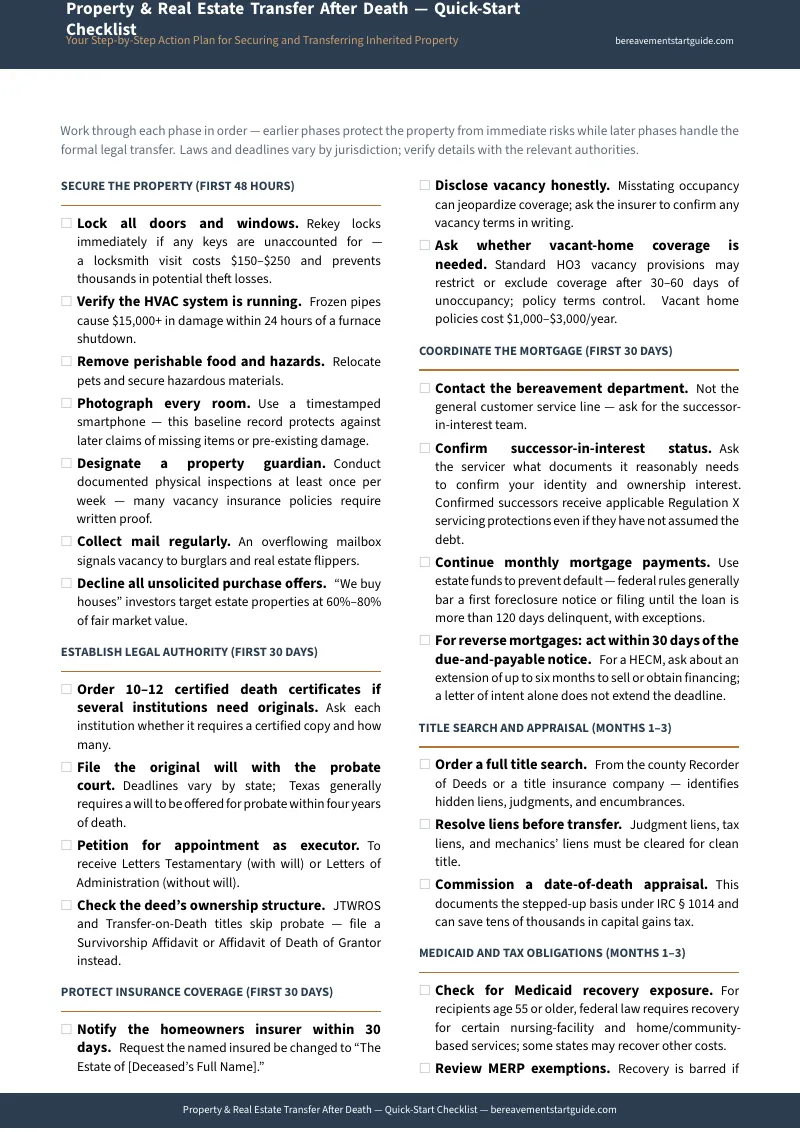
Download the free Quick-Start Checklist to see the 30 most urgent action items at a glance. When you're ready for the full system — the walkthroughs, the scripts, the worksheets, and the decision frameworks — the complete toolkit is waiting at .