Your bereavement leave is ending. Your grief is not.
Three days. Maybe five. That's what most employers give you to bury someone you love, settle into a new version of your life, and come back ready to hit deadlines. Meanwhile the probate court is waiting for your filing, your father's pension is still depositing, three banks need certified death certificates, and your brain can barely hold a grocery list.
Researchers call it "grief brain" — a documented 50 to 70 percent drop in concentration, memory, and decision-making that can last six to twenty-four months. Your employer calls it "we need you back Monday."
The Dual-Burden Navigation System — work and estate admin in one structured plan
This is not a grief journal or a sympathy card. It is an operational system for professionals who have to keep performing at work while managing a second full-time job nobody trained them for: settling a loved one's estate. The Dual-Burden Navigation System works because it treats the return to work and the estate administration as one integrated timeline instead of two competing emergencies.
Most resources give you either workplace advice or estate checklists. They never acknowledge that you're doing both at once — negotiating a phased return schedule on Tuesday morning while calling the probate court clerk on your lunch break. This guide was built around that exact reality.
What's inside
- Bereavement leave rights by jurisdiction — current leave laws for six US states with mandatory protections (California, Illinois, Maryland, Oregon, Washington, Minnesota), the UK's Jack's Law and Acas guidance, and Canadian and Australian frameworks, so you know exactly what you're entitled to before your HR meeting
- Grief brain workplace strategies — task restructuring, error-catching protocols, and cognitive pacing techniques based on how impaired executive function actually works, not just "take it easy"
- FMLA and ADA accommodation templates — ready-to-send email templates for requesting family medical leave, ADA reasonable accommodations, phased return schedules, and remote work arrangements
- Communication scripts for every awkward conversation — templates for notifying your manager, responding to "how are you?" without falling apart, declining high-stakes projects during your first month back, and setting boundaries with well-meaning colleagues
- Parallel estate-admin scheduler — a tracking system that maps probate deadlines, creditor notification windows, tax filing dates, and benefits claim periods against your work calendar, with flags for tasks that need a full business day off versus 15-minute phone calls during lunch
- Phased return planning — week-by-week schedules for full-time, part-time, and hybrid returns that match your actual cognitive capacity, not your employer's wishful thinking
- Financial stabilization roadmap — how to manage household cash flow during reduced hours, when employer-sponsored EAP benefits apply, and how to access state-level paid family leave programs
- Self-employment chapter — client communication scripts, force majeure contract provisions, cash-flow management during reduced capacity, and when to bring in subcontractors
- Family conflict protocols — decision-tree frameworks for resolving estate disputes with siblings while you're also trying to maintain your professional performance
- Digital legacy management — RUFADAA-informed procedures for closing online accounts, securing digital assets, and navigating platform-specific posthumous access policies
- 8 standalone printable worksheets — fillable forms you print and use: phased return-to-work agreement, workload triage matrix, estate deadline tracker, document vault tracker, family decision log, professional consultation prep sheets, communication scripts card, and ADA accommodation request worksheet
Who this is for
- Professionals returning to work after losing a parent, spouse, or sibling — whether you're the executor or not
- Employees navigating bereavement leave who aren't sure what they're legally entitled to
- Anyone experiencing grief brain at work and worrying their performance is slipping
- Executors and estate administrators managing probate deadlines alongside full-time employment
- Self-employed workers and freelancers who can't take standard bereavement leave
- HR professionals looking for a resource to share with bereaved employees
Why not just Google it?
At 2 a.m. you'll find government pages that list your state's leave law but say nothing about what to do when your three days run out and you're still non-functional. Legal portals that explain probate filing but don't mention that you'll be doing it between meetings. Grief support articles that tell you to "be kind to yourself" while your inbox fills up and your project deadline doesn't move.
The Dual-Burden Navigation System puts both sides of your life into one integrated plan — the workplace scripts, the legal rights, the estate admin timeline, and the cognitive pacing strategies — so you're not stitching a survival plan together from nine browser tabs with a brain that can barely read.
Satisfaction guarantee
Full refund, no time limit. If the guide doesn't help you navigate this transition, email hello@bereavementstartguide.com and you'll get your money back. No forms, no waiting period, no questions.
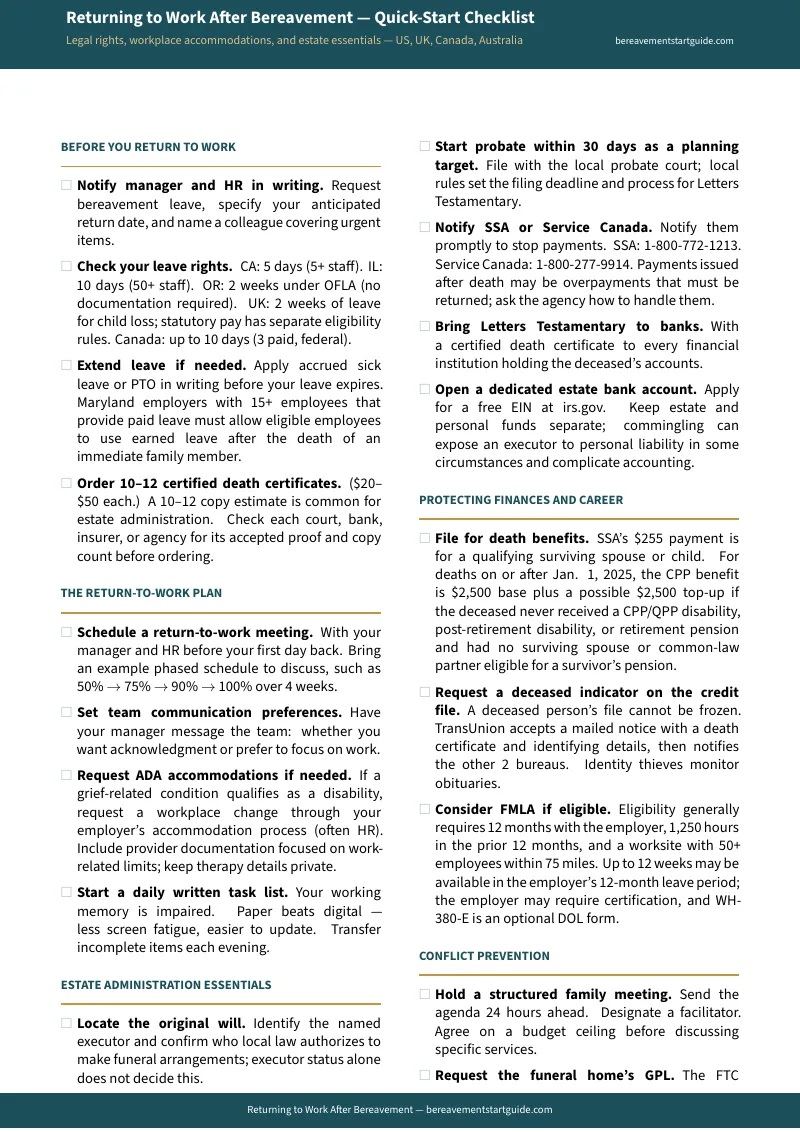
The free checklist gives you the first steps. The full guide gives you the system — .