
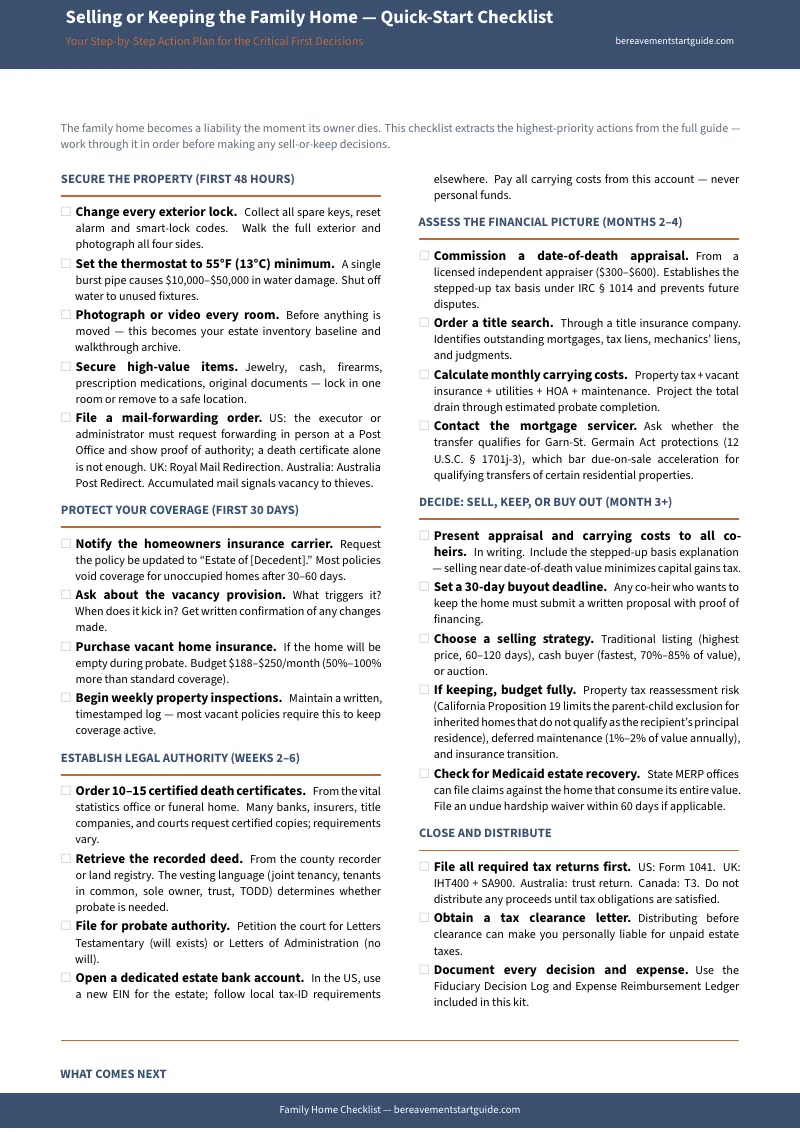
The house is still standing. The carrying costs are not standing still.
Every month the family home sits in probate limbo, the estate bleeds money — mortgage payments, property taxes, vacant-home insurance, utilities, HOA dues, and maintenance on a house nobody is living in. Meanwhile, one sibling wants to sell immediately, another wants to keep the home forever, and the bank is sending letters you're not sure how to answer.
Executors spend an average of 570 hours administering an estate. A large portion of that time goes to the single most valuable asset: the house. And every decision you delay or get wrong — skipping the date-of-death appraisal, missing the insurance vacancy window, accepting a lowball cash offer because you didn't know your options — costs the estate real money that comes directly out of your family's inheritance.
The Property Transition System — from first lockdown to final distribution
This is not a grief journal or a probate textbook. It is a structured operational system that walks you through every stage of managing an inherited property — securing it, establishing your legal authority, understanding the mortgage, making the sell-or-keep decision with actual numbers, resolving sibling disagreements before they become lawsuits, and closing the transaction without leaving money on the table or exposing yourself to personal liability.
The Property Transition System works because it externalizes the decisions grief brain can't hold. Instead of trying to remember which deadlines matter, which phone calls to make first, and what the bank representative actually meant, you follow a chronological sequence with scripts, formulas, and checklists that do the thinking for you during the months when thinking is hardest.
What's inside
- 48-hour property lockdown protocol — the exact security, insurance, and preservation steps that prevent the kind of damage that wipes out tens of thousands in equity before probate even opens
- Insurance vacancy trap guide — how to avoid the 30-to-60-day vacancy provision that voids coverage for the exact risks empty homes face (vandalism, frozen pipes, theft), with the timeline for transitioning to vacant-home insurance
- Legal authority roadmap — a title-structure table covering joint tenancy, tenants in common, transfer-on-death deeds, and living trusts, so you know immediately whether probate is required and what documents to file
- Garn-St. Germain mortgage script — the exact words to say when calling the lender, citing the federal statute that can prevent due-on-sale acceleration on qualifying inherited residential properties, plus the CFPB complaint process when a representative pushes back
- Sibling buyout formula with worked examples — the math for calculating a fair buyout price using the date-of-death appraisal, outstanding liens, and estimated closing costs, with two complete worked examples showing the arithmetic step by step
- Co-heir deadlock resolution — four escalation paths from structured family meetings through professional mediation to partition actions, with decision trees for choosing the right approach based on your family's situation
- Sell vs. keep financial comparison — a side-by-side framework covering carrying costs, property tax reassessment risk, capital gains implications under the stepped-up basis, and long-term ownership projections so the decision is driven by numbers, not emotions
- Medicaid estate recovery chapter — how MERP claims work, which family members are protected, the look-back period, and when to challenge a claim before it consumes the home's value
- 5 communication scripts — pre-written language for calling the mortgage servicer, proposing a buyout to siblings, responding to unsolicited cash offers, requesting utility transfers, and requesting creditor payment extensions
- Tax deadline map — the filing requirements for the final Form 1040, estate income tax (Form 1041), and state-level inheritance or estate taxes, with the specific point at which distributing proceeds without a tax clearance letter makes you personally liable
- Planning worksheets — carrying-cost projector, sibling buyout worksheet, sell-vs-keep comparison, property inspection log, fiduciary decision log, and expense reimbursement ledger — each a separate printable PDF
Who this is for
- Executors and administrators managing a deceased relative's property through probate — whether the will names you or you were appointed by the court
- Adult children who inherited the family home and need to decide whether to sell, keep, or buy out siblings
- Co-heirs who disagree about what to do with a shared property and need a structured process before the disagreement becomes a partition lawsuit
- Surviving spouses navigating a mortgage, title transfer, and property tax implications on a home they may or may not want to keep
- Anyone paying carrying costs out of pocket while waiting for probate to close and wondering how long the estate can afford to hold the property
Why not just Google it?
You could. At 2 a.m., when the anxiety about tomorrow's call with the bank won't let you sleep, you'll find law firm blogs designed to scare you into a $400-per-hour retainer. Legal forms portals that sell you a quitclaim deed template with zero guidance on whether a quitclaim deed is even what you need. Funeral home articles that cover the first week and disappear. Reddit threads full of conflicting state-specific advice from strangers who may or may not have handled an estate themselves.
The Property Transition System puts the legal authority steps, mortgage protections, financial analysis, sibling negotiation frameworks, and communication scripts in one place — so you're not assembling a strategy from fourteen browser tabs during the worst months of your life.
Satisfaction guarantee
Full refund, no time limit. If the toolkit doesn't help you navigate this process, email hello@bereavementstartguide.com and you'll get your money back. No forms, no waiting period, no questions.
The free checklist gives you the action sequence. The full toolkit gives you the system — .