
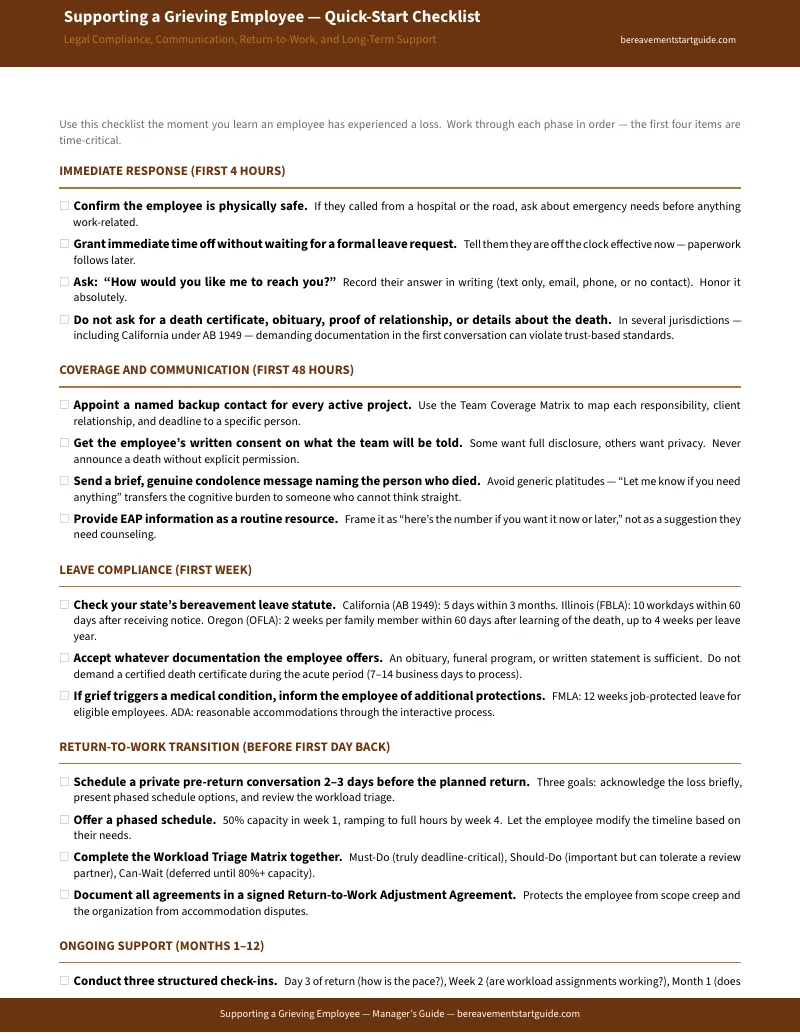
Your Employee Just Lost Someone. You Have No Training for This Conversation.
You got the call. An employee's parent died, or their spouse, or their child. You need to say something — but every option feels wrong. "Let me know if you need anything" sounds hollow. Silence feels cruel. And somewhere in the back of your mind, you're calculating project deadlines, client handoffs, and who covers what for the next month.
Seventy-three percent of managers say they need training on supporting a bereaved employee. Fifty-one percent of grieving employees voluntarily resign within twelve months when they perceive inadequate support. The cost of replacing a single professional-grade employee runs between $20,000 and $40,000. You are standing between a retention win and a preventable loss — and no one gave you a playbook.
The Bereavement Leadership System
This is not a sympathy card with bullet points. The Supporting a Grieving Employee — Manager's Guide is a structured operational toolkit that walks you from the first phone call through twelve months of reintegration — with the exact scripts, legal frameworks, and accommodation templates you need to lead with both compassion and compliance.
Where generic HR pamphlets tell you to "be supportive," this guide hands you the sentence to say, the form to file, and the schedule to offer. Where enterprise bereavement platforms require six-month procurement cycles, this toolkit is in your inbox tonight.
What's Inside
- 72-Hour Manager Response Protocol — the exact sequence for confirming safety, granting leave, containing information, and sending a condolence message that does not transfer the cognitive burden back to a person in shock
- Copy-and-Paste Conversation Scripts — what to say in the initial call, how to announce the absence to the team (with and without the employee's consent), the return-to-work meeting opener, and the six-month check-in
- Leave Navigation Framework — U.S. federal FMLA and ADA intersections, state-by-state bereavement mandates (California AB 1949, Illinois FBLA, Oregon OFLA, and others), international requirements, and what documentation you can legally request without crossing a line
- Workload Redistribution Plans — a Team Coverage Matrix and a Workload Triage system that sorts every active responsibility into Must-Do, Should-Do, and Can-Wait so the team absorbs the absence without building resentment
- Phased Return-to-Work Schedule — a structured ramp from 50% capacity in week one to full hours by week four, with a signed Return-to-Work Adjustment Agreement template that protects both employee and organization
- Grief-Calibrated Performance Management — how to adjust expectations, give feedback, and handle quality dips when grief brain has suppressed prefrontal cortex function and your employee physically cannot plan, prioritize, or retain instructions the way they used to
- ADA-Aligned Accommodation Checklists — cognitive support modifications, spatial adjustments, and schedule flexibility options aligned with Job Accommodation Network standards
- 12-Month Check-In Calendar — structured touchpoints through the full first year, including anniversary dates and holidays, so your support does not evaporate after week one
- Memorial and Team Acknowledgment Protocols — how to honor the loss at the team level without overstepping, and guidance on navigating the team's own grief response
- Clinical Escalation Criteria — the observable warning signs that distinguish normal grief from complicated grief disorder, and when to guide an employee toward professional resources
Who It's For
- Managers and supervisors facing an employee's bereavement for the first time — or the fifth time, but still without a framework
- HR professionals building or updating organizational grief-support protocols
- Small business owners without a dedicated HR department who need to handle this personally
- Executive leaders who want to set a compassionate, consistent standard across the company
- Employee advocates — a family member or close colleague who wants to hand their manager a structured blueprint for how to provide real support
Why Free Articles and EAPs Are Not Enough
Free resources online give you fragments — a list of "what not to say" from a funeral blog, a dry FMLA fact sheet from a government site, a clinical grief article that says nothing about workload coverage or return-to-work scheduling. You spend hours compiling conflicting advice under emotional pressure, and you still do not have a conversation script or an accommodation template.
Your Employee Assistance Program serves the employee. It does not tell you how to restructure the team's workload, how to navigate the interactive ADA process, how to handle a performance dip at the three-month mark without triggering a discrimination complaint, or what to say at the six-month check-in when everyone else has stopped asking.
Enterprise bereavement platforms do address all of this — but they require corporate procurement, security reviews, and multi-month contracts. You need answers tonight.
This toolkit fills the gap: immediate access, comprehensive structure, zero procurement friction. For less than the cost of a sympathy arrangement, you get the operational framework that protects your employee, your team, and your organization.
Satisfaction Guarantee
If the guide does not immediately simplify how you manage an employee's bereavement, email hello@bereavementstartguide.com for a full refund, no time limit. We read every message.
Get Started Now
Download the free Quick-Start Checklist for the 24 most critical actions across the first-year timeline. When you are ready for the full scripts, legal frameworks, and accommodation templates, the complete Manager's Guide — with nine standalone printable worksheets — is — delivered instantly to your inbox.