
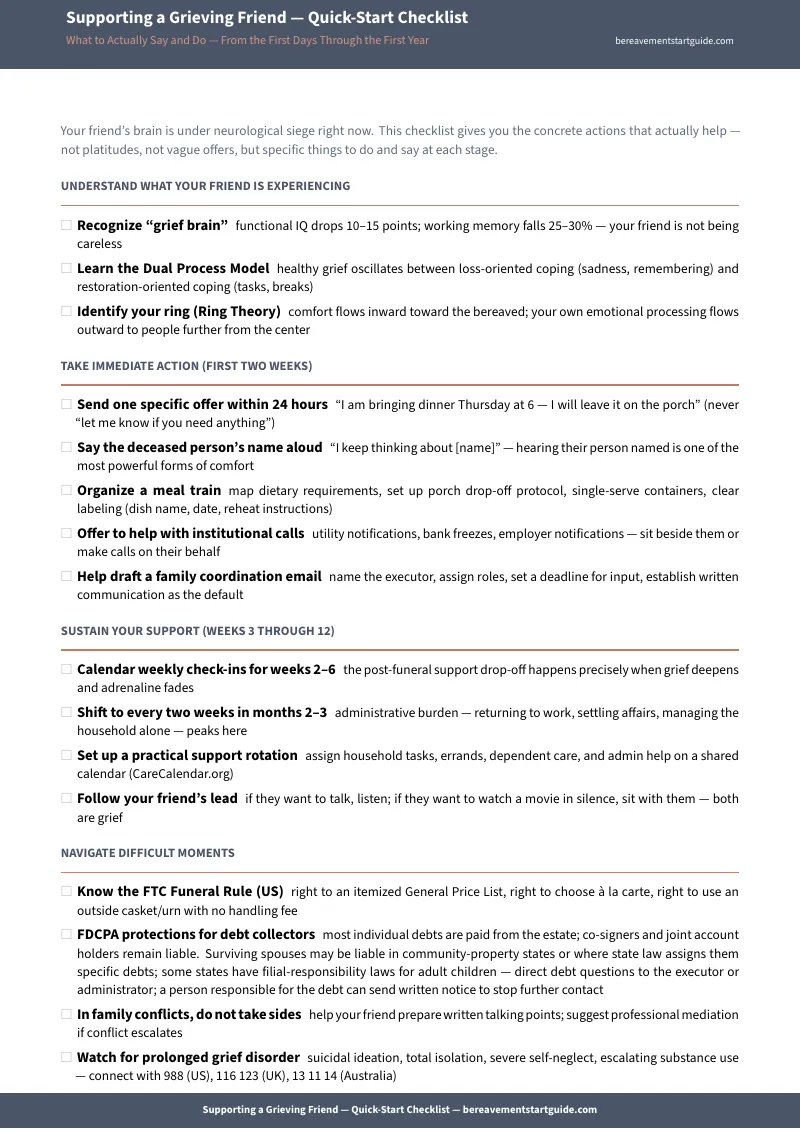
You Want to Help. You Just Don't Know How.
Your friend lost someone. You have been staring at your phone for twenty minutes trying to compose a text that does not sound hollow, performative, or accidentally hurtful. You have typed and deleted "let me know if you need anything" three times because some part of you knows that phrase puts the burden back on the person drowning.
Meanwhile, the casseroles have stopped arriving. The visitors flew home after the funeral. Your friend is entering weeks two through six — the stretch where adrenaline fades, the emotional reality sets in, and the mountain of practical life keeps growing. Community support peaked during the first seven days, and now it is gone. Your friend has never been more alone, and you have never felt more useless.
This is not a character flaw. It is a skills gap. Nobody teaches us how to support someone through grief — not what to say, not when to say it, not how long to keep showing up, and definitely not what to do when the conversation turns awkward or the family dynamics explode.
The Comfort-In Protocol — A Complete Support System for the Person Standing Next to Grief
This toolkit replaces frozen silence with a structured, research-grounded support system. It is built around Susan Silk's Ring Theory protocol and the Dual Process Model of grief — the two frameworks that clinical psychologists actually use — translated into plain language, ready-to-use scripts, and calendar-based action plans you can start tonight.
This is not a book about grief. It is a field guide for the supporter — the friend, co-worker, neighbor, or family member who wants to show up consistently, say the right things, and avoid the well-meaning mistakes that push grieving people away.
What's Inside
- The Grief Brain Briefing — why your friend forgets mid-sentence, cannot make decisions, and seems fine one hour and shattered the next. Understanding the neurobiology changes how you respond to every behavior that otherwise feels confusing or frustrating.
- Ring Theory Protocol — a clear framework for identifying exactly where you fit in the support circle and what flows inward (comfort, action, presence) versus outward (your own emotions about the loss). Stops you from accidentally making the grieving person manage your feelings.
- The Dual Process Decoder — explains the oscillation between loss-oriented and restoration-oriented coping so you stop worrying when your friend laughs at a joke two weeks after the funeral, and stop pushing "stay busy" advice that suppresses the grief they need to process.
- Post-Funeral Drop-Off Calendar — a 12-month check-in schedule with specific timing for when to reach out (weeks 2–6 weekly, months 2–3 biweekly, monthly through month 6, plus every birthday, anniversary, and holiday). Eliminates the guessing about when and how often.
- What to Actually Say — A Practical Language Guide — a reference table of phrases that help and phrases that harm, with the reasoning behind each. Replaces "everything happens for a reason" and "at least they're no longer in pain" with scripts that validate without minimizing.
- Practical Support Playbook — concrete actions (meals, errands, childcare, household tasks, rides) with exact wording so you never have to say "let me know if you need anything." Tells you what to do, not what to offer.
- Family Dynamics Navigation — what to do when grief resurfaces old sibling conflicts, when family members grieve at different speeds, and when you are caught between competing needs in the family circle.
- Communication Scripts for Difficult Conversations — copy-and-paste language for the first phone call after hearing the news, what to say at the funeral, how to check in at the six-month mark, how to talk to a grieving colleague at work, and how to respond when someone says "I'm fine" and clearly is not.
- Clinical Warning Signs — how to distinguish normal grief from prolonged grief disorder, with specific behavioral markers and a gentle script for suggesting professional help without making your friend feel broken.
- Specific Loss Type Guidance — tailored communication adjustments for supporting a friend through suicide loss, infant or pregnancy loss, overdose death, sudden or violent death, death of a child, and loss involving estrangement.
- Printable Tools — six standalone PDFs you can print and use immediately: an Outreach and Check-In Calendar, a Meal Train Coordination Sheet, a Practical Support Menu, Difficult Conversation Script Cards, a Warning Signs Reference Card, and a Joint Decision Log.
Who This Is For
- Close friends who want to get it right instead of disappearing after the funeral
- Co-workers unsure what to say when their colleague returns to the office
- Neighbors who want to help practically but feel awkward about it
- Extended family navigating group dynamics when grief hits differently across the family
- Anyone who has ever frozen in the face of someone else's grief and wished they had a script
Why a Free Grief Checklist Is Not Enough
You can find individual grief tips scattered across psychology blogs, Instagram infographics, and well-meaning listicles. What you cannot find is a single resource that connects the neuroscience of grief brain to specific communication scripts, maps a 12-month check-in calendar, teaches you how to navigate family conflict as an outsider, covers the unique dynamics of supporting someone through suicide loss versus sudden death versus long illness, and gives you worksheets to actually plan your support instead of relying on good intentions that fade by month two.
Good intentions without a system produce the exact pattern every grieving person describes: overwhelming support for seven days, then silence.
Full Refund, No Time Limit
If the toolkit does not help you show up for your friend with more confidence and consistency, email hello@bereavementstartguide.com for a full refund. No deadline, no questions.
Start Tonight
Download the free checklist to get the 20 highest-priority actions you can take right now. When you are ready for the full system — the scripts, the calendar, the worksheets, and the chapter-by-chapter guidance — get the complete toolkit for the price of .